


This article is a review of Health Writer Hub’s Introduction to Medical Writing and Artificial Intelligence (AI) course. The author took the course of their own accord and is sharing their honest opinion.
Medical writing is a great non-clinical career for those passionate about scientific writing in the medical field. Medical writers create content for the healthcare, medical, or pharmaceutical industries. This work requires researching topics, writing, and editing, which can be mentally demanding and time-consuming, making it worth exploring how Artificial Intelligence (AI) can and can’t help.
That’s where the Introduction to Medical Writing and AI course by Health Writer Hub comes in! This valuable course helps medical writers better understand the benefits and limitations of AI and how to start using AI to make themselves stronger medical writers in the era of AI. As we know, AI isn’t going anywhere, and it’s always evolving, so it’s a great course to learn how to use it effectively and responsibly.
Before diving straight into the course review, let’s briefly revisit what AI is. AI uses computers and machines to perform tasks in ways that mimic human thinking and behavior, but it’s not always as effective as humans in every way (more on that below). AI is excellent at quickly processing data, recognizing patterns, and supporting decision-making. For example, Large Language Models (LLMs), like ChatGPT and Perplexity, generate answers, summaries, and other content based on the questions or prompts you give them.
This post may contain affiliate links or codes. This won’t increase your cost, but it helps keep TNCPT alive, and free of annoying ads! Thank you for your support. 🙂
What does the Introduction to Medical Writing and AI course cover?
True to its name, this class is a great place for writers with little to no AI experience to start as an introduction. The course also provides actionable content like AI prompts specifically for medical writers to help writers immediately get started using AI. I found this course not only helpful for current medical writers, but for health writers and content writers at any stage, whether you are just starting out, freelancing, or writing as part of your job.
The course instructor, Michelle Guillemard, has over 16 years of experience as a medical writer and writing teacher. The content is easy to understand, and the course platform is easy to navigate and user-friendly. This course is self-paced with short lessons that cover:
- AI’s role in medical writing
- How to ethically use AI writing tools
- AI tool limitations
- Career strategies for AI-era writers
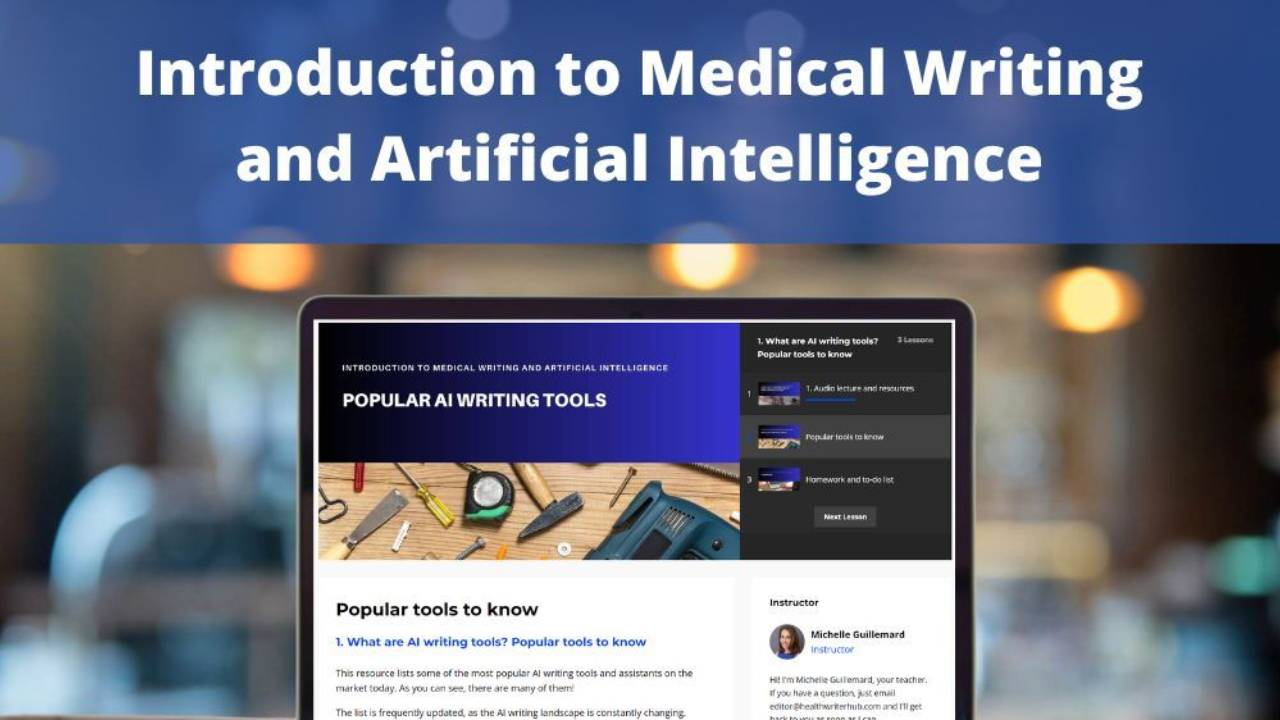
You can learn more about the course here, but be sure to enroll using our affiliate link to save 20%!
While you could get through the course by either listening to the audio or reading the text in one to two hours, I highly recommend that you dedicate more time to this course to take advantage of all the additional content and experiences (see below). You also get lifetime access to the course, so you can go at whatever pace you want and come back to the material. This is definitely a plus for busy rehab professionals who may need the flexibility to learn in shorter sessions and fit the lessons into their own schedule.
Is the course worth it?
From my perspective as an occupational therapist (OT) turned writer – yes!

Clear, practical, and ready-to-use information
Approachable
I appreciate that the content goes straight to the point about what you actually need to know as a medical writer. The course provides just enough background on AI fundamentals, so you can have a basic understanding of AI tools as a writer without overwhelming students with all the technical details of AI models. This allows you to start using AI without being super tech-savvy, making using AI much more approachable!
Actionable
The course gives students immediate and actionable content relevant to the real world of writing. You learn how to start using AI to make your writing more efficient by practicing with common AI tools and learning best practices in prompting. You also learn all the ways AI can help you with the writing process beyond just writing a draft, like using AI tools for idea generation, title suggestions, Search Engine Optimization (SEO), summarizing articles, organizing references, and much more!
Realistic
I appreciate that the course didn’t just highlight AI’s benefits – it also acknowledges that, in some cases, it’s faster or more effective to just write that first draft or find references yourself. It helps writers understand when to use AI and when a traditional approach may be better.
Extras that make the class stand out
I honestly expected more of a passive class experience like so many other lecture-based courses, so I was pleasantly surprised by all the opportunities for learning and engagement. There are several chances to practice, reflect, and interact throughout the course!
Real practice and conversation
Each lesson ends with an optional homework assignment ranging from experimenting with popular AI tools to reflecting on AI’s potential impact on your writing career. The interactive comment section also allows students to discuss prompts and assignments with each other and the instructor for deeper, collaborative learning.
Personalized feedback
Michelle offers personalized feedback on the optional final homework, a writing assignment using AI. This opportunity is truly valuable as few courses provide personalized feedback directly from the instructor!
Bonus content
Beyond the main content in the course, there are insightful suggested readings and helpful handouts that support you in mastering the material and taking a deeper dive into medical writing and AI. Suggested readings cover how AI is changing medical writing, current AI model limitations, how to stay up to date on AI developments, and more. The handouts are nicely organized and serve as a quick reference covering a variety of topics, including a list of popular AI writing tools and key AI concerns in medical writing, and how to handle them.
Business acumen
As a freelance writer, I appreciate the guidance on explaining the value of using AI in my writing to prospective clients, as well as the provided letter template to describe my writing process. This made it easy to describe how I use AI tools in my writing process and why. It shifted my mindset from shying away from talking about AI to confidently explaining how I use AI in my writing process ethically for productivity. It also gives me a competitive advantage as a writer.
Continued learning
As an alumni bonus, you have ongoing access to the Health Writer Hub Community, which includes extra resources like freelance business planning guides, blog and CV templates, etc., and opportunities to interact and network with other students and the instructor. This means you still get support and continuous learning options beyond the course itself.
Uncovering and addressing real concerns
Risks and limitations
The course also offers a well-rounded analysis of using AI – it not only covers the benefits of using AI, but also explores in-depth the challenges, limitations, risks, and ethical and legal considerations. It highlights that AI cannot replace the uniquely human voice and empathy that make for compelling or persuasive writing. The course points out that AI certainly does not always get its facts straight, and humans must do the fact-checking. It also discusses concerns regarding privacy and fault for misinformation, among many other limitations and legal considerations of AI in its current form.
Writers’ futures
The content not only reveals what you can do today to leverage AI as a writer, but also explores what to expect in the future, including the evolving roles current medical writers might fill as AI becomes more prominent and in-demand. I find all the potential new roles – AI editor, AI researcher, prompt engineer – exciting and a little intimidating to ponder as a writer. However, the course does an excellent job of starting to prepare you to future-proof your writing career!
Minor critiques
These minor critiques certainly do not come anywhere near outweighing the numerous benefits of the course. I just want to mention that there are no interactive video demos showing how to use AI tools or other video content in the main course, which might be important to some visual learners or those who prefer demos. There was a little delay in getting feedback on the article I submitted for personal feedback, but the response I received was excellent and incredibly helpful!
Final thoughts
While I gained numerous insights regarding medical writing and AI, I wanted to share a few of my main takeaways from the course.
Key course insights
- Writers have human skills – a unique voice, subject matter expertise, etc. – that AI cannot yet replace.
- Embracing and effectively using AI can give writers a competitive advantage.
- Using good prompts is vital to using AI effectively and efficiently.
- AI can assist during the entire writing process.
- Considering ethics, transparency, and legal factors is necessary.
If you want deeper insights and actionable strategies to use AI as a medical writer, I highly recommend taking the full course and taking advantage of all the extras. While it is not required as a medical writer or to become one, it gives you a clear advantage by showing you how to use AI effectively and responsibly in a short amount of time through a well-organized course with an abundance of supportive content. Overall, I highly recommend the Introduction to Medical Writing and AI course for medical and health writers!
Ready to take action and learn about the role of AI in your medical writing career?
You can learn more about the course here, but be sure to enroll using our affiliate link to save 20%!
AI was used for efficiency in drafting, rewriting sentences for clarity, and checking the grammar of this content, and it has been reviewed by the author, Corrin Godar. The opinion shared is entirely of the author and reflects their honest experience with the course.
