
Published:

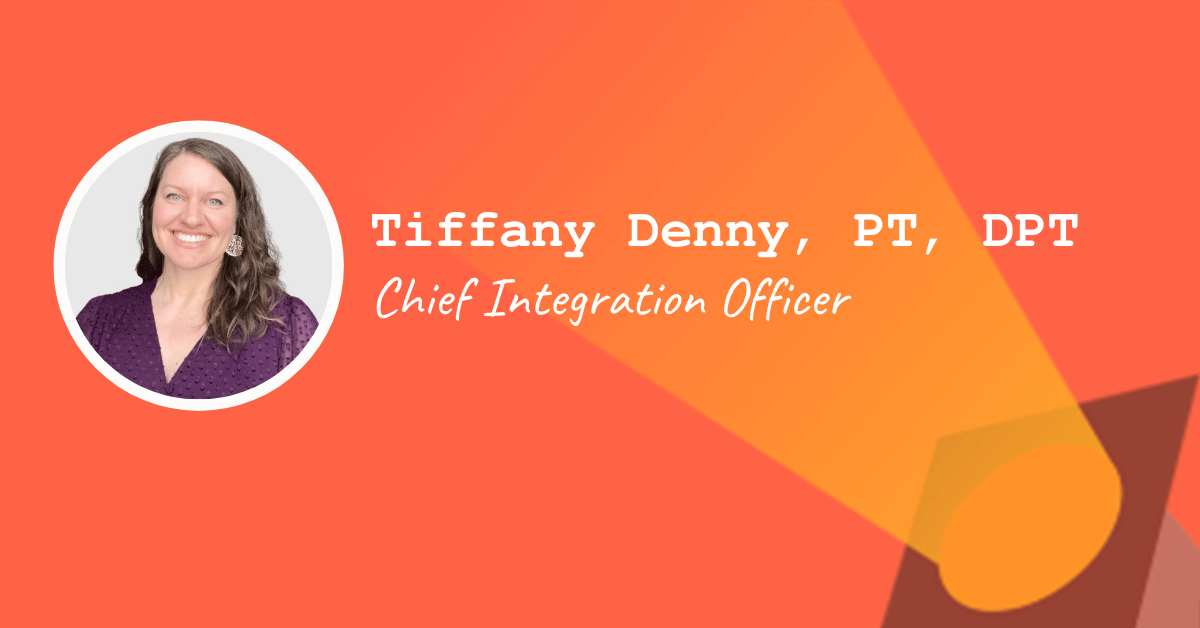
This week’s spotlight is on Tiffany Denny, PT, DPT, a non-clinical physical therapist who is now Chief Integration Officer for Helping Restore Ability!
This post may contain affiliate links or codes. This won’t increase your cost, but it helps keep TNCPT alive, and free of annoying ads! Thank you for your support. 🙂
What is your full name, title, and company name for your current, primary role?
Tiffany Denny, PT, DPT — Chief Integration Officer for Helping Restore Ability
What additional roles do you currently have?
Yoga Instructor, Yoga Therapist, and Rehab Coach.
Where are you located?
Buena Vista, Colorado.
Where did you go to PT school, and what year did you graduate?
Texas Woman’s University, 2011.
What did you do when you first finished school, and for how long?
I was an outpatient orthopedic physical therapist for eight years and a pelvic health physical therapist for two years.
In what settings did you work, and what types of patients did you treat?
I mostly worked in orthopedic and sports physical therapy settings, as well as pelvic health settings. I ended up treating a lot of chronic pain and post-op patients, and probably an unusually high number of patients with foot and ankle injuries.
What did you enjoy about your early roles? What didn’t you enjoy?
I was and still am a real nerd when it comes to the science of movement and pain. I loved working with my patients and constantly learning and growing as a practitioner.
I struggled mightily with the arbitrary insurance limits placed on physical therapy visits, the lack of true direct access in my state, the documentation requirements and the unpaid time it took to meet those requirements, and the clinical push for quantity at the expense of quality.
What else have you done since then, prior to your current role?
I owned a yoga studio for three years and have taught yoga since college. For one year, I also served as interim executive director of a small nonprofit dedicated to preventing eating disorders through media literacy and body image work.
When and why did you decide to do something non-clinical?
I dabbled with several different iterations of clinical work aside from full-time outpatient PT, including PRN outpatient orthopedic work, pelvic health, and serving as the physical therapist within an acupuncture clinic in conjunction with non-clinical work.
In the end, I decided to switch into a full-time non-clinical role after having several surgeries that made me feel it was risky to build an entire career around a very physical role. Additionally, my husband and I wanted to switch to remote roles together so that we could travel and move without the limitation of job location.
I was also frustrated by what felt like a salary ceiling for the majority of clinicians in the physical therapy profession.
What are you doing these days?
These days, my primary role is a remote role as Chief Integration Officer at a nonprofit in Arlington, Texas called Helping Restore Ability. I am in charge of informatics and data management, strategic technology selection, process automation and efficiency, and compliance.
Aside from this role, I teach yoga online and locally in my community, lead anatomy and biomechanics trainings for yoga teachers, and offer rehab coaching for individuals who need education and support to get back to or maintain their physical activities after injury or when working with chronic pain or fear of certain movements and exercises. This is how I stay connected to my PT roots.
Are you still treating patients, or are you solely non-clinical?
I am still licensed and am considering treating patients as I have moved to Colorado where there is true direct access, but currently I am solely non-clinical.
How long have you been in your current role?
I started my current role in August of 2020.
What do you wish you would’ve known before going into this role?
I wish I had been more clear about my transferrable skills from physical therapy so I could work on trainings and certifications that would help translate those skills into a different industry and type of job role.
Did you get any special certifications or training along the way to help you get into your current role?
I used online courses as well as free resources to learn the basics of software development, as initially I was looking for software developer roles. I did not get any particular certifications, though in technology the opportunities for certifications are endless!
How did you find your job? Did you apply or find it through a connection?
I found my job by posting about my career change and job search on social channels along with my resume and the portfolio site I had built. A former yoga student saw the post and was looking for someone to fill a recently vacant software developer role at her nonprofit.
Did you do anything special to your resume and cover letter to land the job?
I created a portfolio website that I think was helpful for the software development role I was seeking.
What was the interview like for the role?
I had multiple interviews, as I needed to speak with both technical and non-technical individuals at the organization to ensure that I had the requisite skills but would also be a good fit overall at the organization, and a good fit with the CEO who would be my manager.
If you advanced through a company to get to where you are, what are some of the things you did to stand out, take initiative, and advance in your career?
I believe that the skills I honed as a PT, such as active listening, problem-solving around a process, and motivating others to stay accountable through change, helped me advance quickly at my organization. We were in the midst of switching EHR systems when I came on, but the process was not really being project-managed inside of our organization.
I developed a sample plan using an online tool to organize the execution of the transition and presented it to our CEO as an example of an approach that might help, and I ended up being asked to lead the project.
How have people reacted to you leaving patient care?
People have generally been understanding and supportive, at least to my face!
What’s a typical day or week in the life like for you? What types of tasks and responsibilities fill your time?
I spend my work day on my computer, working on projects automating or otherwise improving operational process, responding to data requests, supporting direct reports and other staff, or in meetings with various departments and third-party vendors. I do have some flexibility in my day and often fit in a yoga or gym class.
What are some of the rewards of your Chief Integration Officer role? What are the biggest challenges?
I am grateful to work for a nonprofit, where ultimately I support our mission to connect people with the caregiving services they need to thrive in their homes and communities. I enjoy my coworkers, and I really enjoy and feel good about working from home.
The biggest challenges are spending so much time on my computer, and staying motivated when the work I do day to day is not necessarily a passion of mine. At the same time, there were plenty of struggles when doing a job that aligned well with my interests and passions.
With my current role, I have flexibility in where I can live and the amount of time I can spend traveling, both of which are important to me.
How did your clinical background prepare you for this role? Which skills transferred?
The most impactful skills that transferred for me are critical thinking and strategic thinking, as well as my communication skills, and all the practice I got with detailed documentation.
Roughly speaking, how are the hours and pay compared to patient care?
On paper my full-time hours are the same, but with patient care I spent a ton of time completing unpaid documentation, so realistically my hours are much better, and I have the ability to flex my time in my non-clinical role. I initially took a pay cut when I switched roles, but had a written plan to complete certain training and skill checks that allowed me to match my PT salary within the first six months, and to exceed it within the first year. Once I was promoted to an executive role, my salary increased by over 50% from my PT salary.
What type of person do you think would do well in your Chief Integration Officer role?
In my role, you need excellent critical thinking skills, communication skills, creativity, the ability to educate and help others build skills, and it is essential to be internally motivated and largely self-sufficient.
Do you work remotely or onsite?
I am a fully remote employee.
Does your organization hire PT, OT, or SLP professionals into non-clinical roles? If so, what type of roles?
My organization does not specifically hire from allied health professions. I was hired due to my technical skills, and my PT designation was a bonus for us due to our proximity to healthcare and our participation in research. We are a small organization, and aside from caregiver roles, we do not often have available administrative roles.
At the same time, I would encourage anyone to look for niche roles in organizations like mine, as it has been a great experience and I have been able to learn and grow so much in my role.
Did you read any books, take any courses, or do anything special overall to get you where you are today?
When I was learning software development, I took several courses, including but not limited to all the “Learn Enough” courses from Michael Hartl, the Ruby on Rails Tutorial from Michael Hartl, a ReactJS course from Tyler McGinnis, the Complete Python & PostgreSQL Developer Course on Udemy, Algorithmic Toolbox from UC San Diego on Coursera, Mathematical Thinking in Computer Science from UC San Diego on Coursera, and even the Harvard Intro to Computer Science course that was available for free on YouTube.
What is a typical career path for someone in your Chief Integration Officer role?
In truth, I’m not sure! My role is a bit of a combination role from which I could go in different directions.
What is next for you? What are your high-level career aspirations?
I am happy in my current role, though at some point I would like to do similar work for a company or organization operating more in the rehab or fitness realm.
What career advice would you give yourself that you wish you had during school?
The career advice I gave my kids that I wish I’d had was to not only think about what I enjoy doing and ways I could turn that into a career, but to seek a career that aligns with my values and the kind of life and lifestyle I want to have.
