
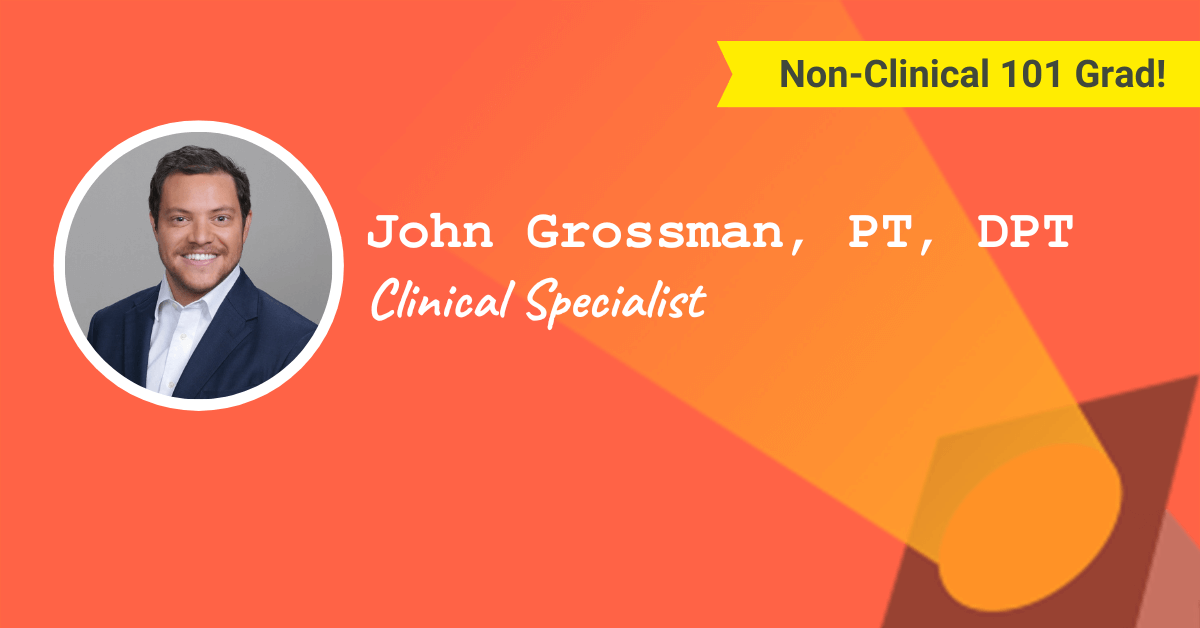


This week’s spotlight is on John Grossman, PT, DPT, a Non-Clinical 101 graduate who is now Clinical Specialist for Sword Health!
This post may contain affiliate links or codes. This won’t increase your cost, but it helps keep TNCPT alive, and free of annoying ads! Thank you for your support. 🙂
What is your full name, title, and company name for your current, primary role?
John Grossman, PT, DPT — Clinical Specialist for Sword Health
Where are you located?
Washington, D.C.
Where did you go to PT school, and what year did you graduate?
Please refrain from contacting our spotlight participants on social media. There are thousands of readers just like you out there. 🙂 Please ask your questions in the comments on this blog post.
If you’re a Non-Clinical 101 student or Go Non-Clinical member, you can network with many of our spotlight participants in our community!
What did you do when you first finished school, and for how long?
After finishing school, I began my career in the acute care setting at the University of Maryland Baltimore Washington Medical Center in Glen Burnie, MD. My primary focus was in orthopedics, but I also covered the general medical-surgical, cardiac, and neuro floors.
Over time, I transitioned into a dual role, splitting my time between inpatient and outpatient care and expanding my skill set to include work in the ICU. I held that position for four years before transitioning to a PRN role and beginning work as a travel physical therapist.
In what setting(s) did you work, and what types of patients did you treat?
I have worked in both acute care and outpatient settings throughout my career. After starting in a traditional hospital-based role and juggling acute care and outpatient within the hospital, I transitioned into travel physical therapy, completing outpatient and inpatient contracts in Ocean City, MD, and San Francisco, CA, respectively.
When the COVID-19 pandemic began, I shifted away from travel work and took on multiple PRN roles across several hospitals and a neuro-focused outpatient clinic. Additionally, since 2018 and up until this year, I have served as adjunct faculty at my alma mater, primarily supporting students in their acute care courses.
What did you enjoy about your early roles? What didn’t you enjoy?
In my early roles, I really appreciated the flexibility and work-life balance that acute care offered. I enjoyed the exposure to a wide variety of patients and medical conditions, and I found it especially fulfilling to work in both acute care and outpatient settings simultaneously.
One of the most rewarding aspects was being able to treat a patient in the hospital and then continue their care in outpatient, allowing me to see their full progression and recovery.
During my time as a travel physical therapist, I valued the opportunity to live in different areas for short periods of time. The financial benefits were certainly a plus as well!
Serving as adjunct faculty has also been meaningful—it’s rewarding to give back to students and contribute personal clinical insights to their education, which I know I valued when I was a student.
One of the challenges I encountered early on was the lack of a clinical ladder, which ultimately influenced my decision to pursue travel PT and now into the digital space with Sword.
What else have you done since then, prior to your current role?
Prior to my current role as a clinical specialist at Sword, I began my journey with the company as an intake specialist. In that position, I conducted virtual evaluations with patients via Zoom, gathering clinical information to support the assigned physical therapist in developing a personalized treatment plan.
After about six months, I transitioned into a role as a treatment physical therapist, where I provided asynchronous digital physical therapy. I held that position for nearly a year and a half before moving into my current role.

What I loved about these earlier roles at Sword was it provided a new challenge for me with treating patients virtually and exposed me to remote work life.
When and why did you decide to do something non-clinical?
I’ve always had a sense that my strengths and interests aligned more with non-clinical work, and over time, that became increasingly clear. In my previous roles, I naturally gravitated toward non-clinical tasks and found those aspects of the job especially fulfilling.
In 2021, I made the decision to seriously pursue a non-clinical path, which ultimately led me to my role at Sword. As part of that transition, I enrolled in Non-Clinical 101 to gain more clarity and guidance on how to navigate the shift and identify the opportunities that best matched my skill set.
What are you doing these days?
As of March 2025, I’ve been working as a clinical specialist at Sword. In this role, I support the commercial team by providing product demos, serving as a clinical subject matter expert, and delivering patient care for individuals trialing our solutions.
I work on a team of five alongside an incredible manager, which has made the experience collaborative and rewarding. In this role, I get to travel to different client sites domestically, but also internationally, and I am getting exposure into the commercial side of things, which has been exciting.
Are you still treating patients, or are you solely non-clinical?
Yes, I am still treating patients, but in a more limited capacity. As mentioned above, I primarily work with individuals who are trialing our product. While patient care is still a part of my role, the majority of my day is focused on non-clinical responsibilities.
How long have you been in your current clinical specialist role?
Since March 2025.
Did you get any special certifications or training along the way to help you get into your current role?
The only real training I completed prior to transitioning into my current role was the Non-Clinical 101 course. This program helped me learn how to better market myself for non-clinical opportunities and highlighted that physical therapists bring a diverse skill set beyond the traditional clinical scope.
Most importantly, it gave me the confidence to network with professionals both inside and outside of physical therapy, allowing me to seek advice, learn from their experiences, and gain valuable insights into non-clinical career paths—something I was hesitant to do before.
Plus, you’ll get early access to curated non-clinical job listings and a bonus lesson on AI!
How did you find your job? Did you apply or find it through a connection?
One of my good friends from PT school works at Sword. When the opportunity appeared on my LinkedIn feed, I reached out to him about it. This led me to apply, and after getting the job, I realized that several other physical therapists from my grad school also work here.
Did you do anything special to your resume and cover letter to land the job?
Yes, I applied several strategies I learned from the Non-Clinical 101 course to tailor my resume and cover letter. I reworked the formatting to make it more appealing for a non-clinical role, incorporated relevant buzzwords, and emphasized my non-traditional skills. Additionally, I focused on clearly demonstrating how my clinical experience translates effectively to a non-clinical role.
What are some of the things you did to stand out, take initiative, and advance in your career?
I got involved in several committees, volunteered to trial new programs and initiatives, and generally said “Yes” to almost everything that came my way. I know that approach isn’t always sustainable and can lead to burnout, but at the time, I really wanted to become well-rounded and gain a variety of experiences I could learn from and apply down the line.
How have people reacted to you leaving patient care?
Overall, people have been really supportive of my transition out of patient care, though there’s been some confusion—my dad, for example, was a bit surprised. I think he saw how much time, effort, and money I invested in becoming a physical therapist, so it was hard for him to understand why I would make a change.
I’ve had to explain that I’m still using my education, just in a different way. I’m continuing to grow professionally—and likely at a much faster rate than if I had stayed fully clinical—while also learning new skills and expanding my impact. And honestly, I’m also earning more, which has been an added bonus.
It’s also been eye-opening for many of my family and friends to learn about the challenges physical therapists face in the clinical setting. Once I shared more about the limited opportunities for professional growth and the financial constraints many PTs experience, they began to understand my decision on a deeper level.
What’s a typical day or week in the life like for you? What types of tasks and responsibilities fill your time?
No two days are exactly the same in my current role, which is something I really enjoy. Some days involve traveling to meet with clients and their employees, while others are spent supporting the commercial team by leading product demos or answering clinical questions that come up.
I also continue to provide patient care, so part of my time is spent juggling those responsibilities alongside my non-clinical tasks. For example, I spent a week in LA with a client and their employees at a few benefits fairs. During my time there, I still managed the patients that I was caring for, but the rest of my team supported our commercial team with any demos in my absence.
What are some of the rewards of your clinical specialist role? What are the biggest challenges?
One of the most rewarding aspects of my role has been seeing my non-clinical skills truly shine and recognizing how much I’ve grown since stepping into this space. It’s also incredibly fulfilling to know I’ve contributed to the commercial team’s success when they close a deal with a client I’ve supported.
The biggest challenge has been getting up to speed with the commercial side of the business—learning the terminology, understanding the processes, and adapting to a very different environment than traditional clinical practice. I’ve always joked that if a fifth grader doesn’t say they want to be it when they grow up (i.e. teacher, firefighter), then I probably don’t know what you do—and that’s definitely been the case here learning all of these new roles! But it’s been an exciting and motivating challenge.
How did your clinical background prepare you for this role? Which skills transferred?
I think one of the most transferable skills from my clinical background is strong communication. As a physical therapist, you’re constantly building trust and rapport with patients—skills that directly translate to building relationships with clients in this role.
Whether it’s educating patients or guiding clients through a solution, the ability to communicate clearly and with empathy is essential.
Additionally, physical therapists are trained to be strong critical thinkers and problem solvers, which has helped me navigate the complexities on the commercial side of things. This role goes far beyond simply selling a product; it requires understanding client needs, adapting on the fly, and providing tailored solutions—skills I honed in clinical practice.
Roughly speaking, how are the hours and pay compared to patient care?
I generally work a standard 9–5 schedule, but the remote nature of the role gives me more flexibility throughout the day when needed. When traveling for work, hours can shift depending on the situation or if a client meeting happens outside my normal hours, I just adjust, but overall, my work-life balance has improved significantly compared to patient care. In terms of compensation, I do make more in this role than I did as a physical therapist.
What type of person do you think would do well in your clinical specialist role?
Someone with strong people skills would do really well in this role—building relationships and trust is key. You also need to be comfortable stepping outside your comfort zone, especially when learning new things or navigating unfamiliar situations with thick skin when clients push back or question you.
Strong time management is essential to stay organized and effective, and being a strong problem solver with solid critical thinking skills helps you adapt and find solutions quickly in a fast-paced environment.
Do you work remotely or onsite?
Mostly remote unless I am traveling to a client or conference.
Does your organization hire PT, OT, or SLP professionals into non-clinical roles? If so, what type of roles?
Yes, they do. In fact, we even have physical therapists who have transitioned fully into sales roles.
Did you read any books, take any courses, or do anything special overall to get you where you are today?
Non-Clinical 101 is the only thing I did externally. Once I was in this role, Sword provided a bunch of internal resources and training that have been helpful.
What is a typical career path for someone in your clinical specialist role?
Not sure if there is a typical career path, but most clinical specialists at Sword have gone on to more commercial roles (i.e. account executives).
What is next for you? What are your high-level career aspirations?
To be honest, I haven’t given much thought to what’s next, as I’m really enjoying this new role. For a long time, my goal was to transition out of clinical care, and now that I’ve made that shift, my focus has been on growing and learning here.
The role has been both challenging and rewarding. I’m fortunate to be part of a supportive team with a great manager, and I hope to explore more of the commercial side of things.
What would you recommend to someone who is considering going into a role like yours? Do you have any special words of wisdom for the readers?
Take the time to truly understand what you’re looking for in a new career. Be intentional—do your research, explore different paths, and connect with as many people as you can. Not everyone will be helpful or responsive, and that’s okay.
All it takes is one person to offer the insight or support that helps move you forward, so keep reaching out and don’t get discouraged.
What career advice would you give yourself that you wish you had during school?
I would tell myself to explore more options and take a broader range of classes. I went into undergrad knowing I wanted to become a physical therapist, so I stayed very focused on that path and didn’t venture much outside of my major.
Looking back, I wish I had taken some business courses or explored other disciplines—it might have broadened my perspective, potentially shifted my focus, or at the very least given me additional skills I could have brought into PT school and the profession.
