
Published:

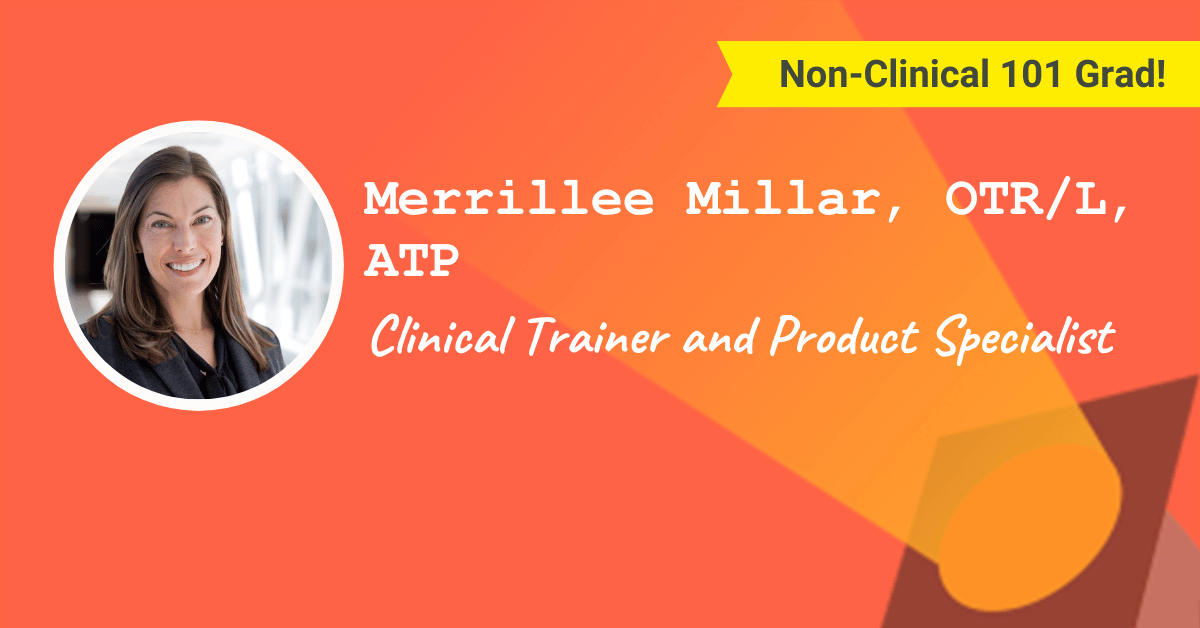
This week’s spotlight is on Merrillee Millar, OTR/L, ATP, a Non-Clinical 101 graduate and non-clinical occupational therapist who is now Clinical Trainer and Product Specialist for Myomo!
This post may contain affiliate links or codes. This won’t increase your cost, but it helps keep TNCPT alive, and free of annoying ads! Thank you for your support. 🙂
What is your full name, title, and company name for your current, primary role?
Merrillee Millar, OTR/L, ATP — Clinical Trainer and Product Specialist for Myomo, Inc
Where are you located?
Charleston, SC.
Where did you go to OT school, and what year did you graduate?
Washington University in St. Louis, 2012.
What did you do when you first finished school, and for how long?
I worked in acute care at a community hospital that was in the same healthcare system where I did one of my Level 2 fieldworks. I didn’t feel like acute care was the right setting for me, so I decided to explore other settings by working as a travel OT.
I loved the travel OT life and what started as a three-month contract ended up as three years of contracts. During that time, I decided that I really loved acute rehabilitation. I found an acute rehab hospital I was really excited about and spent six years working there.
In what settings did you work, and what types of patients did you treat?
Acute care, SNF, acute rehab, outpatient. I’ve worked with all sorts of patients, although I spent the last six years of my OT career treating a mix of inpatients and outpatients at a neurorehabilitation hospital for people post-SCI and TBI.
What did you enjoy about your early roles? What didn’t you enjoy?
I loved going home at the end of the day knowing that I had helped people. That was true from day one as an OT. I’m also someone who likes to constantly be learning — and there was no shortage of learning as a new grad in a hospital environment.
What I enjoyed less were the nerves. While I felt proud at the end of the day, I felt nervous during my drive into work every morning for the first two years.
In acute care, I never knew what I was going to encounter behind each door — was the person going to pass out on me? Yell at me? Buckle at the knee mid-transfer? The nerves dissipated with experience, but the confidence that replaced it was hard-earned.
When and why did you decide to do something non-clinical?
After 12 years of working as an OT, I was feeling very burnt out on patient care. I knew that I wanted to become a single mom by choice and, from watching my co-workers, it was clear that my current OT job wasn’t going to allow me the kind of flexibility I would need.
It was time to do something different — but I had no idea what — and I didn’t have the mental energy to figure out a career change and mount a full-scale job search while working full-time.
Eventually, I took a leap of faith and quit my job in order to devote my full attention to finding a non-clinical role.
What are you doing these days?
As a Clinical Trainer for Myomo, I get to do a lot of teaching — which I love. I primarily educate orthotists and prosthetists about our product — a custom, myoelectric orthosis for people with upper extremity weakness. I help them learn how to identify and evaluate patients, as well as fit and program the braces.
Some of this training is done remotely, but I often end up traveling to the clinics and, although they aren’t MY patients, I get to be hands-on with patients during evaluations and fittings, which makes my OT heart happy. My role also involves creating new training material and updating existing material — it is a nice creative outlet and I enjoy it more than I expected!
Are you still treating patients, or are you solely non-clinical?
Although I felt burnt out on patient care, I was really hesitant to give it up completely, so I kept up my PRN job for about four months after I started my non-clinical role. Six-day work weeks got old pretty quickly, though, and now I am solely non-clinical.
How long have you been in your current Clinical Trainer and Product Specialist role?
I started my non-clinical role in June of 2025.
Did you get any special certifications or training along the way to help you get into your current role?
I took the Non-Clinical 101 course — it helped give structure to the early days of my non-clinical search, while the TNCPT job board gave me confidence that there really were some non-clinical jobs out there with job requirements that at least somewhat matched my resume. I also obtained a Customer Success certificate through Aspireship and brushed up on my Excel skills through Coursera, although I’m not sure that either of those specifically helped me to land my current role.
How did you find your job? Did you apply or find it through a connection?
I learned about Myomo and started following the company on LinkedIn when a former OT colleague of mine accepted a job there. When I started my non-clinical search, Myomo’s was one of a handful of job boards that I checked frequently, and I applied as soon as a relevant job opening was posted.
Did you do anything special to your resume and cover letter to land the job?
I took Non-Clinical 101 — it gave me some much needed structure and direction when I wasn’t exactly sure where to start. The job board postings provided me with some reassurance there were, indeed, non-clinical roles out there for people with skillsets similar to mine.
I also utilized a career coach to help me with my resume. Whereas I had just been describing previous roles, she helped me to come up with specific metrics to help quantify my experiences.
What was the interview like for the Clinical Trainer and Product Specialist role?
I completed two rounds of interviews. The second-round interview included a 30-minute PowerPoint presentation on a topic of my choice.
How have people reacted to you leaving patient care?
The reactions have been very positive. My friends and family knew that I was ready for a change and a new challenge, so they were very enthused and excited for me.
What’s a typical day or week in the life like for you? What types of tasks and responsibilities fill your time?
There is a lot of variety! I spend a lot of time supporting orthotics and prosthetics clinics that are or want to become providers of my company’s myoelectric arm orthosis. That can involve traveling to the clinics to lead in-person training and evaluation days or to assist with deliveries. I enjoy these days “out in the field” because I get to meet clinicians and their patients.
I spend my non-travel time working from home, where I do virtual 1:1 trainings and provide remote support for patient evaluations. I also collaborate with the rest of the clinical training team to create and update internal and external training materials.
What are some of the rewards of your Clinical Trainer and Product Specialist role? What are the biggest challenges?
Challenges first: The start-up world is a different beast! Re-orgs and layoffs and new product roll-outs are not things I had experienced before. While it is exciting to be part of a growing company, it feels like, just when you start to get comfortable with something — it changes!
Working for a health tech company means that, although I’m on the business side now, I also haven’t fully escaped some of the issues I faced as an OT. Insurance is still a barrier. Someone might be a terrific candidate for our device, but their insurance won’t cover it.
The Rewards: It is pretty incredible when we do a trial with our demo brace and someone who hasn’t been able to move their arm for 20 years can suddenly bend and extend their elbow on command. The patients tend to be surprisingly stoic — it’s often the caregivers who get teary-eyed.
Knowing that our myoelectric arm orthoses help people to be more functional is really rewarding: what was previously a non-functional hand can now be a functional assist.
Watching someone walk out of the clinic carrying their brace bag in their affected hand is priceless.
Patients aside, it is also rewarding to be part of a growing company: we have a dream that our MyoPro brace will become the worldwide standard of care for individuals with chronic upper extremity paresis. Every time I educate a patient or a clinician about our device, I feel like I’m moving us toward that goal so that we can identify and help more and more people.
How did your clinical background prepare you for this role? Which skills transferred?
Because my company manufactures a myoelectric orthosis for people with upper extremity paralysis, and most of these people have suffered a neurological insult or injury, my clinical experience working with people with neurological impairments is very relevant. MMT, ROM, Modified Ashworth Scores, and gross cognitive screens are all part of our evaluation criteria.
Understanding how Botox injections impact hypertonicity is really helpful as I teach clinicians to evaluate tone and spasticity. Prior experience communicating with people with expressive aphasia helps me communicate more confidently. I still get to use my “OT lens” when talking with patients about their functional goals and emphasizing to orthotists and prosthetists the importance of considering the whole person when determining candidacy.
Roughly speaking, how are the hours and pay compared to patient care?
I was worried that I would end up having to take a significant pay cut in order to secure my first non-clinical role, and I feel very fortunate that it ended up being a fairly lateral move.
While the hours worked are roughly the same, I hugely appreciate the fact that my schedule is not as rigid and that I have more control over it. Because my work travel often involves a night or two away from home and flights outside of normal business hours, it is less of an ordeal if I need to block my schedule for personal appointments on days when I’m home.
What type of person do you think would do well in your Clinical Trainer and Product Specialist role?
Someone who can walk into a clinic or treatment room — or join in virtually — and get a quick read on an individual’s personality so that you can not just get along with them, but can also teach and support them while not diminishing their authority in front of their patients.
Someone with good communication and presentation skills who doesn’t get nervous presenting to a room or teaching and problem-solving over virtual platforms like Zoom and Microsoft Teams.
Someone who is okay with not having a set daily routine and is able to shift their focus and priorities based on what emails come in and who calls needing help that day.
Truthfully, I think that lots of therapists would do well in this role because many of the core skills — particularly the people skills — overlap.
What I had to strengthen were what I call “work from home skills.” Unlike in a hospital or a clinic where every minute is scheduled and accounted for, in this role you need to be disciplined and self-directed with your time because you don’t have someone sitting next to you or setting your schedule.
Do you work remotely or onsite?
I work fully remotely. There is a travel component to my job — I usually spend one or two days each week at client sites.
Does your organization hire PT, OT, or SLP professionals into non-clinical roles? If so, what type of roles?
Yes, my company hires OTs and PTs. They are most commonly hired as regional specialists, although there are a few of us on the clinical training team, as well.
Did you read any books, take any courses, or do anything special overall to get you where you are today?
I took Non-Clinical 101 and did some courses to brush up my Excel and PowerPoint skills. As it turns out, it would have been handy if I had practiced with Canva — I’ve had to learn that platform on the job.
What is a typical career path for someone in your Clinical Trainer and Product Specialist role?
I imagine you could progress to Clinical Education Manager; you could become a regional manager; you could get involved with product management and/or the product development side of the company. While my role is not specifically a sales role or a customer success role, I imagine that these are directions people could potentially transition to if they were interested.
What is next for you? What are your high-level career aspirations?
I’m really not sure! At the moment, I am still enjoying this first step into the non-clinical world. It will be interesting to see what new roles emerge as the company continues to grow.
What would you recommend to someone who is considering going into a role like yours? Do you have any special words of wisdom for the readers?
An approachable personality and good, personable presentation skills are important. It helps to be versatile enough to adjust your teaching style based on what you can deduce about the person in front of you. You need to be comfortable problem-solving in the moment — therapists are generally already good at this.
Being self-directed is also important — this is a skill we don’t always get to exercise as much in the hyper-scheduled world of healthcare, so if this is not a strength of yours, it is worth taking the time to figure out some strategies to help you be successful in the transition to a work-from-home role.
What would you like to change most in your profession, and why? How would you propose doing so?
The debt-to-income ratio is a real challenge for a lot of allied health professionals, especially those who get their doctorates — I would like for us to be better paid!
I also think it is really unfortunate how heavily healthcare has to cater to insurance and to accrediting bodies these days — I hate how often I would see decisions being made based on hospital metrics rather than what was actually best for the patient. I wish I knew how to fix this.
What career advice would you give yourself that you wish you had during school?
Although Occupational Therapy is a noble profession and there are many things I love about it — I would have told myself that there is very little opportunity for professional or financial advancement in OT, that the rate of burnout is incredibly high across all healthcare professions, and that the changing insurance landscape will leave me feeling like I spend as much time documenting as I do seeing patients.
In all honesty, I would have told myself to think long and hard about choosing OT as a career. I can’t say that I would have told myself to go straight to my current job instead — because my OT experiences were a pre-requisite for the role.
What would you teach to today’s graduate students in your profession, if you had the opportunity?
I would teach a course on the US healthcare system. Our graduate students need to have a better understanding of the healthcare landscape — learning about how it evolved into its current form as well as our best guesses regarding where it is headed. I think we also need to do a better job of teaching allied health students about the insurance industry and how it impacts the future of our careers.
Do you have any special advice for others who want to follow in your footsteps?
People said this and I didn’t really believe it, but I now understand that my soft skills were more transferable than I realized — don’t underestimate how good you are at reading people, thinking on your feet, pivoting quickly from one plan to the next, conveying complex information in an easily digestible way, analyzing problems and coming up with creative solutions, navigating difficult situations respectfully — the list goes on and on.
More tactically, I would encourage you to build your professional network and to research companies that you or your patients had some level of exposure to in your clinical role so that you can draw and then strengthen links between where you are now and where you want to go.
