
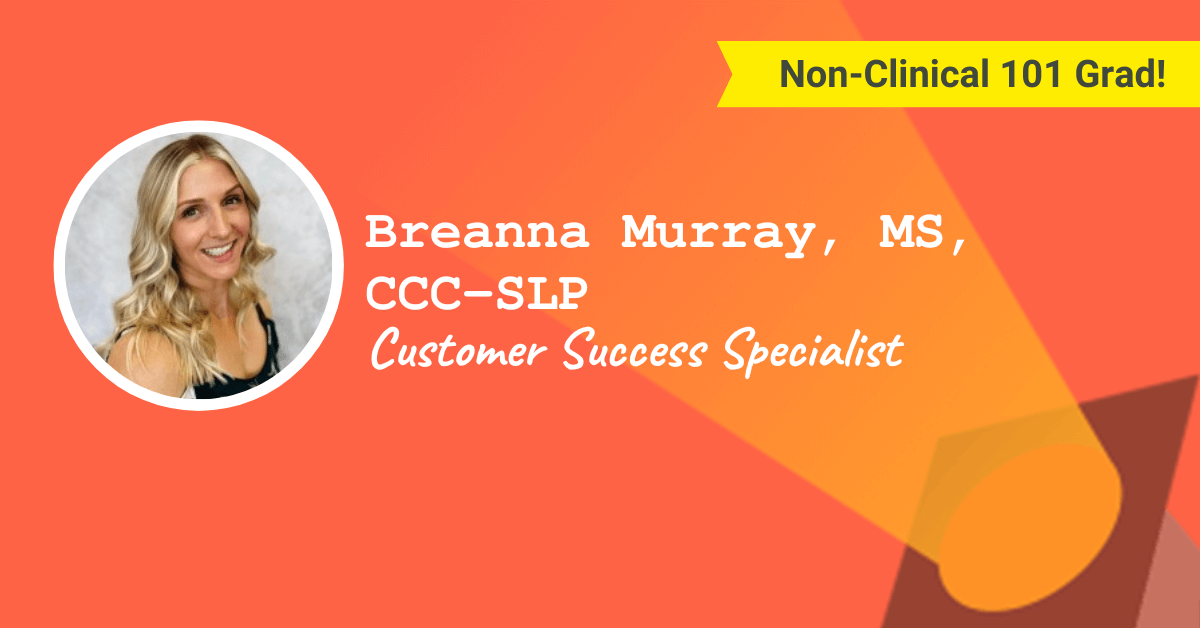


This week’s spotlight is on Breanna Murray, MS, CCC-SLP, a Non-Clinical 101 graduate who is now Customer Success Specialist for Cala Health!
This post may contain affiliate links or codes. This won’t increase your cost, but it helps keep TNCPT alive, and free of annoying ads! Thank you for your support. 🙂
What is your full name, title, and company name for your current, primary role?
Breanna Murray, MS, CCC-SLP — Customer Success Specialist for Cala Health
Where are you located?
Portland, Oregon.
Where did you go to SLP school, and what year did you graduate?
University of Hawaii Manoa, 2019.
Please refrain from contacting our spotlight participants on social media. There are thousands of readers just like you out there. 🙂 Please ask your questions in the comments on this blog post.
If you’re a Non-Clinical 101 student or Go Non-Clinical member, you can network with many of our spotlight participants in our community!
What did you do when you first finished school, and for how long?
When I first graduated, I completed my clinical fellowship in a small rural hospital. I worked in outpatient and also provided acute care coverage. After I earned my C’s, I relocated to work for a bigger hospital system in acute care.
In what setting(s) did you work, and what types of patients did you treat?
I worked in outpatient, acute care, IPR, and home health. I primarily worked with adults and treated a range of neurological-based impairments, including stroke, Parkinson’s, MS, ALS, and trauma patients. I would treat everything from dysphagia, cognitive impairments, and speech and language disorders/communication.
What did you enjoy about your early roles? What didn’t you enjoy?
I really enjoyed working in acute care. I enjoyed the fast-paced environment of the hospital and in the ICU, as well as performing diagnostics. I also enjoyed collaborating with the medical team and providing education for patients and families as they went through their treatment plans.
I did not enjoy the schedule and having to work weekends and holidays, and I often felt misunderstood by other medical members and struggled to gain respect. I also experienced extreme burnout after working through Covid.
When and why did you decide to do something non-clinical?
I began to explore non-clinical possibilities in 2022 when I was pregnant with my first son. Ideally, I wanted something that would provide more flexibility and allow me to be present with my family. I also really wanted a role that would provide more upward growth and salary potential.

What are you doing these days?
I am currently working as a customer success specialist for Cala Health, a med tech company. I serve as a product specialist and provide onboarding support for clients and implementation of our device to ensure optimal product adoption.
Are you still treating patients, or are you solely non-clinical?
I am solely non-clinical.
How long have you been in your current customer success specialist role?
I’ve had this role since May 2025.
Did you get any special certifications or training along the way to help you get into your current role?
I took the Non-Clinical 101 course to help identify the type of role I wanted to transition into, and this helped me identify customer success.
Plus, you’ll get early access to curated non-clinical job listings and a bonus lesson on AI!
I also took a customer success certification through Aspireship. I ultimately believe my reason for landing my current role was because of an internal referral.
How did you find your job? Did you apply or find it through a connection?
I did a tremendous amount of networking through LinkedIn, and I was ultimately able to connect with another former clinician who provided an internal referral.
Did you do anything special to your resume and cover letter to land the job?
Yes, I spent a lot of time redoing my resume to highlight my non-clinical skills and implement metrics.
What was the interview like for the customer success specialist role?
I went through five separate interviews with different team members in the customer success department, as well as the heads of other departments that the customer success team collaborates with on a regular basis. The final interview was with the VP of Sales and Customer Success.
How have people reacted to you leaving patient care?
Everyone has been very supportive. I have several members from my grad school cohort that I keep in touch with on a regular basis, and they have also been very encouraging even though they’ve all found roles that they really enjoy.
What’s a typical day or week in the life like for you? What types of tasks and responsibilities fill your time?
I typically participate in cross functional meetings with our sales and therapy access team, complete new patient trainings and onboarding for our device, and provide proactive outreach to assess how our clients are doing with the device. I am also available for patient education and product support as needed.
What are some of the rewards of your customer success specialist role?
It feels rewarding to be on the innovative side of healthcare and hear how many patients are able to see improvement in daily activities because of this technology. I also still get to work with patients and provide education.
How did your clinical background prepare you for this role? Which skills transferred?
This role focuses a lot on client adoption, retention, and satisfaction, which I believe is something we as clinicians have to hone daily to help with patient buy-in for therapy. I also believe my empathetic nature as a clinician serves me well in this role.
Roughly speaking, how are the hours and pay compared to patient care?
I have way more flexibility during the day, and I have been able to carve out time for regular exercise, which was something that was very important to me.
I did take a small pay cut because I was coming from home health when I made the transition, but having a consistent salary has been very beneficial.
What type of person do you think would do well in your customer success specialist role?
I think anyone who has an underlying empathetic nature and desire to help patients, and also has an affinity for technology, would do well in this setting.
Do you work remotely or onsite?
I am fully remote.
Does your organization hire PT, OT, or SLP professionals into non-clinical roles? If so, what type of roles?
Yes, our customer success team has multiple SLPs and OTs on our team.
Did you read any books, take any courses, or do anything special overall to get you where you are today?
As mentioned previously, I took a customer success certification through Aspireship. I also read the book How to Win Friends and Influence People by Dale Carnegie.
What is a typical career path for someone in your customer success specialist role?
I’m currently working as a CS Specialist I, but there are options for moving up into CS Specialist II positions. Our company is also continuing to grow, and there is a bright future for our department as we continue to expand.
What is next for you? What are your high-level career aspirations?
I am ideally hoping to move into a manager role and develop as a leader.
What would you recommend to someone who is considering going into a role like yours? Do you have any special words of wisdom for the readers?
Continue to network on LinkedIn and find companies whose culture is important to you.
What would you teach to today’s graduate students in your profession, if you had the opportunity?
I wish there were more transparency with graduate programs about tuition and the impact of debt from student loans.
