
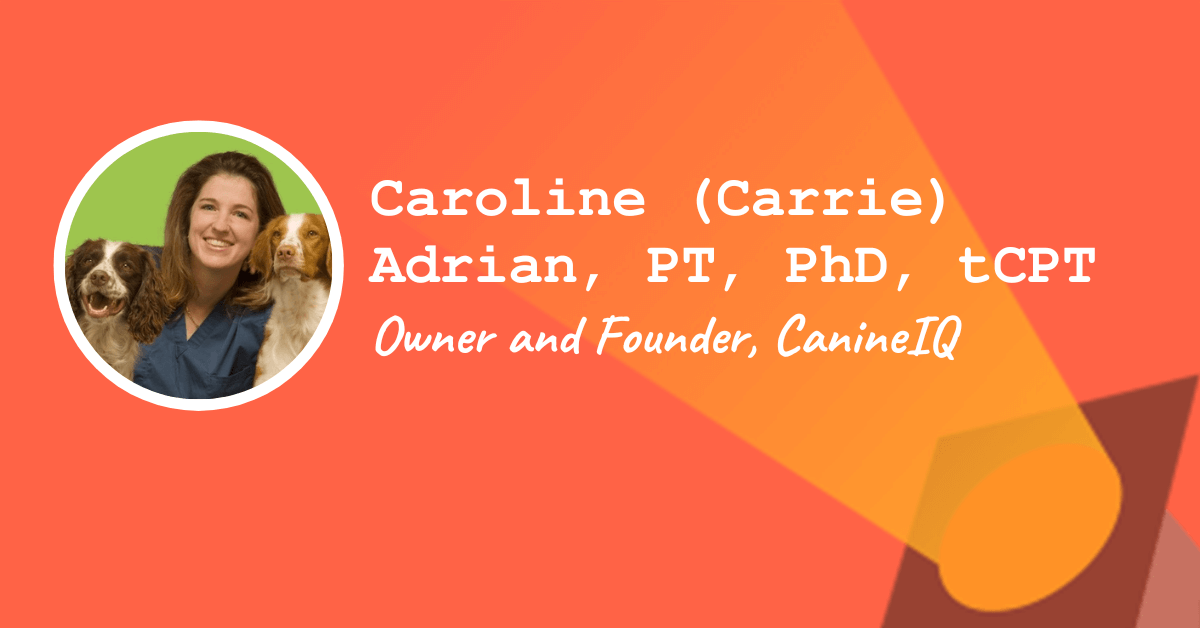


This week’s spotlight is on Caroline (Carrie) Adrian, PT, PhD, tCPT, a canine physical therapist and the Owner and Founder of CanineIQ!
This post may contain affiliate links or codes. This won’t increase your cost, but it helps keep TNCPT alive, and free of annoying ads! Thank you for your support. 🙂
What is your full name, title, and company name for your current, primary role?
Caroline (Carrie) Adrian, PT, PhD, tCPT — Owner and Founder, CanineIQ, LLC

What additional roles do you currently have?
Independent Research Consultant.
Where are you located?
Loveland, CO.
Where did you go to PT school, and what year did you graduate?
North Georgia College, 1999.
Please refrain from contacting our spotlight participants on social media. There are thousands of readers just like you out there. 🙂 Please ask your questions in the comments on this blog post.
If you’re a Non-Clinical 101 student or Go Non-Clinical member, you can network with many of our spotlight participants in our community!
What did you do when you first finished school, and for how long?
I did home health pediatrics for two and a half months in Pittsburgh, PA.
In what setting(s) did you work, and what types of patients did you treat?
After working in home health pediatrics for two and a half months, I moved to Colorado to work as the first physical therapist in a veterinary private practice, treating small animals (mostly dogs) and some zoo animals.
What did you enjoy about your early roles? What didn’t you enjoy?
Working with children was my second choice. Animals were always my first choice as a career path. I always joke that kids and dogs are quite similar—they poop, they pee, and they bite!
I did not enjoy the daily traveling from house to house with home health pediatrics. Additionally, it was difficult to see some of the home situations the children had to endure.
We were thrilled to host Carrie for a live video interview exclusively for our Non-Clinical 101 students! Her journey is so inspiring, and it all began with a pivotal “right place, right time” moment. Check out this clip, where she shares the serendipitous story that launched her entire career. The full replay is available in the private Go Non-Clinical community!
What else have you done since then, prior to your current role?
It has been a very rewarding path for me in canine physical therapy for the past 25 years. Most notably, I had opportunities to:
- Assist in the development of the first canine rehabilitation certification program in the country
- Lecture around the world, educating PTs and DVMs in the field
- Complete a PhD in ‘dog walking’ (canine biomechanics)
- Serve as the National Director of Rehabilitation Services for VCA Animal Hospitals
- Start my own educational platform for physical therapists to become competent canine clinicians
When and why did you decide to do something non-clinical?
It was time. I had been in the clinic for 23 years, which created more and more questions than answers.
My hope is that someday I can take what I’ve learned from my colleagues, clients, and most importantly, my patients to answer some of these questions. Having an opportunity to do clinical research is a dream come true!
What are you doing these days?
I am blessed to have an opportunity as an independent research consultant performing clinical research. I have also started my own educational platform, CanineIQ, that provides a tCPT™ (Transitional Canine Physical Therapist) credential to PTs wanting to transfer their knowledge to a canine (and feline) population.
This program assembles the largest, most diverse group of physical therapist experts, board-certified veterinary specialists, and veterinary technicians to become a confident canine clinician. The tCPT™ credentialing program follows the current (2019) APTA practice analysis that defines the practice of canine physical therapy.
We have created a complete program, guided by the requirements of the physical therapist practice acts in several states, to develop a competent canine physical therapist (CPT).
Are you still treating patients, or are you solely non-clinical?
I am solely non-clinical, though I still get my hands furry on occasion during clinical data collection.
How long have you been in your current role?
Owner and Founder, CanineIQ, LLC — April 2021 to Present.

What do you wish you would’ve known before going into this role?
Once I transitioned out of the clinic, my days became my own. It’s up to me to stay motivated and persevere! Each day, I wake up and have to ask myself, “What am I going to accomplish today?” It requires a lot more self-discipline.
Did you get any special certifications or training along the way to help you get into your current role as Owner and Founder of CanineIQ?
I assisted with development of the first veterinary rehabilitation program in the country back in 2000, leaving that program in 2004.
How did you find your job? Did you apply or find it through a connection?
My story begins in the summer of 1999 with veterinary surgeon, Dr. Robert Taylor. You may recognize him from the famed Emergency Vets show on Animal Planet. I was a new physical therapist graduate with a passion for animals, and he was looking to start a physical therapy department.
I learned of the first International Veterinary Rehabilitation and Physical Therapy conference at the veterinary school in Corvallis, OR through a dear physical therapy colleague, Kimberly Calvert Fusinaz, who has since passed in 2005. Having just graduated from North Georgia College’s Physical Therapy program, I was looking for a way to save some money and volunteered to help with registration to reduce my expenses.
Walking down the sidewalk, I met Dr. Bob, who pointed me in the right direction toward the conference venue. It was there that I learned I CAN work with dogs, my lifelong dream, and began to chase my passion.
Dr. Taylor called after the conference. I flew to Denver to interview with him and the team at Alameda East Veterinary Hospital and found myself moving to Colorado in February 2000. And the rest, as they say, is history…
Did you do anything special to your resume and cover letter to land the job?
No. I didn’t have much of a resume back then, as a new graduate. I found that networking was, and still seems to be, the most effective way to market myself.
What was the interview like for the role?
Back in 1999, when I first interviewed with Dr. Bob Taylor, he flew me from Pittsburgh, PA (my hometown) to Colorado. I stayed with him and his family for a few days, while meeting the staff at Alameda East Veterinary Hospital.
My interview with Dr. Taylor consisted of a bike ride through Waterton Canyon. As a lowlander, I quickly realized the effort required to ride a bike and answer questions while at elevation! One question I recall from Dr. Taylor was, “What do you do when you get mad?” I don’t even remember my answer, as I was more focused on obtaining enough oxygen to my brain.
What are some of the things you did to stand out, take initiative, and advance in your career?
Once Alameda East Veterinary Hospital was sold to a corporation, VCA Animal Hospitals, I took the initiative to submit a proposal (with the help of a PT colleague) to create a position within this company. Working with their Chief Medical Officer, I became the Director of Rehabilitation Services under VCA’s Medical Operations Department.
When did you start your business?
I applied for an Employer Identification Number (EIN) in April 2021, but I sat on CanineIQ for a few years until I transitioned out of my corporate and clinical roles. It wasn’t until Spring 2023 that I dove headfirst into developing the Transitional Canine Physical Therapist credentialing program under CanineIQ.
Where did you get the idea for your business?
Three other colleagues and I had been discussing a way to educate more physical therapists for over five years—investigating a variety of different opportunities but hitting a wall with each one for various reasons. At that point, I didn’t see any other option but to develop a program on my own.
What is your business, and what types of products or services do you offer?
CanineIQ’s tCPT™ (Transitional Canine Physical Therapist) credentialing program is for PTs wanting to transfer their knowledge to a canine (and feline) population. Our self-paced, six module, online program is taught by instructors who are experts and leaders in the canine physical therapist and veterinary specialty fields. The tCPT™ program is designed to fill in the knowledge gaps of a human physical therapist program, transitioning the physical therapist into a competent canine practitioner.
During our live interview, Carrie went into even more detail about the “why” behind her business. In this clip, you can hear her explain—in her own words—the specific gap in the market she aims to fill for fellow PTs.
How have people reacted to you leaving patient care?
There was a lot of shock and sadness. It was a very difficult decision to walk away at the ‘height’ of my career, with stable financial compensation as well. Colleagues and clients were sorry to see me go. There were a few tears shed, for sure.
What’s a typical day or week in the life like for you as Owner and Founder of CanineIQ? What types of tasks and responsibilities fill your time?
I find myself sitting in front of my computer a lot more, which is very different from hopping up and down off the floor all day, treating canine patients.
As a business owner with CanineIQ, navigating and developing social media content and my educational platform, constantly updating content, working with faculty, attorneys, marketing groups, insurance, etc. has all been a learning curve for me.
What are some of the rewards of your role? What are the biggest challenges?
The opportunity to fill my daily schedule as I see fit is priceless, especially being there for my children on a daily basis. Each morning, I find that me, myself and I have a meeting to determine what I’m going to accomplish today. Prioritizing the looong ‘TO DO’ list can be a (good) challenge.
How did your clinical background prepare you for this role as Owner and Founder of CanineIQ? Which skills transferred?
Clinically, having an understanding of running a veterinary physical therapy department, as well as experience working for a large corporation, has been incredibly helpful in understanding some aspects of running a business.
Roughly speaking, how are the hours and pay compared to patient care?
Hours are much longer owning a business, especially in the first year trying to navigate all of the new aspects of running a business. Pay is less, and frankly, is more of a money suck early on, until hopefully, the business starts to make a profit.
Consulting has been the most rewarding, not just financially, but more importantly, being able to take what I’ve learned in the clinic and try to find answers to my clinical questions that have been swirling in my head for so many years.
Ready to launch your own non-clinical career?
Plus, you’ll get early access to curated non-clinical job listings and a bonus lesson on AI!
What type of person do you think would do well in your role as Owner and Founder of CanineIQ?
They would need to be detail-oriented, make friends easily, and have a thick skin. I am a ‘big picture’ person; however, owning a business has forced me to focus on each detail, one at a time, to accomplish that big picture.
Also, networking. Having created a large net of friends and colleagues over the years, who are eager to help along the way, is the biggest blessing.
I couldn’t do all of this by myself and recognize the need to have an incredible network behind me.
Do you work remotely or onsite?
I work remotely out of my home office. Occasionally, I utilize local facilities for data collection.
Does your organization hire PT, OT, or SLP professionals into non-clinical roles? If so, what type of roles?
Yes. I recruit PTs, PTAs, DVMs and veterinary technicians to help train and provide lectures within their specific field of expertise for CanineIQ’s tCPT™ credentialing program.
Did you read any books, take any courses, or do anything special overall to get you where you are today?
We wrote the book(s). Literally. When I started in veterinary physical therapy in Feb 2000, the field was in its infancy in the United States. I was fortunate to participate in many publications over the years that helped define this profession, with the culmination being the 2019 Clinical Practice Standards, Physical Therapy on Animals through the Animal Rehabilitation Special Interest Group (ARSIG), The Academy of Orthopaedic Physical Therapy, American Physical Therapy Association.
What is a typical career path for someone in your role?
Complete additional training to become a competent canine physical therapist.
What is next for you as Owner and Founder of CanineIQ? What are your high-level career aspirations?
The goal of CanineIQ is to continue to advance education in this field and to include client-facing educational information as well. I will continue to perform clinical research and find answers to 23 years of clinical questions!
What would you recommend to someone who is considering going into a role like yours? Do you have any special words of wisdom for the readers?
Confidence. You have the physical therapy education already! Obtain training to build on your existing human education and translate that to a canine patient population.
What would you like to change most in your profession, and why? How would you propose doing so?
Legislation. Practicing on animals is not legal in all states. I am taking steps to change this by creating a complete program, guided by the requirements of the physical therapist practice acts in several states, as well as our 2019 Practice Standards to show this is a viable career path. Legislation always lags behind; however, competency is a first step to making these changes.
What career advice would you give yourself that you wish you had during school?
I always knew I wanted to work with animals. It was not a popular idea in 1996, when I was pursuing my professional education as a PT. I am glad I didn’t back down and continued to pursue this avenue.
If I knew this was going to be my journey, I would not have pursued three years worth of applications to veterinary school, spending time and money on applications and interviews. But, I wouldn’t change a thing about my journey.
What would you teach to today’s graduate students in your profession, if you had the opportunity?
That canine PT is a THING! Becoming a canine physical therapist is a viable career path, and it does exist!
Do you have any special advice for others who want to follow in your footsteps?
Find a mentor. Of course, I’m always happy to chat. It’s often who you know, in addition to what you know.
I’ve had people in my corner from day one to help navigate and build my confidence in this field. And I’m still learning—every day.

