
Published:

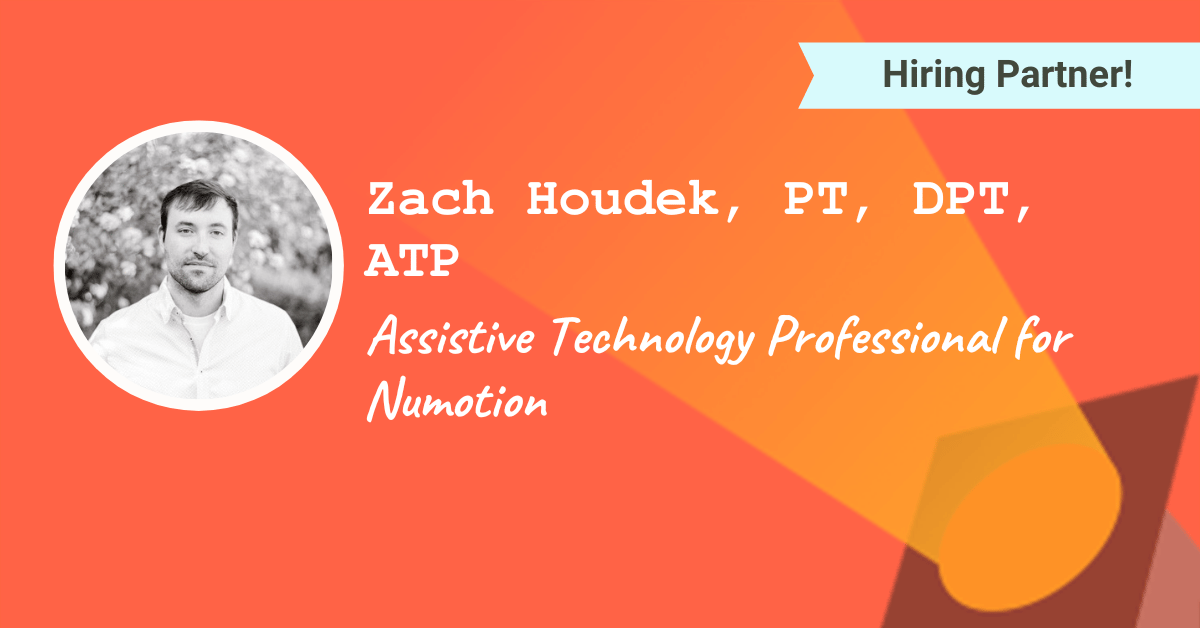
This week’s spotlight is on Zach Houdek, PT, DPT, ATP, a non-clinical physical therapist who is now Assistive Technology Professional for Numotion!
We’re excited to share that Numotion is a hiring partner of Go Non-Clinical, our community for clinicians exploring non-clinical careers!
This post may contain affiliate links or codes. This won’t increase your cost, but it helps keep TNCPT alive, and free of annoying ads! Thank you for your support. 🙂
What is your full name, title, and company name for your current, primary role?
Zach Houdek, PT, DPT, ATP — Assistive Technology Professional for Numotion

Where are you located?
Ohio.
Where did you go to PT school, and what year did you graduate?
University of Toledo (Bachelor’s, 2013) and D’Youville University (DPT, 2016)
Please refrain from contacting our spotlight participants on social media. There are thousands of readers just like you out there. 🙂 Please ask your questions in the comments on this blog post.
If you’re a Non-Clinical 101 student or Go Non-Clinical member, you can network with many of our spotlight participants in our community!
What did you do when you first finished school, and for how long?
I was a Staff Physical Therapist for a home care company.
In what settings did you work, and what types of patients did you treat?
I worked in LTC and home care, mostly with geriatric patients across a mix of populations. I saw general debility, post-op orthopedic patients, neuro, and chronic conditions.
What did you enjoy about your early roles? What didn’t you enjoy?
The pros were a flexible schedule, reasonable pay, and 1:1 time with patients. The cons were productivity, drive time, and a long-term outlook that did not appeal to me.
What else have you done since then, prior to your current role?
I used my experience in home care to start a contract therapy company, which I ran for three years. We subbed out 11-12 1099 contractors and did not work with insurance, but rather invoiced home care companies, who handled billing via their insurance contracts.
This was mostly enjoyable until we ran into issues collecting invoices from multiple agencies. However, the pros mostly outweighed the cons, and I enjoyed being my own boss/company and the flexibility that came with it.
When and why did you decide to do something non-clinical?
After working for a handful of companies, completing multiple travel stints, and running my own company, I felt I gave PT a good shot over the 9-10 years. I am in my mid-30s, and in my opinion, the field of PT/OT/SLP is a mentally taxing field. There are always insurance cuts while productivity requirements for the majority of therapists have increased.
I was looking for something that offered a chance for growth, within a clinical field, and with more earning potential. My current role offers a chance to network and build a book of business, while still using and maintaining my clinical knowledge.
Additionally, the CRT world offers so much technology that I never knew existed as a therapist, so it is fun to learn something new every day.
What are you doing these days?
I’m an ATP with Numotion in Complex Rehab Technology (CRT).
Are you still treating patients, or are you solely non-clinical?
Partially non-clinical. As an ATP, we rely on our clinical background to problem-solve, but ultimately the clinical portion falls on the therapists who evaluate for the CRT.
How long have you been in your current Assistive Technology Professional role?
I started in May 2025.
What do you wish you would’ve known before going into this role?
Insurances are a bear, as with anything in healthcare, but I did not realize how much they factor into the decision-making, and that the process is typically drawn out due to insurance requirements. Other than that, I feel I had a good understanding of the processes, as I completed evaluations for CRT when I worked as a therapist.
Did you get any special certifications or training along the way to help you get into your current role?
I earned my ATP licensure.
How did you find your job? Did you apply or find it through a connection?
One of the ATPs I used for CRT evaluations turned me onto the idea. I applied when a position was open, completed the interview process, and received an offer a couple of weeks later.
Editor’s note: Numotion is a hiring partner of The Non-Clinical PT! If you’re interested in becoming an Assistive Technology Professional, check out their ATP Development Program. You can also browse all of their current openings on Numotion’s careers page.
How have people reacted to you leaving patient care?
Good question. Mostly negative reviews from family and friends, honestly, as PTs spend six to eight years and plenty of student debt to acquire the degree.
However, my close friends and family trust my judgment and hope for the best.
What’s a typical day or week in the life like for you? What types of tasks and responsibilities fill your time?
A typical week is a mix of:
- CRT evaluations for patients with therapists
- Trialing equipment with patients
- Meetings and phone calls with manufacturer reps about products
- Scheduling, emails, and calls to catch up on orders
- Drive time
What are some of the rewards of your Assistive Technology Professional role? What are the biggest challenges?
In therapy, I saw patients for a couple of weeks due to insurance restrictions mostly. I do love that we get to evaluate a patient and see the final product through to the end, as we will make final tweaks as needed. It has been satisfying to see the positive impact we play in a patient’s life by providing the correct, properly fitted equipment.
The biggest challenge coming from a clinical background is the product knowledge. There is so much out there, and it takes time to learn all of the products and how they mount to devices. I am still learning each day about a different product, or what could have been done differently to provide the perfect outcome.
How did your clinical background prepare you for this role? Which skills transferred?
The skills that transferred include:
- Clinical background and evaluation skills
- Patient interaction
- Professionalism when interacting with therapists, doctors, or patients and families
- Time management
- Documentation ability
Ready to launch your own non-clinical career?
Plus, you’ll get early access to curated non-clinical job listings and lifetime access to the Go Non-Clinical community!
Roughly speaking, how are the hours and pay compared to patient care?
The job is what you make it. If you have downtime, it is wise to use that time to market ourselves, our products, and our services to a new facility or doctor’s office. While I am in my first full year, the pay has been comparable, with the expectation that I will far exceed a therapist’s salary after my first full year.
What type of person do you think would do well in your Assistive Technology Professional role?
I do not think this job is for everyone. You need to be able to multi-task while in the field. We are navigating calls and emails all day long while working in evaluations, marketing, driving between patients, and spec’ing equipment.
I think someone needs to be personable, manage time well, and be willing to learn. Marketing skills and building a book of business come with time, but with experience, this becomes easier.
As a new grad PT, I would not have been comfortable in this role, but with my background, I feel that I have an excellent foundation and am much more comfortable in this role (in all facets) than I would have expected.
Do you work remotely or onsite?
I drive to our office, facilities, homes, hospitals, etc. I do work from home at times to spec equipment and complete orders.
Did you read any books, take any courses, or do anything special overall to get you where you are today?
Nothing specific for me. I just had an inkling after a couple of years that therapy was not going to be the long-term answer for me and my family. I am naturally competitive, motivated to learn, and want to experience new things. With that innate wiring, I did not feel comfortable staying at a job that I would be complacent at.
What is a typical career path for someone in your Assistive Technology Professional role?
Numotion seems to hire from various backgrounds. I am aware that we have had techs, PTAs, and COTAs all transition into an ATP role. I think they are open to hiring someone who shows the willingness to learn and grow, but the clinical background was a big factor in me acquiring the job. Also, I never would have known this role existed if I had not been a PT prior.
Editor’s note: You can also find all open positions at Numotion on the private job board inside our Go Non-Clinical community, where members can contact hiring managers directly and get a head start on the application process.
What is next for you? What are your high-level career aspirations?
At this point in my role, I want to continue to learn, network, and build strong relationships with some of the key hospitals and facilities in Northeast Ohio.
I want to be a reliable ATP for the partners who choose to work with us, because I truly enjoy the work I am doing.
