
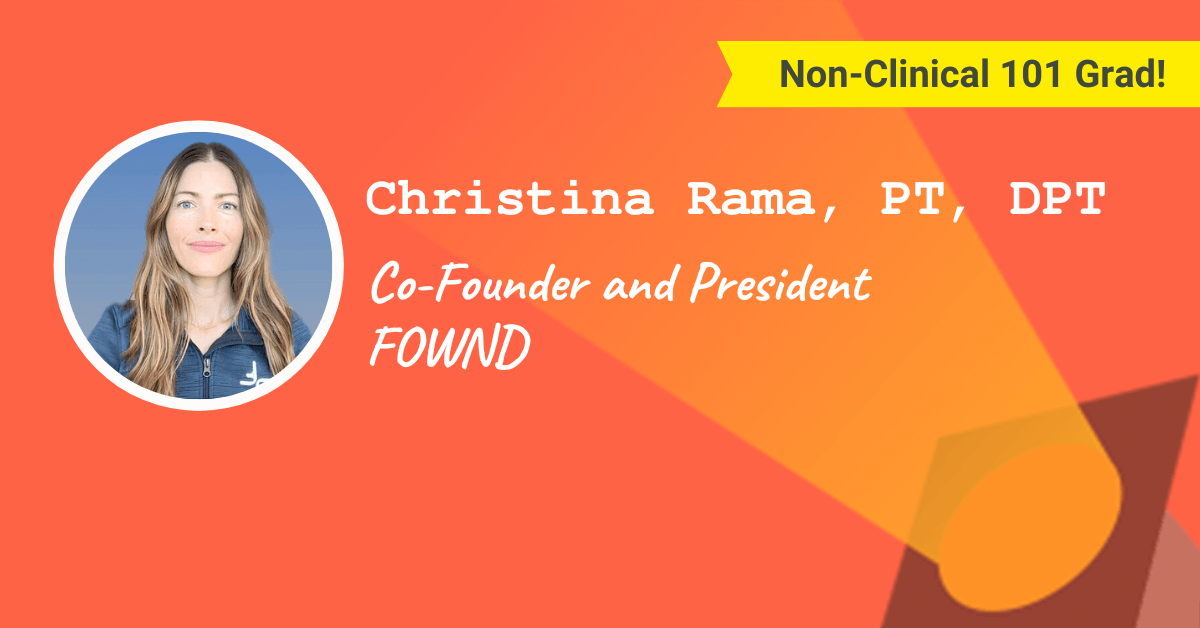


This week’s spotlight is on Christina Rama, PT, DPT, a Non-Clinical 101 graduate and Physical Therapist who is now the Co-Founder and President for FOWND!
This post may contain affiliate links or codes. This won’t increase your cost, but it helps keep TNCPT alive, and free of annoying ads! Thank you for your support. 🙂
What is your name, title, and company name for your current role?
Christina Rama, PT, DPT — Co-Founder and President of FOWND
What additional roles do you currently have?
In addition to leading FOWND, I maintain a small cash-based and pro bono physical therapy practice. Staying connected to patient care is important to me because it keeps me grounded in the real challenges clinicians face.
Where are you located?
San Francisco, CA.
Where did you go to PT school, and what year did you graduate?
I earned my Doctor of Physical Therapy degree from Grand Valley State University in 2007.
What did you do when you first finished school, and for how long?
I started my career as a travel physical therapist and spent several years working in a wide range of clinical settings across the country. That experience gave me early exposure to very different workflows, documentation systems, and patient populations, which shaped how I think about the profession today.
In what setting(s) did you work, and what types of patients did you treat?
I’ve worked across outpatient orthopedics, inpatient rehab, neurorehabilitation, occupational rehab, and home health. My patient population ranged from post-surgical orthopedic patients to neurological and cardiopulmonary cases.
That variety gave me experience working with patients at very different stages of recovery and with very different functional goals.
What did you enjoy about your early roles? What didn’t you enjoy?
The most rewarding part was always the patients. Helping someone regain mobility, independence, or confidence after an injury is incredibly meaningful work, and that’s what draws most of us to the profession in the first place.
What became frustrating over time was the administrative burden surrounding care, especially documentation. It often felt like the systems we relied on weren’t really designed around how clinicians evaluate patients or think through treatment decisions.
What else have you done since then, prior to your current role?
I spent time working in digital health, which gave me a different perspective on how technology can support patient care and engagement outside the traditional clinic setting.
When and why did you decide to do something non-clinical?
My interest in non-clinical work developed gradually. After years working across several clinical settings, I found myself regularly finishing a full day of patient care and then spending evenings catching up on documentation. At first I assumed it was something I just needed to get better at managing, but over time it became clear that many therapists were dealing with the same challenge.
That experience made me more curious about the systems behind the work and how they were designed. I started exploring opportunities outside of traditional patient care and became increasingly interested in how technology and workflow design could better support clinicians.
What are you doing these days?
Most of my time is focused on building my company, FOWND. I work closely with the PTs on our team alongside AI and machine learning engineers and researchers as we develop technology focused on improving documentation and the workflows clinicians deal with every day.
In reality I wear a lot of hats. Depending on the week, that might mean working on product development, speaking with clinicians and clinic owners, partnerships, marketing, interviews, or even things like editing videos and preparing demos. Like most early-stage founders, I do whatever needs to get done.
Are you still treating patients, or are you solely non-clinical?
I still treat patients on a small scale through a cash-based and pro bono model, but the majority of my time is now focused on FOWND.
How long have you been in your current role?
I co-founded FOWND in August 2023.

What do you wish you would’ve known before going into this role?
How much of the learning happens outside your original training. As clinicians we’re used to developing expertise in a specific field, but building something new requires learning across a lot of different areas at once — technology, product development, partnerships, and business.
It’s been a constant process of figuring things out as you go.
Did you get any special certifications or training along the way to help you get into your current role?
While exploring non-clinical paths, I did take the Non-Clinical 101course. It helped me see the range of ways clinicians apply their skills outside traditional patient care and gave me more confidence that many of the skills we develop as PTs are transferable to other roles.
Most of what prepared me for my current role has come through experience, collaboration with people in different disciplines, and a lot of learning along the way while building FOWND.
How did you find your job? Did you apply or find it through a connection?
In my case, I didn’t apply for the role. The opportunity came from recognizing a problem in clinical practice and deciding to try to solve it. That eventually led to co-founding FOWND.
Where did you get the idea for your business?
The idea grew out of a lot of conversations about the realities of clinical practice. After years working in different settings, I kept thinking there had to be a better way for clinicians to handle documentation and the systems surrounding care.
My husband works in the AI space, and talking through those challenges with him is what pushed me to start exploring how technology could be part of the solution.
What is your business, and what types of products or services do you offer?
FOWND is a clinician-led company focused on improving the tools physical therapists use every day, starting with documentation. Our first platform, Notation, is a documentation assistant designed specifically for physical therapists and developed through collaboration between practicing PTs, AI and machine learning engineers, and researchers.
Rather than acting like a traditional AI scribe that simply transcribes conversations, Notation is designed around how PTs actually evaluate patients and reason through care. The platform is designed as an assistant to clinicians, helping structure documentation while preserving the therapist’s clinical judgment and expertise. It helps organize the information needed for clear and defensible notes and provides real-time cues that help clinicians stay aligned with documentation and compliance requirements as the visit unfolds.
Notation is EMR-agnostic and designed to work across settings, from outpatient clinics to home health. It also structures clinical data so clinicians can better track patient progress, validate outcomes, and understand trends over time.
Our longer-term vision is to expand our computer vision capabilities to help clinicians capture and analyze movement during care, from gait analysis and biomechanics to return-to-sport testing and functional capacity evaluations.
How have people reacted to you leaving patient care?
I haven’t received any pushback. Most clinicians understand the pressures that come with patient care and documentation, and many have experienced some level of burnout themselves, so the reaction has generally been very supportive.
What’s a typical day or week in the life like for you? What types of tasks and responsibilities fill your time?
There really isn’t a typical week, which is part of what makes it interesting. Some days are spent reviewing product updates and thinking through how different features will fit into real clinical workflows. Other days are focused on speaking with clinicians and clinic owners, doing demos, interviews, partnerships, or gathering feedback that helps guide what we build next.
A lot of the role is simply staying close to the problems clinicians face and making sure the technology we’re building actually reflects the realities of practice.
What are some of the rewards of your role? What are the biggest challenges?
One of the most rewarding parts is building something that directly supports the profession I come from. As clinicians, we spend years working within systems we didn’t design, so having the opportunity to help shape those systems and work alongside other therapists in the process has been incredibly fulfilling.
The biggest challenge is that building something new takes patience. Healthcare moves carefully for good reason, so progress often comes through steady iteration rather than quick breakthroughs.
How did your clinical background prepare you for this role? Which skills transferred?
Clinical training teaches you how to think through complex problems, communicate clearly, and make decisions with incomplete information. As PTs we’re constantly evaluating situations, adjusting plans, and explaining our reasoning to patients and other providers, and that mindset translates well to building products and working across different disciplines.
Roughly speaking, how are the hours and pay compared to patient care?
Entrepreneurship is definitely less predictable. The hours can be longer and more variable than patient care, especially in the early stages of building a company.
The tradeoff is the opportunity to work on something you believe in and potentially create broader impact over time.
What type of person do you think would do well in your role?
Someone who is naturally curious and comfortable learning new things would do well in this kind of role. Building something new means stepping outside your comfort zone often, so being adaptable and willing to figure things out as you go is important. It also helps to be resilient and able to handle uncertainty, since entrepreneurship rarely follows a straight path.
Do you work remotely or onsite?
Primarily remote, although my work involves frequent conversations with clinicians, partners, and our team.
Does your organization hire PT, OT, or SLP professionals into non-clinical roles? If so, what type of roles?
Yes. Because we’re a clinician-led company, therapists play an important role in shaping what we build. We’ve hired PTs and OTs into roles such as product design and sales.
We actually found our UI/UX designer through this community. She’s a PT who went through the Non-Clinical 101 program and has done an incredible job helping shape the design of the platform. As we grow, we expect clinicians to continue contributing across both product and business roles.
Did you read any books, take any courses, or do anything special overall to get you where you are today?
I took Non-Clinical 101, which helped me better understand the range of opportunities available outside traditional patient care and gave me confidence that many of the skills we develop as clinicians are transferable.
Beyond that, much of my learning has come through experience, curiosity, and working across disciplines while building FOWND.
What is a typical career path for someone in your role?
There really isn’t one typical career path. Many people start with clinical experience and then move into areas like digital health, healthcare technology, consulting, product development, or entrepreneurship. Clinical practice often gives you a strong understanding of the problems in healthcare, which can become a foundation for building or improving systems that support care.
What is next for you? What are your high-level career aspirations?
Right now my focus is continuing to build FOWND and expand what Notation can do.
Longer term, I’m passionate about helping the profession better show the value of physical therapy care. If we can better capture outcomes and progress, that has the potential to influence how PT care is understood and reimbursed.
What would you recommend to someone who is considering going into a role like yours? Do you have any special words of wisdom for the readers?
Stay curious and pay attention to the problems you see every day in practice. Many of the most interesting opportunities come from clinicians who notice something that could work better and start asking questions about how to improve it.
What would you like to change most in your profession, and why? How would you propose doing so?
I would love to see the profession supported by systems that actually understand rehabilitation care. Physical therapists help people regain function, independence, and confidence every day, yet many of the tools we rely on were not designed with that reality in mind.
Better platforms could help clinicians capture outcomes and progress more clearly, making it easier to demonstrate the value of the care PTs provide and giving the profession a stronger voice in shaping the future of healthcare.
What career advice would you give yourself that you wish you had during school?
I would remind myself that it’s okay if your career path doesn’t look exactly the way you expected when you started school. Staying curious and open to new opportunities can lead to really meaningful work.
Do you have any special advice for others who want to follow in your footsteps?
You don’t have to have the entire path mapped out. Some of the most interesting opportunities come from starting with an idea and being willing to grow into the role over time.
