
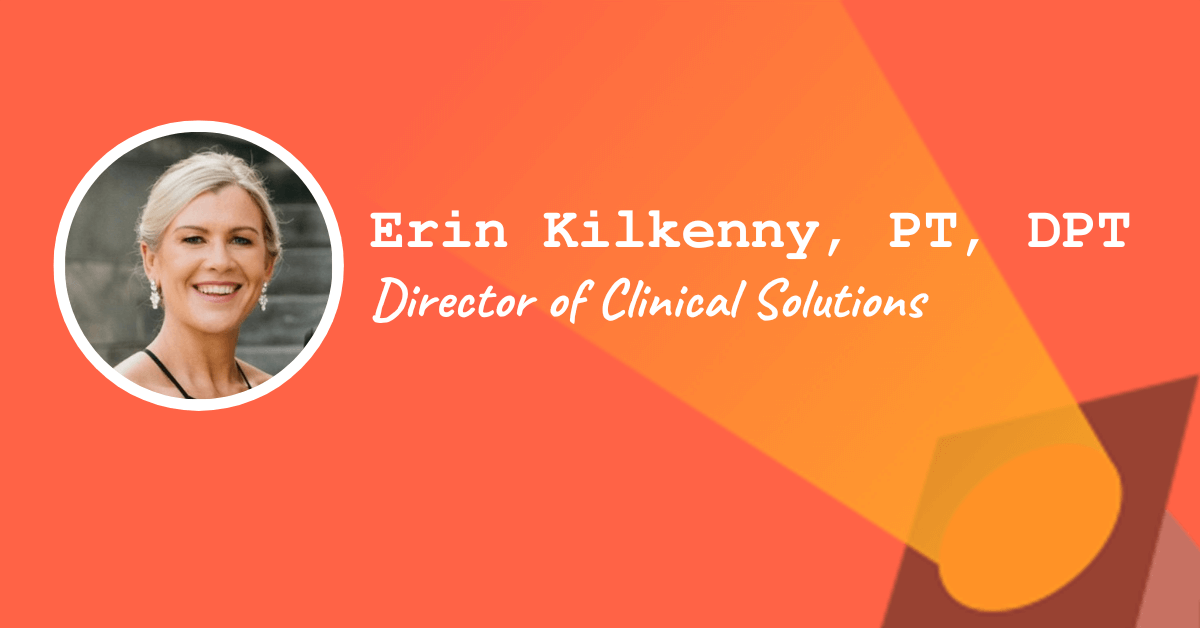


This week’s spotlight is on Erin Kilkenny, PT, DPT, a non-clinical physical therapist who is now Director of Clinical Solutions at Vestibular First!
This post may contain affiliate links or codes. This won’t increase your cost, but it helps keep TNCPT alive, and free of annoying ads! Thank you for your support. 🙂
What is your full name, title, and company name for your current, primary role?
Erin Kilkenny, PT, DPT — Director of Clinical Solutions at Vestibular First

Where are you located?
Doylestown, PA.
Where did you go to PT school, and what year did you graduate?
Widener University, 2011.
Please refrain from contacting our spotlight participants on social media. There are thousands of readers just like you out there. 🙂 Please ask your questions in the comments on this blog post.
If you’re a Non-Clinical 101 student or Go Non-Clinical member, you can network with many of our spotlight participants in our community!
What did you do when you first finished school, and for how long?
I worked in a privately owned outpatient clinic for almost 14 years, rotating through several of the clinic’s locations and spending the last four years as the manager of one of the clinics.
About a year after graduating, I also began working per diem in a hospital acute care setting on top of my full-time outpatient job, which I continued for about five years.
In what setting(s) did you work, and what types of patients did you treat?
During my outpatient career, I developed a specialization in vestibular therapy, attending the Emory conference in 2012 to strengthen my skills. I went on to earn certification in the LSVT BIG program for Parkinson’s disease and treated a high volume of patients with vestibular, balance and Parkinson’s-related needs, in addition to managing a wide range of orthopedic conditions.

In my acute care role, I gained broad experience across nearly every floor of the hospital—working with critically ill patients in the ICU as well as those recovering from surgery in skilled rehab.
What did you enjoy about your early roles? What didn’t you enjoy?
I enjoyed the fast-paced environment and seeing patients make progress, especially in vestibular therapy, where improvements often came quickly. I also valued the relationships I built with colleagues and patients, and the daily opportunities to connect with people.
When and why did you decide to do something non-clinical?
About three years ago, the outpatient clinic where I worked went through a buyout and acquisition, which brought changes to the overall workflow. At the same time, my family life was becoming busier, and I realized I needed more flexibility.
Balancing patient care with clinic management had become increasingly demanding, and I knew it was the right moment to explore new opportunities that would allow me to grow professionally while maintaining a better balance in my personal life.
What are you doing these days?
I am currently the Director of Clinical Solutions at Vestibular First, the company that produces the Insight Pro+ Infrared Video Goggles—the same technology I relied on daily when evaluating and treating vestibular patients in my outpatient role. In this position, I create educational content for the company’s website and provide online demonstrations for potential customers interested in the goggles.
Are you still treating patients, or are you solely non-clinical?
I am solely non-clinical.
How long have you been in your current director of clinical solutions role?
Since April 2025.
How did you find your job? Did you apply or find it through a connection?
Over the course of two years, I focused on networking—reaching out to non-clinical physical therapists on LinkedIn, sending emails, and having one-on-one conversations to learn from their experiences.
Every interview I received came directly through these connections, which reinforced the value of persistence and building relationships.
During this time, I reconnected with Helena, co-founder of Vestibular First and my former clinical instructor. When a position opened last March, she reached out to me because we had already been in touch.
How have people reacted to you leaving patient care?
Some people were surprised, but overall the response has been positive, as most knew I was ready for a change.
What’s a typical day or week in the life like for you? What types of tasks and responsibilities fill your time?
My work varies week to week but typically includes collaborating with colleagues on website and newsletter content, assisting with educational materials, and contributing to marketing strategies. I also spend time writing and developing content, as well as leading virtual meetings to educate clinicians on the functions and clinical applications of the Insight Pro+ Infrared Video Goggles. After these sessions, I follow up with clinicians to address any questions they may have.
What are some of the rewards of your role? What are the biggest challenges?
I get to assist clinicians in deepening their understanding of vestibular disorders and provide education on technologies that support more accurate diagnosis. While there was initially a learning curve with both the technology and leading meetings via Zoom, with the right guidance the transition has been smooth, and I value the opportunity to keep learning something new every day.
How did your clinical background prepare you for this role? Which skills transferred?
I would not have been able to do this job without my clinical background. Vestibular diagnoses and treatments can be complex, and providing education on them requires firsthand experience in evaluating and treating these conditions in the clinic, as well as direct familiarity with the technology used in practice.
Ready to launch your own non-clinical career?
Plus, you’ll get early access to curated non-clinical job listings and a bonus lesson on AI!
What type of person do you think would do well in your director of clinical solutions role?
They would need strong time-management skills, effective communication abilities, and the capacity to stay organized and detail-oriented.
Do you work remotely or onsite?
I work in a hybrid setup, typically spending two days onsite and three days working from home.
Did you read any books, take any courses, or do anything special overall to get you where you are today?
I completed various vestibular courses during my time as a treating PT. I also followed The Non-Clinical PT job posts and Facebook group before obtaining my current role.
I believe networking was the key factor that ultimately helped me get to where I am today.
What is a typical career path for someone in your director of clinical solutions role?
They would need to have prior clinical experience, ideally with a background in vestibular care.
What is next for you? What are your high-level career aspirations?
My goal is to continue growing as a leader in vestibular care and technology, shaping how clinicians integrate innovative tools into patient care.
