
Published:

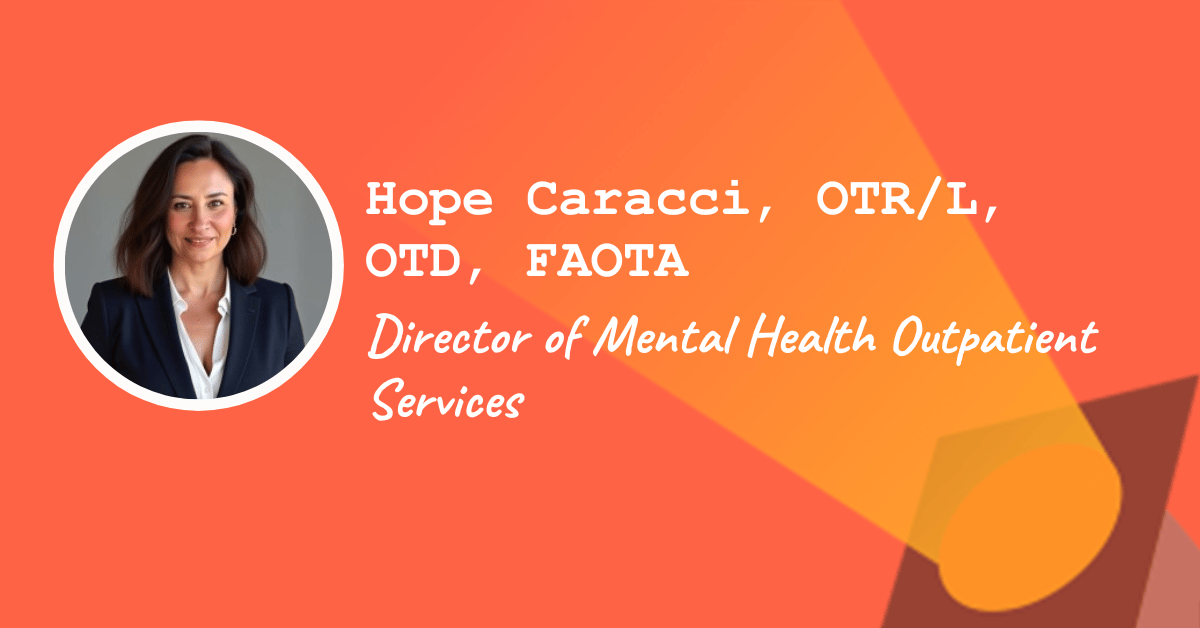
Hope Caracci, OTR/L, OTD, FAOTA, is Director of Mental Health Outpatient Services at Children’s Hospital of The King’s Daughters — the Norfolk system known as CHKD. It is Virginia’s only free-standing, full-service pediatric hospital, and it runs more than 40 outpatient locations across Hampton Roads, so the clinics she oversees are spread across a region rather than gathered under one roof.
One phrase is worth defining first. A service line is how a hospital groups an entire clinical area — its clinicians, its clinics, its budget, its outcomes — into a single unit with one person accountable for it. That person is there to make the unit work: staffing it, funding it, measuring it, and answering for it. Hope holds that job for outpatient pediatric mental health.
Read her answers below to see how a non-clinical occupational therapist works her way into running one of these units.
This post may contain affiliate links or codes. This won’t increase your cost, but it helps keep TNCPT alive, and free of annoying ads! Thank you for your support. 🙂
The clinical years, and the promotions that led out of them
What is your full name, title, and company name for your current, primary role?
Hope Caracci, OTR/L, OTD, FAOTA — Director of Mental Health Outpatient Services for Children’s Hospital of The King’s Daughters (CHKD)
What additional roles do you currently have?
Adjunct Professor, Contract
Where are you located?
Chesapeake, VA
Where did you go to PT/OT/SLP/A school, and what year did you graduate?
I earned my Bachelor of Occupational Therapy in 1999 from Utica College of Syracuse University (now Utica University).
I later earned my Post-Professional Doctor of Occupational Therapy (OTD) from Virginia Commonwealth University.
What did you do when you first finished school, and for how long?
Like many therapists, I started in direct patient care. I worked at a large Level I trauma center in upstate New York, primarily in acute care, treating both adult and pediatric patients. I was later promoted to Lead Burn Therapist in the hospital’s burn center.
Those early years helped me develop strong clinical reasoning, interdisciplinary collaboration skills, and a deep appreciation for the patient and family experience.
In what setting(s) did you work, and what types of patients did you treat?
Next, I worked within a large health system in outpatient pediatrics. During my time there, I was promoted to Education and Performance Improvement Coordinator and later to Quality Manager. I remained with that health system for 17 years, and they invested tremendously in my professional growth.
I had the opportunity to participate in a variety of hospital-based initiatives and learned how to apply the Institute for Healthcare Improvement framework to both clinical and operational challenges. I gained experience in root cause analysis, patient safety, and Lean Six Sigma methodologies through direct work with Toyota Production System principles.
I partnered closely with physicians, nurses, case managers, therapists, and other interdisciplinary team members to improve quality, safety, and operational performance across the organization.
What did you enjoy about your early roles? What didn’t you enjoy?
I loved connecting with patients and families and helping them navigate difficult moments. I also enjoyed solving complex problems and collaborating with interdisciplinary teams.
Over time, however, I realized I was increasingly interested in improving the systems surrounding care delivery rather than impacting one patient at a time. I found myself drawn to process improvement, quality initiatives, leadership opportunities, staff development, and organizational strategy.
I also developed a passion for professional development and leadership. I have always believed that education and training are essential components of lifelong learning in healthcare, whether in clinical practice or operations.
Swapping a caseload for a service line
What are you doing these days?
My transition wasn’t a single decision—it happened gradually. As I advanced in my career, I consistently sought new opportunities, volunteered for additional responsibilities, and became involved in committees, leadership initiatives, accreditation programs, quality improvement projects, and professional association work.
I realized I could potentially impact thousands of clinicians and patients by improving systems, processes, education, and organizational performance. That broader impact became increasingly meaningful to me.
During my doctoral work, I also discovered that I love writing, publishing, presenting, and public speaking. I recently delivered my first keynote presentation, which was an incredibly rewarding experience.
How long have you been in your current role?
September 2025
Are you still treating patients, or are you solely non-clinical?
Today, I lead a large outpatient mental health service line within a pediatric health system. I oversee a multidisciplinary team that includes psychiatrists, psychologists, LCSWs, LPCs, nurses, operational staff, and administrative professionals.
My responsibilities include operational leadership, strategic planning, organizational design, workforce development, quality improvement, performance management, and culture transformation.
Throughout my career, I’ve also led national accreditation and professional development programs, developed continuing education frameworks, managed large volunteer networks, supported regulatory and quality initiatives, and helped organizations scale programs and services.
What got her hired, and how colleagues responded
How did you find your job? Did you apply or find it through a connection?
It was a combination of networking and demonstrating results throughout my career. Interestingly, I returned to an organization where I had previously worked after being away for six years. That experience reinforced the importance of leaving organizations on good terms and maintaining strong professional relationships.
You never know when an opportunity to return may arise.
Most of my career opportunities have come from building relationships, volunteering for challenging projects, taking initiative, and developing a reputation as someone who can solve complex organizational problems.
How have people reacted to you leaving patient care?
If you can believe it, no one has ever really questioned or discussed it with me. The transition felt very natural and made sense at each stage of my career. Even in my first leadership role as an Education and Performance Improvement Coordinator, I still had opportunities to treat patients.
The biggest shift has been moving completely out of occupational therapy-specific roles and into broader healthcare leadership and mental health operations. Because I’ve been away from direct patient care for so long, most people simply view me as a healthcare leader rather than focusing on my OT background.
What fills the week, and what carried over from the clinic
What’s a typical day or week in the life like for you? What types of tasks and responsibilities fill your time?
No two days are exactly alike, and that’s one of the things I enjoy most about the role.
A typical week includes coaching and mentoring leaders, solving operational challenges, making strategic decisions, and ensuring teams have the structure and support they need to be successful. I spend a significant amount of time communicating—whether that’s meeting with leaders, collaborating across departments, or simply being visible and available so people feel seen, heard, and supported.
Other responsibilities include budgeting, workforce planning, performance management, hiring, organizational design, and leading change initiatives. Some weeks are focused on long-term strategy, while others require responding to immediate operational issues.
At its core, my role is about helping people and systems perform at their best. Every decision ultimately comes back to improving the experience of our patients, families, clinicians, and teams.
What are some of the rewards of your role? What are the biggest challenges?
One of the greatest rewards is the opportunity to improve care at a systems level. While I loved working one-on-one with patients, I now have the privilege of creating the conditions that help hundreds of clinicians deliver exceptional care to thousands of patients and families.
I also find a great deal of fulfillment in developing people. Whether it’s coaching leaders, creating professional development programs, building quality systems, or helping teams solve problems independently, I enjoy watching people and organizations grow.
The biggest challenge is that meaningful change takes time. Healthcare is complex, and improving quality, operations, and culture requires bringing together many different perspectives, building trust, and maintaining momentum—even when progress isn’t immediate. I’ve learned that successful change is rarely about having the right answer; it’s about engaging people in creating the right solution together.
How did your clinical background prepare you for this role? Which skills transferred?
More than many people realize.
Occupational therapy taught me how to evaluate complex situations, understand multiple perspectives, identify barriers, develop plans, and measure progress toward meaningful goals.
Those same skills apply to leadership, operations, quality improvement, accreditation, workforce development, and organizational transformation.
The clinical skills transferred. The scale simply changed.
Compensation, fit, and why she’s onsite
Roughly speaking, how are the hours and pay compared to patient care?
Like many roles—clinical or non-clinical—the hours and work-life balance tend to ebb and flow based on organizational priorities, leadership responsibilities, and the boundaries you establish.
From a compensation perspective, non-clinical leadership roles often provide greater earning potential as your scope of responsibility increases. That said, I don’t think most people should pursue these roles for the salary alone. The work is different, the challenges are different, and the responsibility can be significant and stress a bit higher.
For me, the biggest reward has been the opportunity to influence systems, develop leaders, and improve care at a broader organizational level. That’s ultimately what made the transition worthwhile.
What type of person do you think would do well in your role?
I think the people who thrive in roles like mine are naturally curious. They enjoy learning, asking questions, and understanding why things work the way they do rather than simply accepting the status quo.
They also need to be comfortable with ambiguity. Much of my work involves solving complex problems where there isn’t a clear roadmap. You have to enjoy bringing structure to complexity and helping others navigate change.
Strong relationship-building skills are essential because very little in healthcare leadership is accomplished alone. Success depends on earning trust, influencing across disciplines, and bringing people together around a shared vision.
Finally, I think it’s important to genuinely enjoy developing other people. The most rewarding part of my career hasn’t been solving problems myself—it’s been building systems, developing leaders, and creating environments where teams can solve problems independently.
Do you work remotely or onsite?
Mostly onsite. I work from home a few days per month, but visibility is part of the role.
How she built the expertise, and what the path looks like
Did you read any books, take any courses, or do anything special overall to get you where you are today?
I’ve always been a lifelong learner. Throughout my career, I’ve intentionally sought out opportunities that expanded my thinking beyond my clinical training.
Some of the most influential areas of study have included Lean methodology, quality improvement, implementation science, healthcare leadership, change management, project management, and organizational development. I’ve also completed extensive professional development in accreditation, continuing education, and workforce development through my work at AOTA, while pursuing doctoral education focused on leadership and organizational systems.
More recently, I’ve been exploring clinical excellence, outcomes measurement, value-based care, and digital health. I also make it a priority to learn directly from other leaders. Some of the most valuable professional growth has come through networking conversations with healthcare executives, founders, and innovators who challenge how I think about leadership and the future of healthcare.
Books have certainly influenced me as well. A few that stand out include Positive Intelligence by Shirzad Chamine, which strengthened my self-awareness as a leader, and The Toyota Way, which reinforced the importance of systems thinking and continuous improvement.
One thing I’ve learned is that leadership isn’t a destination—it’s a continuous process of learning, reflecting, and applying new ideas.
What is a typical career path for someone in your role?
Many people in roles like mine have an MBA, a Master’s in Healthcare Administration, or a behavioral health background such as an LCSW, LPC, or psychologist. My path was a bit different.
As an occupational therapist, I brought a systems-thinking approach to leadership. OT taught me to evaluate complex situations, identify root causes, develop measurable goals, implement interventions, and continuously measure progress and adjust. Those same skills translate remarkably well to healthcare operations and quality improvement.
Over the years, I intentionally built expertise in Lean methodology, quality improvement, accreditation, professional development, and healthcare operations. Together, those experiences have allowed me to contribute not only from a clinical perspective, but also through operational strategy, leadership development, and organizational transformation.
I actually think my nontraditional path has become one of my greatest strengths because it allows me to approach challenges through both a clinical and systems lens.
Where she’s headed, and what she’d tell a student to do now
What is next for you? What are your high-level career aspirations?
I hope to continue leading large-scale transformation efforts at the intersection of healthcare operations, clinical excellence, quality improvement, workforce development, and innovation. I’m becoming increasingly interested in digital health, health technology, and startups, and I hope to explore opportunities in those areas in the future.
My passion is helping organizations build systems that allow clinicians to do their best work and patients to achieve the best possible outcomes.
What career advice would you give yourself that you wish you had during school?
Take every opportunity to do things outside of your current clinical role. If there’s a committee to join, join it. If there’s an opportunity to present, volunteer. If you can lead a continuing education initiative, do it. If you can participate in an environment of care committee, a root cause analysis team, or a quality improvement project, take advantage of it.
Many of these opportunities may require extra effort and may not come with immediate recognition or compensation, but they help build skills, expand your network, and strengthen your résumé. They also demonstrate that your abilities extend beyond direct patient care.
Don’t underestimate the value of your transferable skills. Therapists are trained problem-solvers. We understand systems, human behavior, communication, change, and goal achievement.
Your clinical license does not limit your career options.
In many cases, it opens doors you may not even realize exist yet.
What would you teach today’s graduate students?
Develop leadership skills early.
Volunteer for projects. Join committees. Learn about quality improvement. Understand healthcare operations. Build relationships across departments.
Your clinical skills will always be important, but your ability to influence, lead, communicate, and solve problems will often determine the scope of your impact.
What to read next
- Honing non-clinical skills at your clinical job — the committee-and-project route, by setting.
- Advice from the hiring managers making the decisions — what they actually screen for.
- Courtney Holmes, Behavioral Health Practice Facilitator at Colorado Access — same domain, different level.
- The Non-Clinical Jobs Report — administration and operations led all non-clinical postings in Q2 2026.
More resources for your non-clinical career
If you’re finding your own way through the non-clinical transition, we’ve created these FREE resources to help you get your bearings.
- Our weekly jobs newsletter: 100+ fresh non-clinical job postings every week, plus new spotlights, our latest articles, and hiring partners recruiting straight from our community.
- Four Secrets to Landing a Fulfilling Non-Clinical Healthcare Job: our free mini-course, delivered to your inbox.
- Our free career quiz: 15 questions, and you’ll come out with a much clearer picture of which non-clinical sectors suit you.
If you’d rather follow a step-by-step roadmap than piece this together on your own, that’s exactly why we made Non-Clinical 101. It’s our course & community teaching rehab pros how to make the switch in half the time with twice the confidence.
