
Published:

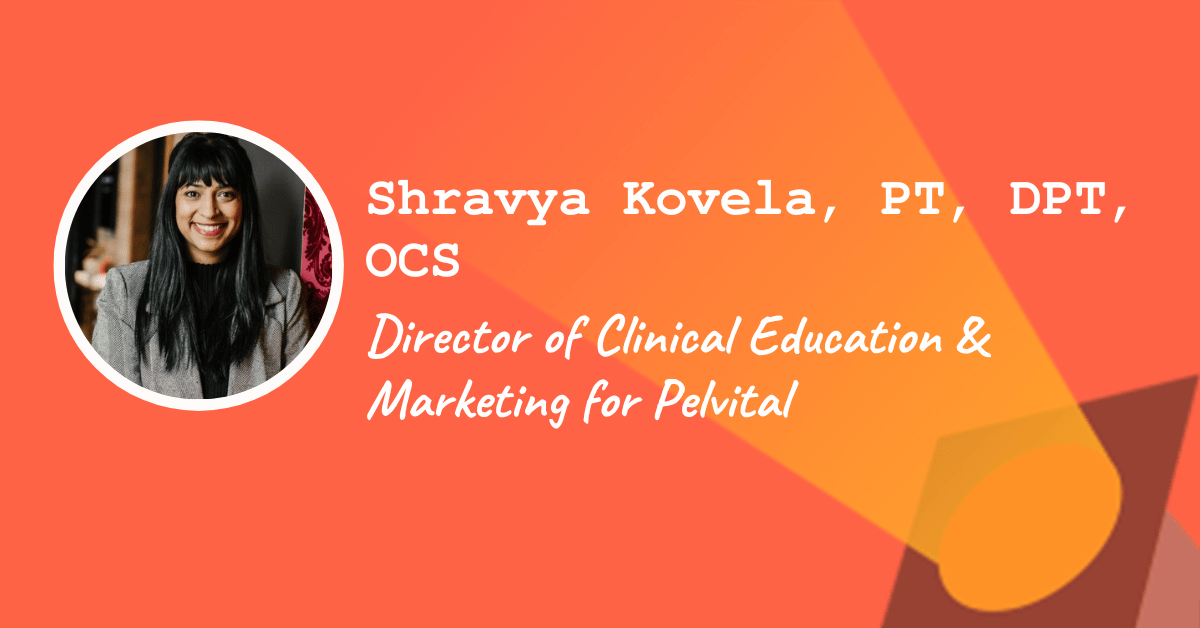
This week’s spotlight is on Shravya Kovela, PT, DPT, OCS, a non-clinical physical therapist who is now Director of Clinical Education & Marketing for Pelvital!
This post may contain affiliate links or codes. This won’t increase your cost, but it helps keep TNCPT alive, and free of annoying ads! Thank you for your support. 🙂
What is your full name, title, and company name for your current, primary role?
Shravya Kovela, PT, DPT, OCS — Director of Clinical Education & Marketing for Pelvital
Where are you located?
Richmond, VA.
Where did you go to PT school, and what year did you graduate?
I went to Emory University and graduated in 2017.
What did you do when you first finished school, and for how long?
I went straight from school into an orthopedic residency, which I loved. It was about 1.5 years long, and I stayed on to treat orthopedic patients prior to obtaining additional training in pelvic floor rehabilitation.
In what setting(s) did you work, and what types of patients did you treat?
I worked in (and loved!) the orthopedic outpatient setting. I treated both ortho and pelvic health, with the majority of my caseload eventually becoming women’s health.
What did you enjoy about your early roles? What didn’t you enjoy?
I loved patient care for all the reasons most people do — having a direct impact on a patient’s quality of life. I enjoyed my residency and getting my OCS. I felt like I could really problem-solve with my patients in a way I couldn’t do before.
I fell in love with pelvic health and the patient connection, the absolute need for support and validation in that community.
I didn’t enjoy the long hours away from home, the monotony of documentation, the annoyances of insurance-based care, and the expectation to work harder but with less time.
What else have you done since then, prior to your current role?
At that first clinic, I worked with leadership to launch a Wellness Program — in which patients could optionally transition to post-PT “wellness” classes (for example, yoga for low back pain) to maintain mobility and strength in a community-based setting. The pandemic hit and it fizzled quickly.
I quit that job in 2021, went on a cross-country road trip with my husband, and found a part-time, remote job that has turned into my full-time one today. Once I moved to where I currently live, I worked for about three years at a small and wonderful out-of-network pelvic health PT clinic on a very part-time basis, because I had a tough time with the idea of leaving patient care completely. I loved this setting and was sad to say goodbye when I made the choice to go fully non-clinical.
When and why did you decide to do something non-clinical?
I knew I wanted a change as I started to get burnt out in the traditional insurance-based outpatient setting. I’ve always loved educating and creating awareness on important topics, especially within women’s health. I had this call to do something different and more creative on a broader scale.
After I quit my job, I decided to do some soul-searching as my husband and I drove, camped, and traveled across the country, to figure out what exactly my next step would be.
What are you doing these days?
I lead clinical education and marketing at a women’s health medical device company — and I love it. I build marketing strategy, direct and create content that resonates with healthcare providers and target patient audiences, and support sales and revenue in all different ways. As a startup company, we all wear many different hats at all times.
Are you still treating patients, or are you solely non-clinical?
I am solely non-clinical.
How long have you been in your current director of clinical education & marketing role?
Since March 2021.
What do you wish you would’ve known before going into this director of clinical education & marketing role?
Talk the talk, walk the walk. It took me a while to figure out how to transition out of a world in which I only think about my patients, building a caseload, and helping support a business of one clinic to thinking about larger-scale creative strategy to push a company forward.
Did you get any special certifications or training along the way to help you get into your current role?
I didn’t, because I happened upon this role in such an unexpected way. Since starting, my role has substantially evolved and I’ve been able to shape it accordingly. I have consumed a lot of different content on B2B and inbound marketing.
How did you find your job? Did you apply or find it through a connection?
I quit my job with the plan of spending six months traveling across the country in my Prius while doing yoga, sleeping in, and hiking. It took only three days for me to be looking for jobs (classic, as my husband would say) because I was curious as to what could be next for me.
I stumbled upon a Facebook post in a pelvic PT networking group from someone I had taken a pelvic floor course from in the past — she was consulting for a women’s health medical device startup that was looking to hire a pelvic PT for a part-time, remote role. This was perfect for what I could do while away on my road trip! I reached out to her and applied from there. At the time, the role was for Business Development Manager and has since evolved into what I do now.
Editor’s note: Want to network with fellow rehab professionals exploring non-clinical paths? Join our free Facebook community, Non-Clinical Networking & Jobs for Rehab (PT, OT, SLP) Professionals!
Did you do anything special to your resume and cover letter to land the job?
I had friends and family — who are not in the healthcare field — take a look at my resume to help me cater it to the role I was applying for at the time. I led with my ideas and how I would plan to implement them in my cover letter, which I think resonated well with the startup environment.
What was the interview like for the director of clinical education & marketing role?
I met with the COO for a 1:1 interview that took about 45 minutes to one hour. I was then asked to prepare a presentation for the rest of leadership. A few days later, I presented via Zoom to a group of three others.
What are some of the things you did to stand out, take initiative, and advance in your career?
I really sat down to determine what value I bring to the table with my clinical background and how I can help us help more people (which means growing the bottom line — revenue). I also took time to determine what I enjoy about my current job and what I didn’t. Armed with these, I had open conversations with my higher-ups to receive feedback and share my ideas.
I was clear in what I envisioned for my role as well as what I could offer, and backed it up with examples of what I had accomplished within and beyond my current role so far. By taking this initiative, I’ve not only advanced my career within the company, but also expanded my impact, something that deeply matters to me.
My goal is to help grow the availability of women’s health resources and make them more accessible to all.
How have people reacted to you leaving patient care?
Very positive! I’ve had some colleagues lament that leaving means that there’s one less pelvic health provider in the field — a field that is so very important and already so stretched thin in terms of demand — which is very valid and a tough pill to swallow. Overall, everyone has been supportive and curious about what I do in a remote job.
What’s a typical day or week in the life like for you? What types of tasks and responsibilities fill your time?
Startup life never has a typical work week! Some weeks are busier than others, but there’s always something interesting going on. My day usually starts with checking emails and responding to Teams chats. A lot of collaboration and calls to coworkers.
Then, I may do anything from working on building out content or marketing strategy for outreach to healthcare providers, or creating swag and educational tools with relevant messaging for a target audience at a conference. I may join a call with our research director to provide input for a pilot study, or present to a group of healthcare providers about the science behind Flyte’s unique mechanism of action, transvaginal mechanotherapy.
My main responsibility is to ensure messaging is consistent and resonates with our target audiences, elevating the healthcare space.
What are some of the rewards of your director of clinical education & marketing role? What are the biggest challenges?
The biggest challenges are the ones that are typical for a startup — always chasing the next goal and pivoting quickly when necessary, even after a lot of time and effort has gone into the original plan.
The biggest reward for me is the autonomy to be creative and shape messaging so that we are a medical device company that is aware of the challenges that women’s health providers and patients face — something I think many medical device and digital health companies that don’t have clinical people in their ranks don’t do well. I also love the flexibility that comes with a work-from-home job and the scrappiness of my mission-driven team.
How did your clinical background prepare you for this role? Which skills transferred?
I’d honestly say everything but my hands-on skills in patient care has transferred. Problem-solving, understanding people on a deeper level, seeing the challenges that exist within the healthcare system, valuing interdisciplinary care and evidence-based education, knowing how to interpret journal articles and new studies, summarizing complicated clinical terms into patient-friendly language, teaching and educating, building rapport with all different types of patient personalities — these are all things my clinical background has brought into my current role.
Roughly speaking, how are the hours and pay compared to patient care?
Infinitely better. I’m able to take a day off if my kid is sick. I’m able to get work done whenever works for my schedule — outside of core hours in the afternoon or for meetings — whether that’s very early in the morning or after my kid is in bed. The pay is much more competitive, with a clearer understanding of what I’m earning, why, and how to achieve and expect growth.
What type of person do you think would do well in your director of clinical education & marketing role?
Someone who can take initiative and not be a perfectionist! Being able to see different perspectives outside of your patient care bubble is also valuable. Applying your clinical knowledge and experience to removing barriers in unexpected spaces within the healthcare system is also valuable — even if it’s not how you would have expected to do it.
In a startup, or at least in my experience, it’s important to be mission-driven, flexible without taking things personally, a self-starter, and able to work with all sorts of people.
Do you work remotely or onsite?
I work remotely.
Did you read any books, take any courses, or do anything special overall to get you where you are today?
I listen to several marketing podcasts and have read relevant books — currently working on some certifications as well.
What is a typical career path for someone in your director of clinical education & marketing role?
I don’t think there exists a typical career path within a startup!
What is next for you? What are your high-level career aspirations?
I’d love to grow my leadership within the clinical and B2B marketing space. I’ve met some wonderful people and mentors, and know that I can lean on them to help guide me as I navigate next steps.
What would you recommend to someone who is considering going into a role like yours? Do you have any special words of wisdom for the readers?
Don’t undervalue yourself!
You have a lot to offer — take time to think about what it is that YOU can excel at and also what brings you joy.
What would you like to change most in your profession, and why? How would you propose doing so?
There are more and more healthcare providers leaving the healthcare field — across all professions. And it makes sense. We are, generally speaking, undervalued, overworked, and underpaid. Quality of care is not standardized, and impressions of what physical therapy is and can do vary from provider to provider and in the public eye.
Digital health is growing, and it should, as access is a huge issue — but there seems to be a disconnect in what quality care looks like in these digital settings, and this seems largely driven by insurance and other factors. I don’t know what the answer is, but there are a lot of pain points that need to be addressed.
What would you teach to today’s graduate students in your profession, if you had the opportunity?
I would teach them how to “sell.” I think a lot of clinicians these days don’t know how to sell or market themselves, and feel uncomfortable doing so. It’s not icky or sleazy! If people don’t know what you have to offer, they can’t benefit.
Learning how to “sell” means being able to easily get patient buy-in when creating an evidence-based plan of care, being able to clearly articulate why you would consider X approach to an orthopedic surgeon during residency, knowing how to achieve and maintain high rates of patient retention, and being able to sell yourself in an interview for a new job.
Do you have any special advice for others who want to follow in your footsteps?
We’re all just out here doing our best.
Don’t hesitate to put yourself out there — what’s the worst that can happen?
