
Published:

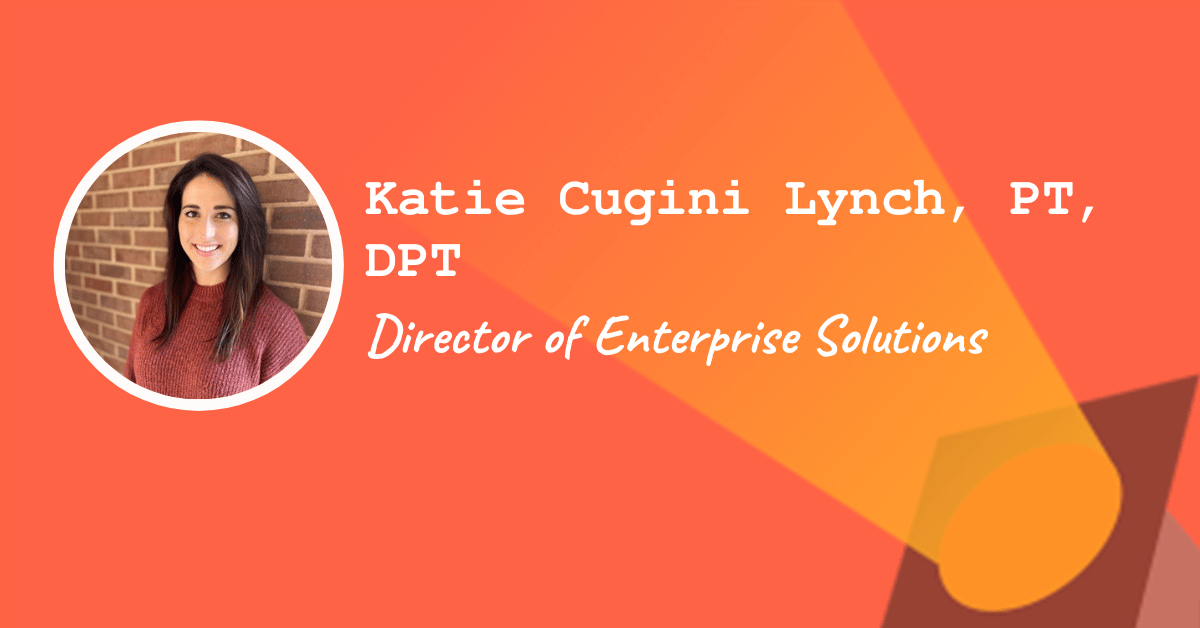
This week’s spotlight is on Katie Cugini Lynch, PT, DPT, a non-clinical physical therapist who is now Director of Enterprise Solutions for Kinetisense!
This post may contain affiliate links or codes. This won’t increase your cost, but it helps keep TNCPT alive, and free of annoying ads! Thank you for your support. 🙂
What is your full name, title, and company name for your current, primary role?
Katie Cugini Lynch, PT, DPT — Director of Enterprise Solutions for Kinetisense

Where are you located?
Denver, CO.
Where did you go to PT school, and what year did you graduate?
Angelo State University, 2015.
Please refrain from contacting our spotlight participants on social media. There are thousands of readers just like you out there. 🙂 Please ask your questions in the comments on this blog post.
If you’re a Non-Clinical 101 student or Go Non-Clinical member, you can network with many of our spotlight participants in our community!
What did you do when you first finished school, and for how long?
I spent six years at a leading children’s hospital where I rotated through critical care, inpatient rehab, the NICU, and outpatient pediatrics. Along the way, I also worked PRN in adult inpatient rehab and pediatric home health, which gave me a truly full-spectrum view of rehabilitation across the lifespan.
In what settings did you work, and what types of patients did you treat?
The bulk of my clinical background is in pediatrics, specializing in Level IV NICU and inpatient rehabilitation.
What did you enjoy about your early roles? What didn’t you enjoy?
I loved rotating through the different settings at the children’s hospital; every day was unique, and I was constantly learning. Supporting parents through some of the hardest moments with their child and helping bring a sense of hope during uncertain times was incredibly meaningful. I especially loved specializing in NICU therapy, a niche area that challenged and inspired me.
Over time, though, I found the limited opportunities for upward growth, particularly financially, and the lack of flexibility to balance work and home life to be difficult. The expectation to work weekends and holidays, particularly to supplement income, was not something I wanted to continue doing long term.
What else have you done since then, prior to your current role?
Before this role, I spent five years with Bioness, a medtech company focused on neuromodulation and robotic rehab solutions, where I worked as both a Clinical Specialist and Area Sales Manager.
When and why did you decide to do something non-clinical?
As I began seeking more autonomy and opportunities to broaden my skill set, a close friend reached out about an open Clinical Specialist role at her company.
Trusting my intuition, I took the leap, and I’ve been on that path ever since.
What are you doing these days?
These days, I serve as Director of Enterprise Solutions at Kinetisense, where I work with health systems, rehabilitation networks, universities, sports performance organizations, and corporate wellness groups to bring AI-powered 3D motion analysis into everyday practice.
My role sits at the intersection of clinical reasoning, technology, and business. I work with clinicians, executives, and operational leaders to figure out how objective movement data can improve outcomes, create consistency across providers, and support smarter decision-making.
One of the things I enjoy most is helping organizations move beyond subjective assessment. Clinicians are incredibly good at identifying movement dysfunction, but we’ve historically had limited ways to quantify it. Kinetisense helps turn movement into something measurable, trackable, and easier to communicate.
Are you still treating patients, or are you solely non-clinical?
I am solely non-clinical.
How long have you been in your current Director of Enterprise Solutions role?
I started my current role in August of 2025
Did you get any special certifications or training along the way to help you get into your current role?
No formal certifications, just leveraging connections and continuous learning in the field.
How did you find your job? Did you apply or find it through a connection?
All of my non-clinical roles have come through connection.
What was the interview like for the Director of Enterprise Solutions role?
The interview process included meetings with the CRO, a sales team panel, interviews with the CEO, the CFO, and a final second interview with the CRO.
How have people reacted to you leaving patient care?
I’ve been fortunate to have a really supportive network. Every transition I’ve made outside of direct patient care has been motivated by what’s best for my family, both financially and in terms of flexibility and autonomy. Friends and family have always understood and supported that.
Occasionally, you’ll run into clinicians who are surprised or even skeptical when someone steps away from patient care. I’ve learned that it usually comes from a place of passion for the profession or uncertainty about their own next step. I try to meet that with empathy and acknowledge that clinical work is incredibly meaningful.
I keep it light and just say something along the lines of, ‘I totally get it! I loved patient care too. I just found another way to make an impact that fits my life a little better right now.’
What’s a typical day or week in the life like for you? What types of tasks and responsibilities fill your time?
My role with Kinetisense is fully remote, which is a big shift from my last role and a huge blessing. Most weeks are a mix of leading discovery and demo calls, working with multi-site groups on solution design and implementation, and managing outbound outreach and account development.
What are some of the rewards of your Director of Enterprise Solutions role? What are the biggest challenges?
Rewards: I love that what we’re doing is truly a paradigm shift; bringing objective, data-driven technology to a space that’s been largely subjective for decades is exciting. I love getting to be part of something that’s not just innovative but genuinely impactful for clinicians and patients. The autonomy, creativity, and variety keep me constantly learning.
Challenges: Managing the mental load of sales, staying resilient through long healthcare sales cycles, and maintaining momentum when results take time.
But when a group “gets it” and you see the lightbulb moment, it’s worth every bit of effort.
How did your clinical background prepare you for this role? Which skills transferred?
Therapists make great salespeople as we’ve been selling movement, motivation, and mindset changes our whole careers. We engage, build trust, and consult with people every day. The same empathy, active listening, and problem-solving we use to guide patients through their goals are similar traits that help us understand customer needs and craft meaningful solutions.
Ready to launch your own non-clinical career?
Plus, you’ll get early access to curated non-clinical job listings and lifetime access to the Go Non-Clinical community!
Roughly speaking, how are the hours and pay compared to patient care?
The pay is generally stronger outside the clinic, with a much higher ceiling for growth and performance-based income. It’s been refreshing to see hard work directly tied to opportunity and reward. I work from home, so my hours are generally very reasonable.
That said, sales does come with a unique mental load. You’re often thinking about deals, clients, or follow-ups outside of traditional hours. It’s part of the territory, but I’ve learned to manage it in a healthy way.
What type of person do you think would do well in your Director of Enterprise Solutions role?
Being coachable and adaptable really go a long way in this kind of role. Things change fast, and you can’t get too hung up on losses. You just learn, adjust, and keep going. It also takes someone who’s naturally self-motivated and hungry to grow, because you have to stay disciplined about hitting your goals.
Do you work remotely or onsite?
Remotely.
Does your organization hire PT, OT, or SLP professionals into non-clinical roles? If so, what type of roles?
Absolutely. Our founder and CEO is a chiropractor himself, which gives Kinetisense a unique foundation, a true blend of clinical expertise and forward-thinking innovation.
Did you read any books, take any courses, or do anything special overall to get you where you are today?
I loved reading “Never Split the Difference” by Chris Voss, and I’m currently reading “Difficult Conversations: How to Discuss What Matters Most” by Douglas Stone, Bruce Patton, and Sheila Heen.
What is a typical career path for someone in your Director of Enterprise Solutions role?
A very common and practical path for clinicians transitioning out of direct patient care is to start in a Clinical Specialist role. That’s the route I took, and it really helped bridge the gap. I still had patient interaction and worked closely with therapy teams, but I was also learning sales processes, business operations, marketing, and customer success.
It’s a great stepping stone because it lets you stay connected to clinical work while building the foundational skills needed for the business side of healthcare. From there, you can see where your strengths and interests naturally pull you, whether that’s sales, operations, marketing, education, or customer success.
What is next for you? What are your high-level career aspirations?
Right now, I’m in a really good place. I’m continuing to learn, grow, and be challenged in my current role, while also enjoying a level of stability that’s been great for my family, especially after coming from a position that required extensive travel. My focus is on mastering this role, continuing to make an impact, and positioning myself for long-term growth within the organization.
What would you recommend to someone who is considering going into a role like yours? Do you have any special words of wisdom for the readers?
Grow your LinkedIn network, connect with others who’ve taken non-clinical paths, and follow The Non-Clinical PT. It’s an incredible resource. Keep an open mind and pay attention to the companies, products, and technologies you already interact with in your clinical role, you never know where the right opportunity will come from.
Most importantly, remember that leaving patient care doesn’t mean leaving your impact behind. Some of the most meaningful opportunities in healthcare happen outside the treatment room. Your clinical experience is far more transferable than you think, and your PT degree can open doors you may not even realize exist while you’re in the clinic.
