
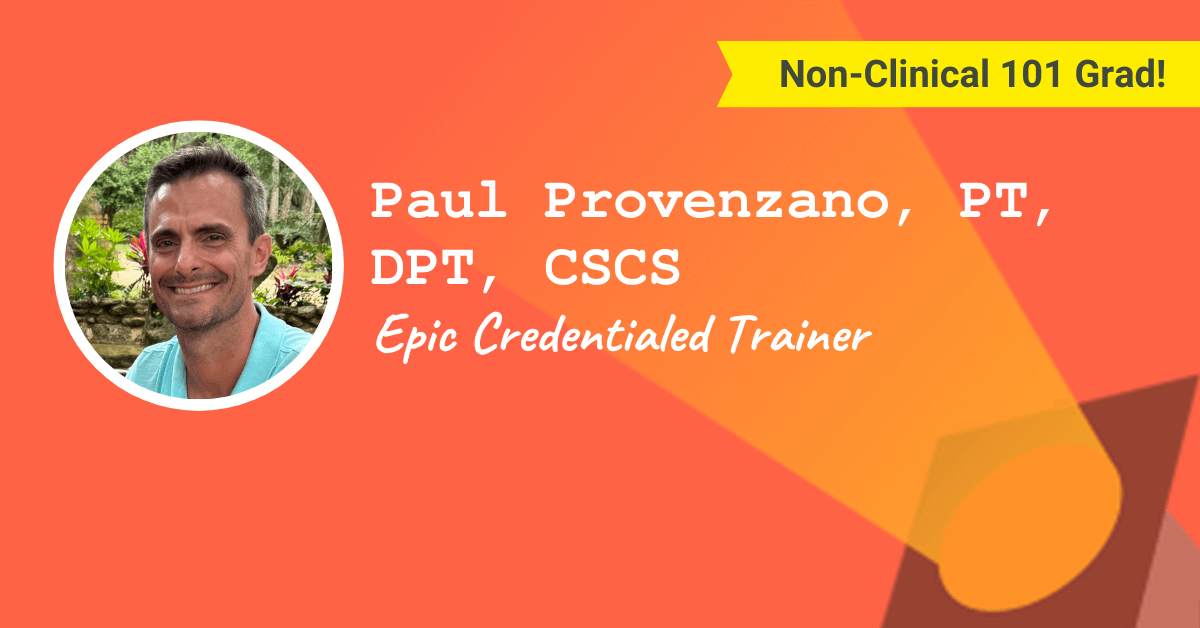


This week’s spotlight is on Paul Provenzano, PT, DPT, CSCS, a non-clinical physical therapist who is now
Epic Credentialed Trainer for Baptist Health!
This post may contain affiliate links or codes. This won’t increase your cost, but it helps keep TNCPT alive, and free of annoying ads! Thank you for your support. 🙂
What is your full name, title, and company name for your current, primary role?
Paul Provenzano, PT, DPT, CSCS – Epic Credentialed Trainer for Baptist Health
Where are you located?
Jacksonville, Florida (Duuuuuval County)
Where did you go to PT/OT/SLP/A school, and what year did you graduate?
University of North Florida, Jacksonville, Florida – 2015
What did you do when you first finished school, and for how long?
I turned my last clinical rotation into a full-time position with Baptist Health here in Jacksonville. I worked as a full-time therapist in the outpatient clinic for over 10 years.
In what setting(s) did you work, and what types of patients did you treat?
I was in the same setting the entire time, in a hospital-based outpatient setting. Patient population was mostly adult geriatric population with higher levels of complexity.Treating a wide range of neurological patients as well as nonspecific orthopedic conditions. My favorite patients were my Parkinson’s patients and the older patients with balance deficits; they were the most fun to work with!
What did you enjoy about your early roles? What didn’t you enjoy?
I enjoyed the learning that came with being a new clinician; I also enjoyed helping people, seeing them improve and the progress that they made. I didn’t like the inflexible schedule and rigid work structure that led to working in silos.
I feel like the rehab profession as a whole can offer a lot to the health system if given the opportunity to collaborate and intervene at different points in a patient’s care journey.
What else have you done since then, prior to your current role?
Became an Epic Credentialed Trainer for the rehab department during our company’s EMR transition from Cerner to Epic in 2022.
When and why did you decide to do something non-clinical?
Simply put, I needed change. I needed variety in my job. I needed a more flexible schedule and ultimately just needed something that was a better fit for me and my non-negotiables in a satisfying career.
What are you doing these days?
I am a full-time Epic Credentialed Trainer currently. I have expanded my credentialing to include training nursing staff, other hospital providers, as well as continuing to train my rehab family!
Are you still treating patients, or are you solely non-clinical?
I am solely non-clinical…for now.
How long have you been in your current role?
I started my current role in October 2025.

What do you wish you would’ve known before going into this role?
I wish I would have had some formal teaching/instructing and public speaking training. But, 10 years teaching, educating, and speaking in front of patients day in and day out has served me well.
Did you get any special certifications or training along the way to help you get into your current role?
I took the opportunity to get Epic Credentialed when my company was looking for volunteers to go through the credentialing process. Non-Clinical 101 was another big help in figuring out which career tracks would be a good fit for me.
How did you find your job? Did you apply or find it through a connection?
Both. I saw the job posted and contacted the hiring manager who was a connection. After a quick conversation with her, it became clear that I should apply for the position.
Did you do anything special to your resume and cover letter to land the job?
I used the direction from Non-Clinical 101, used the job description, leveraged AI, and put a personal touch on it to highlight my skills and unique experience to show how I’d be a good fit for the role.
What was the interview like for the role?
It entailed a presentation and group interview, totally virtual. The stressful part was the recruiter mentioned the presentation part less than 36 hours prior to the interview. It was a scramble to get something together so fast! The Non-Clinical 101 guidebook had excellent questions that prepped me well, both in questions I asked of them and being prepared to field their questions.
What are some of the things you did to stand out, take initiative, and advance in your career?
Said ‘yes’ to opportunities when they presented themselves. Tried to create opportunities when possible.
How have people reacted to you leaving patient care?
A few sideways looks, but otherwise totally positive and excited for me. I’ve had a number of people reach out to me on the side asking advice on how to make a change like this, and as a result, I’m trying to pay it forward!
What’s a typical day or week in the life like for you? What types of tasks and responsibilities fill your time?
Right now, because I’m fairly new, it’s a nice mix of learning new classes, studying/practicing to get credentialed in other Epic applications, and leading training classes for newly hired employees.
What are some of the rewards of your role? What are the biggest challenges?
Rewards are helping clinicians learn how to use technology to streamline their workflows and teach them efficiencies that help ease the burden of documentation. Also, it’s very rewarding to be able to stay on the front end of new technologies as they develop and help roll these initiatives out to clinicians. The biggest challenge right now is keeping up with all of the changes!
How did your clinical background prepare you for this role? Which skills transferred?
Being clinical and working in a hospital system helps me speak the language to other clinicians I’m training. Knowing the pain points of documenting patient care helps me connect with my learners and offer them ways to make their job easier. The communication and teaching skills I developed in patient care have proven invaluable as well.
Roughly speaking, how are the hours and pay compared to patient care?
The pay and hours are about equivalent, but there is way more flexibility in my schedule, which at this point in my life is huge.
What type of person do you think would do well in your role?
Being comfortable talking in front of groups of up to 20 people. Having an ability to not only communicate well, but to be able to articulate concepts and workflows in a concise, clear, and understandable manner. Foundational to that would be to have a knack for understanding how things work, not just being able to memorize things. You must also like to continuously learn, be adaptable, enjoy variety, and be detail-oriented.
Do you work remotely or onsite?
Hybrid, averaging about 30-40% work from home.
Does your organization hire PT, OT, or SLP professionals into non-clinical roles? If so, what type of roles?
It’s a small number, but we hire some in the analytics, training, and informatics fields.
Did you read any books, take any courses, or do anything special overall to get you where you are today?
Aside from Non-Clinical 101, several books I’d recommend:
What is a typical career path for someone in your role?
I feel like everyone I work with now started by getting credentialed as an Epic Trainer or getting some sort of Epic certification. My company needed people to fill those roles when we switched to Epic and most have evolved since we implemented the system.
What is next for you? What are your high-level career aspirations?
I want to grow in this role and learn how to use technology to develop, build, and publish digital educational content.
What would you like to change most in your profession, and why? How would you propose doing so?
What I would like to change most in the rehab profession is the incentive structure.
Our value as rehab professionals would fit better in a wellness model of care; however, our medical model is more geared towards a sickness model of care and our hard work and skills are not properly rewarded.
This leads to unsustainable productivity demands as well as monotony in the workplace and ultimately burnout.
What career advice would you give yourself that you wish you had during school?
Get comfortable at networking. It is something I wish I would have done more of and been more comfortable doing during my career. While I did work at it a little bit, looking back there are many more opportunities I missed.
Also, I would tell myself to be patient when trying to make a career pivot. It oftentimes feels like you are going nowhere, but in reality, it is all about trial and error. Making small iterations and learning from them, gathering information along the way until you find success.

