
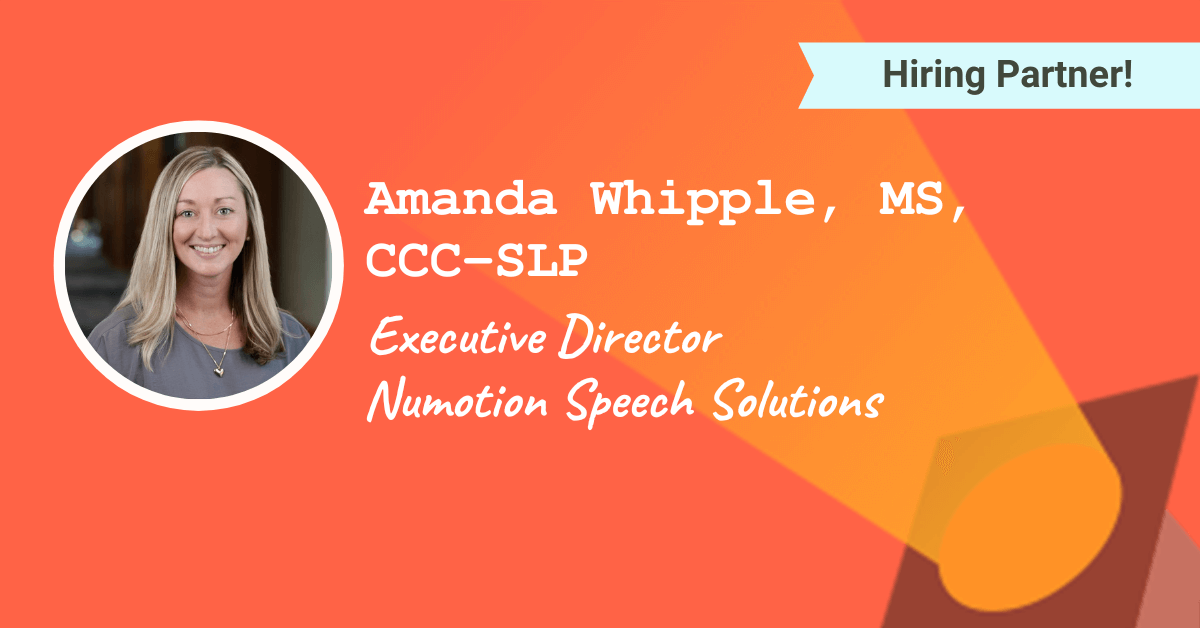


This week’s spotlight is on Amanda Whipple, M.S. CCC-SLP, who is now an Executive Director for Numotion Speech Solutions!
This post may contain affiliate links or codes. This won’t increase your cost, but it helps keep TNCPT alive, and free of annoying ads! Thank you for your support. 🙂
What is your full name, title, and company name for your current, primary role?
Amanda Whipple, M.S. CCC-SLP — Executive Director, Numotion Speech Solutions

Where are you located?
Rochester, NY
Where did you go to SLP school, and what year did you graduate?
Nazareth College, Rochester, NY, 2009
Please refrain from contacting our spotlight participants on social media. There are thousands of readers just like you out there. 🙂 Please ask your questions in the comments on this blog post.
If you’re a Non-Clinical 101 student or Go Non-Clinical member, you can network with many of our spotlight participants in our community!
What did you do when you first finished school, and for how long?
I worked in a variety of settings providing a variety of speech therapy services, including AAC, for eight years.
A co-worker of mine and I also started our own consulting business centered around AAC. This was around the time that AAC apps became available and SLPs were trying to get up to speed on the best software for clients, not knowing where to start. We met with various groups around the state of NY and trained them on the features of the software so they could make the best decisions for their clients. We also focused on functional use, implementation, and editing/customization of apps.
In what setting(s) did you work, and what types of patients did you treat?
I worked in schools, outpatient rehab, early intervention, and preschool.
What did you enjoy about your early roles? What didn’t you enjoy?
I enjoyed developing a wide range of clinical skills and being able to practice in and observe a variety of settings. It gave me a broad sense of the types of facilities I could work in and clients I could treat.
In my last role in EI and Preschool, I ended up feeling burnt out, trying to stack my schedule and live out of my car. I always had a car full of games and toys and felt like I had to have endless energy to serve my clients every day. I enjoyed the direct client contact, but ultimately feel like I put so much into it that I was spent when I would come home every day. When I began having my own kids, this became really difficult to balance.
What else have you done since then, prior to your current executive director role?
I came into Numotion when it was a much smaller, local company, as an AAC Specialist for Central NY. Essentially, I was the sales rep for that territory. I would go out and meet with SLPs within my territory and educate them on the process of obtaining speech devices for their clients, allow them to trial devices, help train them and their clients, and provide ongoing support for care teams.
I was in this role for two years prior to shifting into a leadership role. Our small DME company was acquired by Numotion in 2020.
When and why did you decide to do something non-clinical?
I was home on maternity leave and was having difficulty mentally making the shift to going back to work in EI and Preschool, given my previous mention of feeling burnt out. I happened upon the posting for the AAC Specialist/sales rep role, and the job description sounded like something I was really interested in.
I was really hung up on the title of the job and the fact that there were sales-based responsibilities because I had no sales experience. My husband gave me the push to at least apply, so I did. This was the turning point for me. Once I learned more and got the role, I was hooked.
What are you doing these days?
Today I am the executive director of our Numotion Speech Solutions division within Numotion. I am lucky enough to build relationships with dozens of manufacturers and companies in the AAC space that supply speech devices, accessories, and mounts. We get to collaborate on partnerships that allow us to serve clients with communication impairments nationwide.
I have a wonderful team that is mission-driven and that continues to set the bar higher and higher as it relates to continuity of care and client-centered treatment. This team truly knows what it takes to support complex users and help teams feel empowered to implement and provide ongoing support.

Are you still treating patients, or are you solely non-clinical?
Solely non-clinical.
How long have you been in your current executive director role?
I came into the leadership role here during the summer of 2018.
What do you wish you would’ve known before going into this role?
There is a lot that I wish I would have known or thought to educate myself on prior to moving into this role. Basic business and finance classes would have been really helpful. Sales and marketing classes and foundational skills would also be on my list.
Did you get any special certifications or training along the way to help you get into your current role?
I did not. I have relied heavily on mentors within the company that have been industry leaders for decades. I listened a lot. I learned as much as I could through others and have tried to independently learn and fill the gaps that I know I still lack expertise in.
How did you find your job? Did you apply or find it through a connection?
The job posting for my initial role came through my email. I had previously worked with the company as an SLP recommending speech devices for my clients, so I was on their email list.
Did you do anything special to your resume and cover letter to land the job?
When I applied to the position, I got a call from the hiring manager. He let me know that they were in their final interview stages with other candidates and the posting was actually closed. I remember feeling very nonchalant about it, and saying something to the effect of, “Let me just send over my resume and some information about myself and you can let me know if it seems like I might be a good fit or not.”
I was not trying to disrupt the process, but I figured it couldn’t hurt. They ended up calling me for an interview, very quick turnaround given the stage of the interview process. I think that having my small consulting business helped give me an edge over some candidates, if I had to guess.
What was the interview like for the role?
There were two interviews. The first was with the hiring manager, coordinator of the division, and another leader in the branch location, as well as another sales rep from the team. The questions were centered around my clinical experience, AAC knowledge, and my personality and relational skills. I felt the interview went well and that at the very least, I had presented myself authentically.
I got a call back for a second interview, this time to do a sales pitch (the pitch had nothing to do with the industry I was walking into). This was really outside of my comfort zone, of course. I got through the pitch and then it was time for questions. The owner of the company was also in on this second interview.
The group asked me what concerns or questions I might have, and I mentioned having a lack of experience in sales and being unsure of how my clinical skills would transfer. The hiring manager looked at me and said, “You are more of a sales person than you think.”
At that moment, I began to reflect on what sales in this particular role would mean, and began to connect with what he said. Sales in this role equals strong relationships built on trust. If those were established, the numbers would follow. This holds true to this day, and is something I have never wavered on.
What are some of the things you did to stand out, take initiative, and advance in your career?
The position that I am in has no precedent set in our company. I have been able to pave the road for the division as it has evolved to support what is best for success. Not being afraid of the unknown and always staying in tune with your people and the health of your business is very important. Being able to justify business needs based on data and fact have been important to the ongoing growth of the division.
How have people reacted to you leaving patient care?
I had some families that I worked with that were really sad to see me leave direct care. I had peers and professionals pushing me while I was in direct care roles to extend my skills beyond what I was doing. I always felt too busy to move beyond the day to day.
I have had peers reaching out since I left the clinical role to ask how I made the shift, how I found the role, and what I think about what I am doing now. I love answering these questions.
What’s a typical day or week in the life like for you? What types of tasks and responsibilities fill your time?
My days are currently filled with strategizing for growth and support for our team as we continue to expand. We now have directors that oversee the sales team and the order process, and I spend a good deal of time collaborating with them on needs of the business to drive success.
I also work on various projects that will be required to support the growing business related to inventory, CRM, IT enhancements, marketing, etc. I meet regularly with our partners to ensure our relationships are strong and running smoothly. I also meet with our internal teams nationwide to educate and empower them to share our team as a resource to those they serve with mobility-related needs.
What are some of the rewards of your role? What are the biggest challenges?
This role is really a dream come true. Rewards for me come twofold: through providing voices to those who otherwise wouldn’t have them, and in building a team culture deeply rooted in the mission of helping others.
It is a beautiful thing to see teams who truly believe in making a difference, and then to have feedback from customers in the field on how impactful and instrumental their Numotion rep was in creating quality of life for them.
How did your clinical background prepare you for this executive director role? Which skills transferred?
My clinical background has shaped what this division has become. I learned a lot by being a clinician trying to navigate the AAC/SGD funding process, primarily around the challenges that come with it. I have been able to mold our offerings and processes to support SLPs in a very different way than what I experienced in the field.
Any clinician also knows there is a need for empathy, compassion, and active listening. These skills have been instrumental as we continue to grow. Listening to the team, the SLPs, and the customers has helped me to make decisions led by the needs expressed by others.
Listening to others helps us see so much more than we can see ourselves.
What type of person do you think would do well in your executive director role?
This role requires having your head on a swivel. There are industry changes, funding challenges, partner relations to manage, strategic growth to plan for, team dynamics and evolvement, business insights to track, and the list goes on. It requires staying focused on the end goal while juggling many priorities to ensure success.
Do you work remotely or onsite?
I work remotely but have a branch location close by and try to be there at least once a week to see some of our local team members.
Does your organization hire PT, OT, or SLP professionals into non-clinical roles? If so, what type of roles?
Yes, our organization hires all of the above. We have many roles related to mobility (wheelchairs), retail, medical supply, workers’ comp, and speech devices. Within these various categories, there are roles from technicians to customer care to ATP to leadership. There are so many options and there is always room for growth.
Did you read any books, take any courses, or do anything special overall to get you where you are today?
Most of my tidbits along the way have come from podcasts while traveling, generally related to leadership. I enjoy the books of Patrick Lencioni and Simon Sinek as well.
What is a typical career path for someone in your executive director role?
While there is no set career path for my position specifically (since it is specific to our division), the general path for leadership within the company is Director, Executive Director, VP, Executive VP, Chief Officer.
What is next for you? What are your high-level career aspirations?
I hope to be able to continue to serve the division and support the growth and will evolve in my role as needed to do so.
What would you recommend to someone who is considering going into a role like yours? Do you have any special words of wisdom for the readers?
Become comfortable being uncomfortable. The growth opportunities while being in this state are really endless. Take the plunge, make the jump, go for it!
What would you like to change most in your profession, and why? How would you propose doing so?
The stigma of challenge and complexity related to helping clients obtain speech devices, especially those with complex access. Our goal is to educate and empower SLPs to take this on full speed ahead. Our team supports SLPs in tackling this process and is doing everything we can to help create efficiencies and ease the burden. Ultimately, this means so many more voices for so many more clients in need.
What career advice would you give yourself that you wish you had during school?
Take basic business, marketing, and finance classes. Get a foundational understanding of each of these areas and begin learning how they apply to what you are doing.
What would you teach to today’s graduate students in your profession, if you had the opportunity?
There are so many career options out there. Explore them all, find your niche.
As it relates to AAC, find a resource in your community and latch on. Make that your person, whether it is a vendor rep, professor, or clinical guru, try to learn as much as you can so that you can become an equally valuable resource. This field needs you.
Do you have any special advice for others who want to follow in your footsteps?
Hit every challenge head-on, rise to the occasion, serve and support the people and the mission that life has handed you.
