
Published:

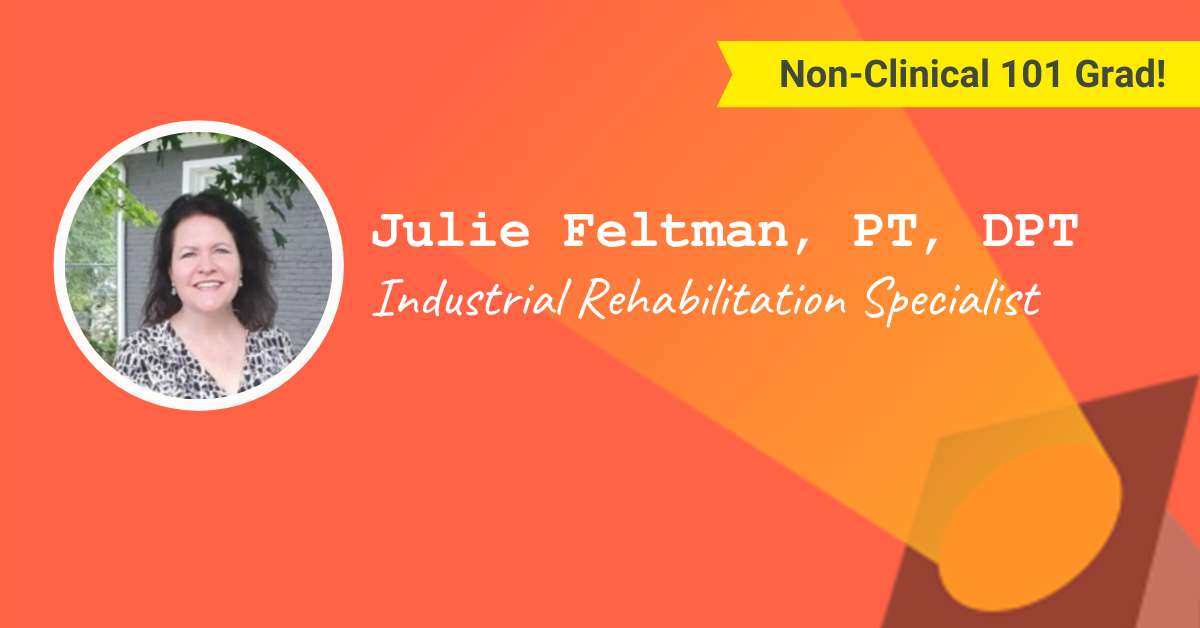
This week’s spotlight is on Julie Feltman, PT, DPT, a Non-Clinical 101 graduate and non-clinical physical therapist who is now Industrial Rehabilitation Specialist for REHAB AT WORK!
This post may contain affiliate links or codes. This won’t increase your cost, but it helps keep TNCPT alive, and free of annoying ads! Thank you for your support. 🙂
What is your full name, title, and company name for your current, primary role?
Julie Feltman, PT, DPT — Industrial Rehabilitation Specialist for REHAB AT WORK
What additional roles do you currently have?
I have an LLC consulting practice where I have provided ergonomics consulting as well as expert witness testimony and consultation for Centers for Medicare and Medicaid.
Where are you located?
Arlington, Virginia
Where did you go to PT school, and what year did you graduate?
Winston-Salem State University, class of 1999, and DPT from Shenandoah University in 2010.
What did you do when you first finished school, and for how long?
I worked for a large regional medical system including a 900-bed hospital for about four years.
In what setting(s) did you work, and what types of patients did you treat?
I worked with patients in orthopedic, neuro, and medical-surgical, working for several-month rotations in all inpatient and rehabilitation areas. After the first two years, an opportunity became available for on-site consulting with companies on ergonomics, providing training, as well as marketing and writing proposals for the services, representing the medical system.
Along with this role, I performed Functional Capacity Evaluations for injured workers to direct rehabilitation or job placement and return to work.
What did you enjoy about your early roles? What didn’t you enjoy?
I loved the teamwork involved in the hospital, collaboration with other therapists and disciplines, drawing from their experience, learning and gaining advice on treating the patients.
What I didn’t love was that we always seemed stretched too thin on manpower to cover our caseload, and it was a stressful environment trying to deliver the best care while also functioning with constant change in healthcare in general and in the health system where I worked.
What else have you done since then, prior to your current role?
I have worked in outpatient therapy, senior living, home health, and served as an adjunct faculty member for a DPT program helping to instruct laboratory coursework.
When and why did you decide to do something non-clinical?
Ever since I served in my first role as a PT specializing in ergonomics and industrial rehabilitation, I knew this was my first love. I enjoyed learning all I could about work environments to prevent injuries. This led me to home health and senior living as I wanted the opportunity to make nursing staff and patients safer during mobility and providing caregiver education.
What are you doing these days?
At REHAB AT WORK, I primarily do Functional Capacity Evaluations to either guide clients and their physicians in determining if they can meet their full-duty work requirements, or to further the client in participating in a Work Hardening Program to lead them to that return-to-work goal by addressing remaining deficits after therapy was completed.
In this role, I often collaborate with the Work Hardening Coordinator daily, as well as Case Managers, Workers’ Compensation Adjusters, and Vocational Rehabilitation Counselors if applicable.
I have provided on-site services including evaluating injured workers’ pre-injury positions to make recommendations for a safe return to work, or to assess the work site if accommodations for the worker were offered.
Are you still treating patients, or are you solely non-clinical?
I evaluate and treat Physical Therapy clients at our practice in the areas of orthopedic rehabilitation of injured workers post-injury.
If you’re still treating patients, what percentage of your time is spent clinically vs. non-clinically?
20% evaluating and treating, and 80% providing FCE evaluations and Work Hardening support.
How long have you been in your current Industrial Rehabilitation Specialist role?
I started this role in September 2022, having returned to the company after having worked there from 2010 to 2014, when I left to pursue more ergonomics and home health opportunities.
What do you wish you would’ve known before going into this role?
Every day I wish for more opportunities to educate employers directly on trends I have seen driving their injury claims, as our system seems to focus on reacting rather than proactively anticipating injuries.
Did you get any special certifications or training along the way to help you get into your current role?
I have received training in Functional Capacity Evaluations, both from my employer and the Ergoscience Physical Work Performance Evaluation. I have certifications in general ergonomics, CEAS, and Advanced Office Ergonomics Specialist from the Back School, as well as the Certified Ergonomic Evaluation Specialist course from Matheson.
How did you find your job? Did you apply or find it through a connection?
I was working as a clinician in an outpatient practice and asked an adjuster for one of my clients where they sent clients for work hardening and FCEs.
When they told me, I literally called the clinic and inquired if they were hiring.
If you advanced through a company to get to where you are, what are some of the things you did to stand out, take initiative, and advance in your career?
I have taken initiative to receive additional training in ergonomics to provide on-site services, as well as worked with management to identify potential clients for our services, including additional service lines to offer.
If you’re a business owner, when did you start your business?
I started my LLC in 2018.
How have people reacted to you leaving patient care?
At my practice, we have a good balance of clinical and industrial work, with members of our team gravitating to what they love best, with positive results.
What’s a typical day or week in the life like for you? What types of tasks and responsibilities fill your time?
While my client is filling out their history and treatment, I read through any medical records received, call case managers to align goals for the worker in returning to work, and review the job description.
Following the evaluation, I will write the report to submit recommendations and collaborate with the Work Hardening Coordinator to plan and advance clients in their programs. I retest the work hardening clients for musculoskeletal progress every two weeks, attend rounds weekly to determine functional progress in the program and if clients are meeting full-duty capability or progressing to return to alternative employment.
I will treat my physical therapy clients about two days per week to meet their goals.
What are some of the rewards of your Industrial Rehabilitation Specialist role? What are the biggest challenges?
I love helping our injured workers return to their lives. There is so much more to a work injury than just being out of work. People have lost their livelihood and often their self-esteem in how they identify themselves as a provider for their family and member of their professions.
It’s great to see the clients see positive change at the end of a very long journey.
A challenge is seeing how limitations or delays in receiving timely care have impacted clients’ cases and at times have given them a negative outlook initially.
How did your clinical background prepare you for this role? Which skills transferred?
The fact that I have worked in most areas of rehabilitation has really helped me to understand the rehabilitation that my clients have already received. I have a more thorough understanding of any impact medication or other medical diagnoses may have on their return to work or accommodation.
My ergonomics experience has helped me to problem-solve or suggest work accommodation to allow someone who otherwise may need to re-employ to adapt in their role.
Roughly speaking, how are the hours and pay compared to patient care?
The hours and pay are comparable to outpatient rehabilitation. As a consultant in my LLC, I am paid on a 1099, and I determine the hourly rate.
What type of person do you think would do well in your Industrial Rehabilitation Specialist role?
In my role, you wear a lot of hats, including PT, listener, case manager, teacher, and supervisor, so having the ability to listen with empathy, use patience, and creativity in explaining is important.
Being able to adapt to occasional unforeseen circumstances is really important, as our population is diverse and workers’ compensation experiences are so different.
Do you work remotely or onsite?
I work almost totally in a clinic location, sometimes covering other locations within the company to perform evaluations.
Does your organization hire PT, OT, or SLP professionals into non-clinical roles? If so, what type of roles?
We hire PTs and OTs to be Work Hardening Coordinators and FCE evaluators, as well as for on-site services when they are applicable.
Did you read any books, take any courses, or do anything special overall to get you where you are today?
I have continued to take CEUs, including certification from the Back School and courses from MedBridge.
What is a typical career path for someone in your Industrial Rehabilitation Specialist role?
In my industrial rehabilitation role, I have been a PT. As an ergonomist, typically professionals will have a clinical or engineering background.
What is next for you? What are your high-level career aspirations?
I would like to have the opportunity to collaborate directly with safety professionals and employers or insurance carriers to redesign job tasks or approaches to prevent injury, and to streamline the workers’ compensation claim process to get people into care appropriately to greatly reduce the likelihood of the rehabilitation process dragging on, wasting time and money.
What would you teach to today’s graduate students in your profession, if you had the opportunity?
Find opportunities to advocate for the profession’s value to ensure quality care and appropriate utilization.
Do you have any special advice for others who want to follow in your footsteps?
Don’t be afraid to take on something non-clinical.
You never know where it will lead, and you are not abandoning your hard work and training but building on that in a new role.
