
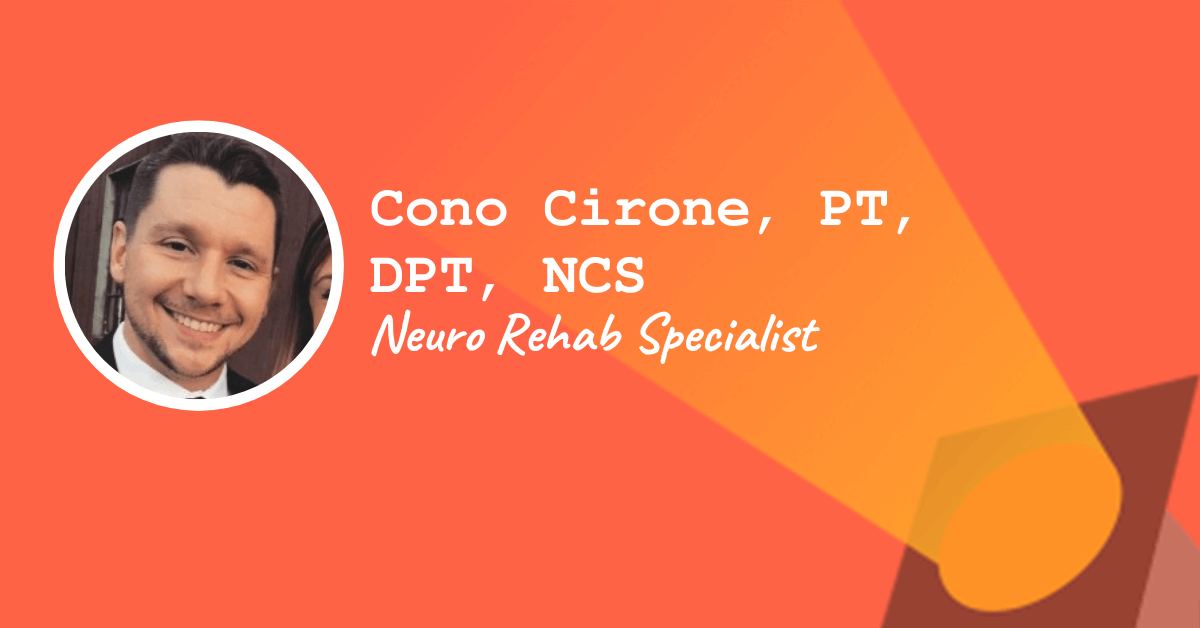


This week’s spotlight is on Cono Cirone, PT, DPT, NCS, a non-clinical physical therapist who is now Neuro Rehab Specialist for Lifeward!
This post may contain affiliate links or codes. This won’t increase your cost, but it helps keep TNCPT alive, and free of annoying ads! Thank you for your support. 🙂
What is your full name, title, and company name for your current, primary role?
Cono Cirone, PT, DPT, NCS — Neuro Rehab Specialist for Lifeward, Inc.
Where are you located?
Burnt Hills, NY.
Where did you go to PT school, and what year did you graduate?
Sage Graduate School, 2012.
Please refrain from contacting our spotlight participants on social media. There are thousands of readers just like you out there. 🙂 Please ask your questions in the comments on this blog post.
If you’re a Non-Clinical 101 student or Go Non-Clinical member, you can network with many of our spotlight participants in our community!
What did you do when you first finished school, and for how long?
My first job was on the orthopedic floor at an acute rehab or inpatient rehab facility (IRF). I worked there for six months. I eventually returned there, but more on that later.
In what setting(s) did you work, and what types of patients did you treat?
I’ve worked in many different settings including acute rehab, acute care, outpatient, and SNF. I gained experience working with a myriad of diagnoses in all areas of practice, including orthopedic, geriatric, neurological, critical care, emergency care, and cardiopulmonary, to name a few.
What did you enjoy about your early roles? What didn’t you enjoy?
I loved working at the IRF. I learned SO much from my experienced colleagues and the tight knit interdisciplinary team.
I also made an effort to seek out per diem opportunities in all different settings to expand my clinical skills and knowledge base. But I always found myself gravitating back to the IRF because of the patients I got to treat, the amount of time I got to dedicate to their care, and the learning experiences available to me.
What else have you done since then, prior to your current role?
After six months at my first job, I had an opportunity to move to Australia to pursue a rugby playing experience. However, a few months later, an injury forced me to move home. Fortunately, I was able to regain a position at the same IRF that I had just left, this time on the neurovascular floor.
I found my niche and passion here for the next 12 years of my career. My case load consisted of a mix of all neurological diagnoses, and I learned SO much. While I treated a fair number of patients with CVAs, TBIs, GBS, LE amputations, PD, and MS; my true passion became treating and advocating for patients with SCIs.
I ended up getting my NCS in 2019 and became heavily involved in developing a robust SCI program with my colleagues that included mentorship and adaptive recreation.
When and why did you decide to do something non-clinical?
During my tenure on the neuro floor at the IRF, I was fortunate enough to be exposed to a host of advanced therapeutic technologies. Those included robotic exoskeleton gait training and FES.

While I loved my colleagues and the patients I was able to help, I started to feel like I was hitting a ceiling in terms of career progress.
I achieved the highest “level” I could as a full-time PT in my particular hospital system. The only other options for career progression were moving into more supervisory and administrative positions, of which I had no interest.
Therefore, I began looking for opportunities outside of the clinical setting. Due to my experience with advanced therapeutic technologies, I naturally was looking to make a move in that direction.
What are you doing these days?
I have recently transitioned to working for Lifeward, Inc (formerly ReWalk robotics). Lifeward manufactures the ReWalk personal robotic exoskeleton and is the exclusive distributor of Myolyn’s LE FES cycle MyoCycle. ReWalk is an FDA approved and Medicare-covered device that allows individuals with an SCI to functionally ambulate and navigate stairs and curbs again.
I gravitated towards this position because it provided that upward career mobility that I was seeking while at the same time, allowed me to continue working in an area I’m passionate about: enhancing the lives of people who have sustained a neurological injury.
My current title is Neuro Rehab Specialist (NRS). My roles include:
- Educating (in-person and remotely) providers, PTs, and patients on ReWalk and MyoCycle
- Providing remote support to PTs to evaluate and assess a patient’s suitability to use a Rewalk
- Traveling to clinical sites to provide hands-on training to patients and PTs when learning how to use a ReWalk or to trial the MyoCycle
- Providing remote training to support the successful use of both devices
- Working directly with inpatient and outpatient neurological PMR and therapy teams to develop and enhance therapy programs that improved patient outcomes and quality of life
Are you still treating patients, or are you solely non-clinical?
Although I am still heavily involved in patient care, I am technically not “treating” patients. I act as a consultant to guide other practitioners to assist with POC development and integrating our devices into their therapy practice. While maintaining my clinical license is a requirement for my role; I am not billing for PT services myself.
How long have you been in your current neuro rehab specialist role?
I started working for Lifeward, Inc. in April 2025.
How did you find your job? Did you apply or find it through a connection?
When I decided that I wanted to make a change, I started reaching out to connections in my current field. Luckily, I was fortunate to have many opportunities over the years to learn about several different advanced therapeutic technologies. I used these connections to express my interest and thankfully, Lifeward ended up reaching out to me.
What are some of the things you did to stand out, take initiative, and advance in your career?
I really made a point to take every opportunity to learn about and be trained on every advanced therapeutic technology that was afforded to me. This fueled my passion for my current position but also demonstrated that I understood the technologies and their application.
How have people reacted to you leaving patient care?
Depends on who you ask. Mostly, it has been overwhelmingly positive.
I think, at first, my colleagues and peers were somewhat surprised that I was leaving the IRF because I honestly loved what I did so much. But when they learned that this new role maintained a level of patient care while also providing better work-life balance and career mobility, they knew it was a no brainer.
What’s a typical day or week in the life like for you? What types of tasks and responsibilities fill your time?
It varies, but most weeks, I travel to a clinical site for one to three days, depending on the activity needed in that territory. This could involve exoskeleton training, FES cycle trailing, educational in-services, or working directly with clinical sites on program development.
Between travel, I work from home, conducting virtual screenings, trainings, and assessments. I also continue to develop business and clinical relationships.
What are some of the rewards of your role? What are the biggest challenges?
The most rewarding part of my job, hands down, is witnessing someone stand and walk in an exoskeleton for the first time. This may sound corny, but it never fails to give me goosebumps when I see a patient’s face light up with joy the first time they stand in their device. Sustaining an SCI is such a traumatic loss. Being able to provide an experience to these individuals that resembles their life and ability “pre-injury” is unlike anything else.
I have also really enjoyed the work-life balance that working from home affords me, as well as the travel. Traveling to different clinics around the country and around my territory has been such a fun, rewarding, and educational experience.
I think the biggest challenge has been time management and organization. Switching from such a structured day in the clinic to an autonomous and fluid day has been an adjustment. The freedom to set your own schedule comes with a level of personal responsibility that you don’t experience in a clinical setting. You learn to be highly organized and plan focused in order to successfully balance your travel itinerary and workload requirements.
How did your clinical background prepare you for this role? Which skills transferred?
My previous clinical experience working with the neuro population, and specifically working with advanced therapeutic technology, gave me such a leg up when I first started. The sound clinical foundational skills I obtained while using these devices as a full-time PT was invaluable.
Beyond that, I believe that PTs have the unique balance of medical knowledge as well as interpersonal skills that ideally suits us for my specific role. You need to be able to easily transition from talking to a patient in layman’s terms about a highly complex medical device to discussing the clinical applications of said devices to other medical professionals, such as PTs and MDs.
What type of person do you think would do well in your neuro rehab specialist role?
I think that an internally motivated person that is passionate about patient care, outcomes, and quality of life is best for my role. To be successful, someone needs to be detail-oriented while also highly flexible. Plans and travel can change at a moment’s notice, so you need to be prepared for multiple conditional scenarios at a time.
Do you work remotely or onsite?
My position is fully remote, but I do have to travel to various clinical sites for patient care activities.
Did you read any books, take any courses, or do anything special overall to get you where you are today?
I have invested quite a bit of time into advancing my clinical knowledge. As I’ve mentioned before, when working as a full-time PT, I took every opportunity offered to me to attend CEUs, participate in professional development, and partake in training for advanced therapeutic technology.
I studied for and obtained my NCS in 2019, which definitely gave me a deeper fundamental knowledge of neurological conditions and which I believe helped propel my career forward.
What is a typical career path for someone in your neuro rehab specialist role?
Lifeward has always been open and encouraging to clinicians who seek continued professional growth. Clinicians in the NRS role have the opportunity to move into other areas of a growing medical device company including marketing, product development, or even executive roles.
Ready to launch your own non-clinical career?
Plus, you’ll get early access to curated non-clinical job listings and a bonus lesson on AI!
What is next for you? What are your high-level career aspirations?
That’s a hard question to answer since this role is relatively new to me. I aspired to make this transition for so long. I’m very happy and have plans to grow professionally in my current role in the long term.
While I’m open to exploring other opportunities that may arise, I don’t have a specific career trajectory in mind at the moment.
What would you teach to today’s graduate students in your profession, if you had the opportunity?
I think that new grads really benefit from early exposure to advanced therapeutic technologies. There is a growing focus in the profession on using technology to augment our treatment protocols. The earlier one can be educated on these advancements the better chance they have at implementing them in the future. This not only will improve their future clinical skills but also highlights other professional areas that PTs can progress to, which expands the scope of the PT profession.
Do you have any special advice for others who want to follow in your footsteps?
Never lose your hunger and drive to learn and grow. The worst thing that anyone can do is to stop learning and growing as a professional and as a person.

