
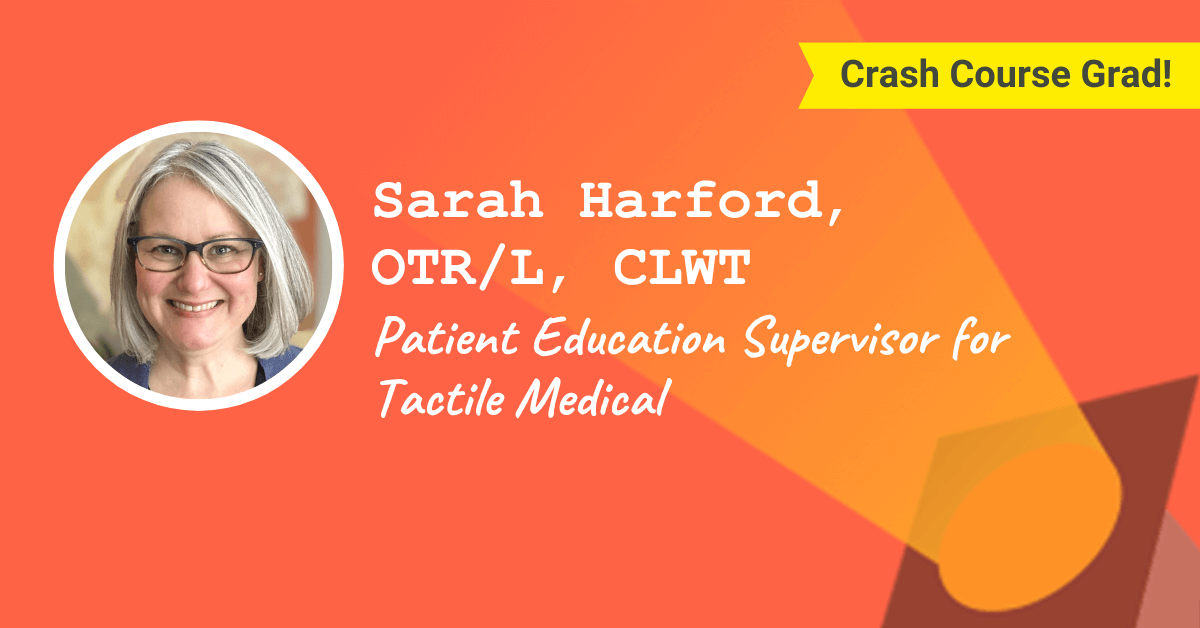


This week’s spotlight is on Sarah Harford, OTR/L, CLWT, a crash course student and non-clinical occupational therapist who is now Supervisor of Patient Education at Tactile Medical.
This post may contain affiliate links or codes. This won’t increase your cost, but it helps keep TNCPT alive, and free of annoying ads! Thank you for your support. 🙂
What is your full name, title, and company name?
Sarah Harford, OTR/L, CLWT – Supervisor of Patient Education for Tactile Medical.
Where are you located?
Hatfield, MA
Where did you go to OT school, and what year did you graduate?
Bay Path University in Longmeadow, MA – 2016
What did you do when you first finished school, and for how long?
I taught as an adjunct in the MOT program (psychosocial coursework) and undergraduate health sciences (research) at Bay Path University and continued working as a licensed massage therapist (my previous career) while studying for my board exam. My first position as a licensed occupational therapist was at a therapeutic day program for adults with acquired brain injury. I was there for a little over a year.
In what settings did you work, and what types of patients did you treat?
Community-based therapeutic day program for adults with acquired brain injury, and inpatient mental health (adult intensive unit with consulting on substance misuse and adolescent units).
What did you enjoy about your early roles? What didn’t you enjoy?
I enjoyed doing needs assessments and developing programming for arts and sensory-based interventions, as well as environmental modifications and community partnerships that supported community integration. I did not enjoy being a new grad without mentorship, and found the environments I was working in to be overstimulating and exhausting.
When and why did you decide to do something non-clinical?
I knew, even during OT school, that I wanted to pursue non-traditional roles. I realized, in my second OT role, that I was interested in exploring non-clinical opportunities because I realized clinical settings were not a good long-term fit for me.
What are you doing these days?
I am working non-clinically as a Supervisor of Patient Education for Tactile Medical. Outside of work I make art, including pottery, cyanotypes, and mixed media fiber art that I sometimes show in local gallery exhibits.
Are you still treating patients, or are you solely non-clinical?
I am solely non-clinical.
How long have you been in your current role?
Since June, 2023 and with Tactile Medical since October, 2020
Did you get any special certifications or training along the way to help you get into your current role?
I became a certified lymphedema and wound therapist. While not required for my current role, the in-depth knowledge has been helpful.

How did you find your job? Did you apply or find it through a connection?
I found the job posting on Indeed by searching for lymphedema.
Did you do anything special to your resume and cover letter to land the job?
I initially hired two different people to help me revamp my resume, then found TNCPT and purchased a package on patient training that included resume templates. The therapy-specific perspective of TNCPT was very valuable.
What are some of the things you did to stand out, take initiative, and advance in your career?
This is my third role at Tactile Medical. I started in October of 2020 as a Virtual Patient Trainer and was promoted to Team Lead just under a year later. That promotion was a combination of intentionality and timing, as the patent education department was shifting from a contractor-based model to an employee-based model post-Covid, and there was a need for team leads to develop and implement onboarding and training for new hires and to provide support as subject matter experts for the growing patient training team.
After about two years in that role, I was promoted to my current role as Supervisor of Patient Education.
In both cases, I was transparent with my managers that I was interested in growing my career at Tactile and initiated special projects to help me stand out.
I was also fortunate that the department was growing and changing and opportunities arose.
How have people reacted to you leaving patient care?
Everyone has been supportive.
What’s a typical day or week in the life like for you? What types of tasks and responsibilities fill your time?
Each day is typically a mix of administrative tasks, meetings, and focused project work.
Admin work includes responding to emails, calls, and Teams chats, managing time off requests and approving timecards, and managing patient assignments flowing to my team.
Seventeen Patient Education Consultants who work in the field with patients report directly to me, and I try to be as available to them as possible for in-the-moment needs in addition to monthly 1:1 and team meetings. In between those meetings, I perform audits and assess performance metrics to understand individual and team successes and areas of opportunity.
Our team works closely with the sales team so I meet regularly with regional sales directors to support effective collaboration and success in meeting company and department goals. I also participate in work groups that focus on strategic planning for department goal development and new hire training and development. I also conduct interviews and hire and onboard new PECs when I have openings on my team.
While my role is primarily remote, I do travel to our home office in Minneapolis 2-3 times per year, and within my New England and Upstate NY region to shadow and provide coaching to my direct reports.
What are some of the rewards of your role? What are the biggest challenges?
The biggest rewards are witnessing and hearing about the positive impact our work has on the patients we serve. I also truly love the people on my team. The supervisors I work with every day, and the many people in other departments I collaborate with are some of the kindest, smartest, and most passionate people I have ever worked with.
The biggest challenge is probably keeping up with the changes. As part of a growing company in a department that continues to evolve, I have to remain adaptable and lead my team through changes I don’t always understand or agree with.
How did your clinical background prepare you for this role? Which skills transferred?
I came to Tactile with a certification in manual lymphatic drainage and earned my full lymphedema and wound therapist certification in my second year.
Both my OT background and these specialized certifications support my understanding of our patients’ disease states, the physical and psychosocial challenges they experience, and how our pneumatic compression devices can positively impact their daily functioning and quality of life.
My clinical background makes me more empathetic, more effective in my communication and problem-solving, and a more insightful collaborator and manager.
Roughly speaking, how are the hours and pay compared to patient care?
On average, I probably work more hours in my current role, especially when traveling. My pay is higher than when I was working in patient care, but I was working in lower paying settings like mental health.
What type of person do you think would do well in your role?
This is a multifaceted role that requires leadership skills, and the ability to prioritize, set boundaries, and be adaptable. To succeed as a manager, it is important to be able to clearly communicate expectations, provide needed support (subject matter expertise), and hold people accountable.
Do you work remotely or onsite?
Remote with travel
Does your organization hire PT, OT, or SLP professionals into non-clinical roles? If so, what type of roles?
Yes, Tactile hires therapists into several non-clinical roles, including patient education consultant, supervisor of patient education, analyst, territory account manager and associate territory account manager, clinical specialist, and clinical patient support. And I’m sure there are others!
Did you read any books, take any courses, or do anything special overall to get you where you are today?
For my initial non-clinical transition, I started by listening to career transition podcasts, assessing what I enjoyed, what I was good at, and special skills from previous roles that could make me stand out. I also joined a group called Career Pivot for people working toward career transitions in the second half of life.
I hired two people to revamp my resume but did not start getting traction until I found The Non-Clinical PT and purchased a package on patient training that included resume templates. I landed my non-clinical role with Tactile Medical shortly after I started using the TNCPT version of my resume.
What is a typical career path for someone in your role?
I’m not sure there is a typical career path. There are eleven supervisors in my role with a variety of backgrounds. Some have clinical backgrounds and some have management backgrounds in other fields.
What is next for you? What are your high-level career aspirations?
I really enjoyed developing onboarding curriculum as a Team Lead and have had the opportunity to collaborate on a project with Tactile’s training and development team recently. I would love to continue developing my skills in curriculum design and adult learning principles. The creativity and collaboration in that work aligns with my strengths and pulls in my previous teaching and curriculum development experience. I am also interested in the arts in health movement that is gaining traction in the U.S.
What would you recommend to someone who is considering going into a role like yours?
Be willing to feel like you don’t know what you’re doing for a while. You got through that phase as a new therapist and will get through it in the non-clinical world too.
If you are struggling to transition, consider roles that may not be your dream job but would be a great stepping stone to something else. A smaller step to a role the hiring manager can easily envision you in may be easier to accomplish initially, and that can lead to opportunities you may not even be aware of right now.
What career advice would you give yourself that you wish you had during school?
Each day in the clinic, do your best, learn what you can, and go home. Burning yourself out will not propel your career forward, it will just make you desperate to leave.
What would you teach to today’s graduate students in your profession, if you had the opportunity?
I would teach a starting out / career exploration class that focused on setting and maintaining boundaries at work, protecting your time outside of work for healthy work/life balance, how to structure your day so you don’t end up working long hours off the clock, seeking mentorship and how to negotiate mentorship if you are the only therapist in the setting, and exploring non-traditional and non-clinical options.
Do you have any special advice for others who want to follow in your footsteps?
I strongly suggest investing time and money in career coaching with someone with a healthcare background and/or something like Non-Clinical 101. It is much more difficult to navigate alone.
