
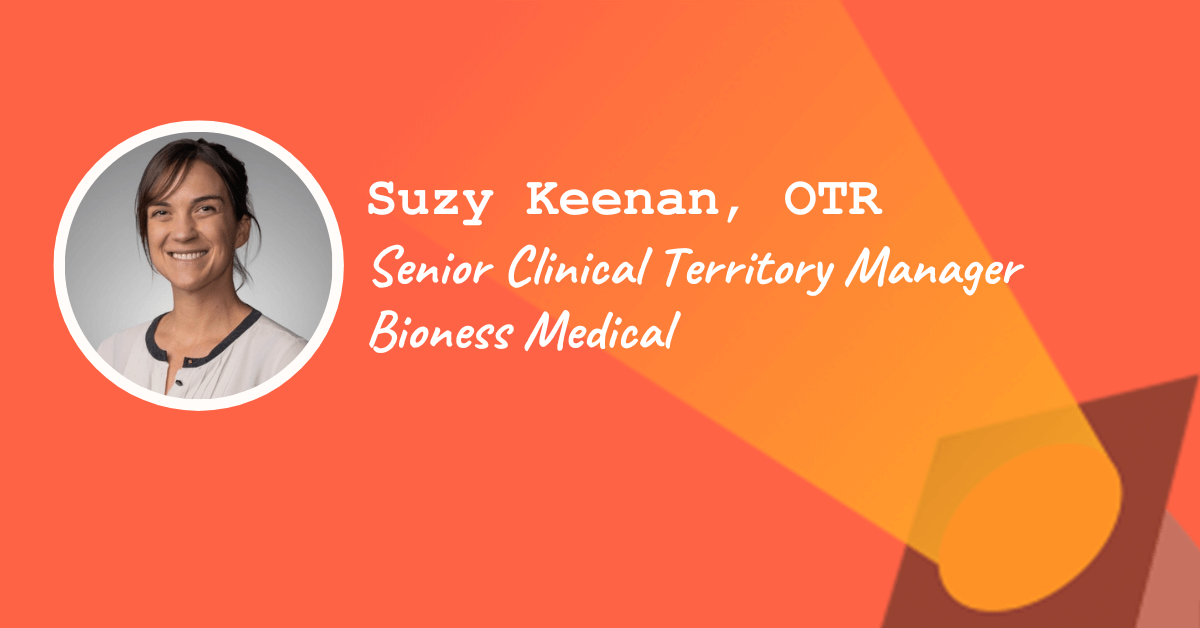


This week’s spotlight is on Suzy Keenan, OTR, a non-clinical occupational therapist who is now Senior Clinical Territory Manager for Bioness Medical!
This post may contain affiliate links or codes. This won’t increase your cost, but it helps keep TNCPT alive, and free of annoying ads! Thank you for your support. 🙂
What is your full name, title, and company name for your current, primary role?
Suzy Keenan, OTR — Senior Clinical Territory Manager for Bioness Medical

Where are you located?
New Orleans, Louisiana
Where did you go to PT/OT/SLP/A school, and what year did you graduate?
I went to LSU Health Sciences Center in New Orleans for my master’s in OT. I graduated in 2017. I completed undergrad from the University of Delaware in 2006.
Please refrain from contacting our spotlight participants on social media. There are thousands of readers just like you out there. 🙂 Please ask your questions in the comments on this blog post.
If you’re a Non-Clinical 101 student or Go Non-Clinical member, you can network with many of our spotlight participants in our community!
What did you do when you first finished school, and for how long?
OT is actually my second career. My undergrad studies were in international politics, and after graduation, I worked in international development focused primarily on West Africa. I served as a Peace Corps Volunteer in Mauritania and Mali (’07-’10).
After three years working in gender and development, I joined Peace Corps headquarters in DC for two years supporting new volunteers, and then worked for a private international development firm helping to facilitate agriculture projects in Ghana. I mostly worked on grant management and bookkeeping. I loved collaborating with people from different backgrounds, being proud of our objectives, and traveling. I eventually realized I wanted a skill that felt more tangible,, something I could use to help people in a more direct way.
OT clicked for me instantly. My dad was diagnosed with Parkinson’s around that time, and a close friend was finishing OT school. Once I started, I never looked back. OT has proved to be a perfect blend of creativity, science, problem-solving, and human connection.
In what setting(s) did you work, and what types of patients did you treat?
I started my OT career after LSU HSC working in inpatient rehab at West Jefferson Hospital, focused on brain and spinal cord injury and worked there for a little over two years. I also loved floating through outpatient and acute whenever I got the chance. Afterward, I worked at a nursing home with a specialty ALS unit. I also had the privilege of collaborating with the LSU ALS Clinic team as the OT member of their monthly clinic.
What did you enjoy about your early roles? What didn’t you enjoy?
I think inpatient rehab is an incredible place to start a career. I feel like I got to see a wide spectrum of diagnoses, work very closely on an interdisciplinary team, and start to understand what people’s recovery trajectories felt and looked like. I also loved how hands-on and active working in this setting is.
There is a grind to it though, and I wanted something that felt like it had more upward mobility and could be more dynamic.
The nursing home setting was great for me too in many ways. I felt like I was able to make a huge impact for families (especially true in the early days of Covid). Where I worked, we took the rehab side of it very seriously, delivering evidence-based, patient-focused care when we could. The challenge here was the slow progress some patients experienced, the trials of working with a population who didn’t always want to participate, and sometimes feeling like you took on a graduate degree just to teach safe transfer techniques over and over. It can be humbling but also meaningful work.
When and why did you decide to do something non-clinical?
Honestly, I feel like my non-clinical job found me. The nursing home where I worked had to evacuate after Hurricane Ida. There was no electricity in New Orleans, so the entire resident population was moved to another nursing home in the north of the state for three months. We were promised part time jobs when they returned, but nothing in the interim.
I heard about the opening at Bioness and had a ton of support when considering it from the person leaving the position and those I’d be working with. It seemed like an excellent fit for what I had done prior to OT and within OT and it offered a new challenge that aligned with what I was seeking.

What are you doing these days?
I now work as a Clinical Territory Manager for Bioness, a company focused on innovations in Neurological Rehabilitation Innovations. It’s hybrid role of sales and patient support. I cover what we call the Gulf South. It spans from Alexandria, Louisiana, to Tallahassee, Florida.
Are you still treating patients, or are you solely non-clinical?
That’s one of my favorite parts of my job! I absolutely love being an OT, and I’m grateful I still get to work hands-on with patients every day. My main job responsibility is helping people access functional e-stim (FES) technology for home use – allowing them to use their own muscles (after an upper motor neuron injury) to walk or open their hand instead of relying on braces or other compensations. Daily, I’m on the floor setting up the L300 or stretching tight, spastic hands… I’m making fine-tuned adjustments, listening to their stories and goals to inform their treatment and next steps.
An incredible part for me of working with technology in rehab is that progress often happens instantly — when a patient or their family sees a hand open, or a step clear, and you can see exactly what this tool could mean for their life. I make people cry all the time (in the best way). It never gets old.
What percentage of your time is spent clinically vs. non-clinically?
I would say in a perfect world, I would be 70% patient-time and 30% working on business development and admin, but right now those percentages are probably flipped. We had some issues with the insurance coverages we were getting previously in Louisiana through this past year, but we’re back to seeing approvals! So I’m hoping to see a lot more patients this coming year.
How long have you been in your current role?
I started with Bioness part time in October 2021 and became a full-time employee in January 2022. My title and territory have changed a few times since then, and I have taken on additional responsibilities, but the “meat and potatoes” of my job has stayed the same.
Did you get any special certifications or training along the way to help you get into your current role?
Honestly, no, but I jump at any learning opportunities that I can get! I think my background in business was helpful when I was applying, but the most important thing is being passionate about learning as the changes and developments are nonstop! Since starting, I’ve taken a lot of CEU courses in gait, I read a lot of books, and listen to podcasts on sales techniques to stay sharp.
How did you find your job? Did you apply or find it through a connection?
I was very lucky. I applied at a time when this position had been open for a little while, and I saw it online while evacuated from my home due to hurricane Ida. These jobs are very competitive, but sometimes your timing can be just right.
What was the interview like for the role?
There were several rounds. One with the person leaving the role for a promotion, one with the person who would become my closest counterpart, and several with the manager who would become my boss. Most were over Zoom. A lot of the discussion was more about personality fit and work style than experience with sales.
This particular position is often a person’s first job out of the clinic and into a non-clinical role.
Generally, I feel like they look for someone who is a self starter and who will be an awesome representation of our company and values (with some experience with the diagnoses of the patients we serve). The questions were more to figure out personality style and discuss what day-to-day in the job would look like and what success entails like to make sure the fit would be good on both sides.
What are some of the things you did to stand out, take initiative, and advance in your career?
My leadership team is wonderfully accessible, and our company strikes a rare balance of having the resources of a larger organization with the agility and warmth of a small one.
I’ve learned that standing out comes from showing up with ideas, stepping in to help whenever you can, and being vocal about wanting to grow. Once the leadership folks knew I was eager to take on more, I was (and am) consistently invited to participate in impactful projects.
How have people reacted to you leaving patient care?
Honestly, the biggest adjustment was my own mindset. At first, I struggled with the idea of being “a salesperson.” It felt like a dirty word. But the more I settled in, the more I realized this job is entirely about impact. In this role, I get to influence recovery outcomes on a scale I never could have reached in traditional patient care.
I’m not just helping the patients I see directly. I’m equipping entire teams of clinicians with tools and knowledge that change their patients’ lives and that they often wouldn’t have time to discover on their own. That’s not sales, that’s advocacy!
For a while, I’d catch myself saying I’m in medical technology sales but my background is OT. That’s cutting it way too short!
I am an OT, and this role expands my impact by partnering with physicians and therapists to bring advanced technology to the people who need it most.
What’s a typical week in the life like for a Clinical Territory Manager? What types of tasks and responsibilities fill your time?
There’s no such thing! And I love that. I travel mostly by car and usually spend two nights a week on the road for about 2 weeks out of each month. The rest of the time, my visits are local or within a day trip. I also help train new hires and support open territories, which can mean flying to another city for an additional few days.
When I’m in clinics, I’m hands-on with patients trialing devices, presenting information to physicians and therapy teams, dropping by doctors offices to share new research or access updates, and finding, and reaching out to potential new partners or referral sources to see how we can collaborate and support their patients.
I typically work from home one or two days a week doing follow-up, emails, order management, preparing partner education, and helping clients secure Bioness devices through insurance or other funding options. This is also when I take on special projects such as participating in R&D focus groups and educational initiatives.
What are some of the rewards of your role? What are the biggest challenges?
I love that it’s really dynamic. I feel like I get to run my own business in my territory, can grow it as much as I can, and implement my own ideas (all with support available if needed). I also have the flexibility to, for example, go to a doctor’s appointment without asking anyone in the middle of a Tuesday. So long as you get your work done well and don’t abuse any privileges, it’s easy to manage life’s other demands in a way that can be really hard when working in a clinic.
The biggest challenges are certainly the times when I’m away from home a lot. It is hard on my family and routines at home. It helps to try to focus on quality time with them when I am home. When I’m on the road, I tend to work all day and all night to give me more flexibility when at home.
And yes, there’s a quota and some months are harder than others. I never feel pressured to recommend devices that aren’t appropriate (I could never do this job if that were part of it), but I do want to reach the right patients consistently. When I fall short, it’s not about external pressure… it’s just my own internal standard for doing meaningful work and wanting to feel successful.
How did your clinical background prepare you for this role? Which skills transferred?
I use my clinical background every single day. Working alongside patients in a variety of neuro-focused settings, including individuals living with MS or recovering from stroke or SCI, has given me a meaningful perspective on the realities of neuro recovery. It reminds me that behind every device is a person navigating physical changes, uncertainty, and hope. I try to let that awareness guide how I introduce our technology and how I anticipate the barriers that may matter most to them.
I’m often discussing spasticity management, anticipating ADL or mobility challenges based on the symptoms I see, and talking through neuro recovery principles. My job is as much about being a clinical resource for our partners as it is about supporting patients directly. Recovery is complex, and having an understanding of what our patients may be working through makes a huge difference.
Roughly speaking, how are the hours and pay compared to patient care?
The hours fluctuate, some weeks it’s way more and some weeks it’s about the same or a little less than in patient care. I move around a lot so it doesn’t feel the same. I like the variety where I am not in the same hospital gym all day eating lunch at a W.O.W. while typing notes. But it can absolutely be stressful in its own different ways. I make more now than I did in the clinic, but I also think I work a lot harder, all be it differently.
What type of person do you think would do well as a Clinical Territory Manager?
I think it’s important to be very open minded and flexible, good at self starting, staying motivated, and with follow up and follow through. I see the same amount of people who are somewhat introverted be successful as those who are very outgoing, it’s about being genuine and confident. And you absolutely need to be comfortable with being ignored or told “no” and to keep at it. It’s not personal; medical professionals are busy.
Do you work remotely or onsite?
Both – I work from home when I do administrative work and in partner clinics when working with clients.
Did you read any books, take any courses, or do anything special overall to get you where you are today?
Some of my favorite books focus on sales skills and communication. I recently read Never Split the Difference by Chris Voss, and it was very helpful for communication ideas and confidence when negotiating. I love Brené Brown and Dare to Lead is a great place to start. I like to listen to a lot of self-help books on an app called Blinkist, where they condense the main points of the book into 15-minute segments. I know there are other similar apps too. It feels a little bit like cheating, but it’s great while driving!
What is a typical career path for someone in your role?
I don’t know that there is one. Everyone I work with has spent some time in the clinic, but some have gone on to have non-clinical roles before they come to us, others focused in ortho, others in neuro…
What is next for you? What are your high-level career aspirations?
My absolute favorite parts of my job are when I get to support my coworkers- either in helping to onboard a new employee or in mentoring others. I would love the opportunity for that to be my primary role responsibility, but it’s an amazing time to be at Bioness. Our company is growing and constantly changing… so while I have earmarked goals, I am excited and don’t necessarily know what options will be available! I’m also genuinely happy and remain challenged where I am, so I’m not exactly in a rush for the next thing.
What would you like to change most in your profession, and why? How would you propose doing so?
I feel like everyone answers this question the same way. I think we all want to give amazing care for the clients we get to work with (especially those patients who are giving everything they have), but we quickly find that the productivity goals, documentation, and insurance requirements get in the way or cause folks to “burn out” long before their career is near an end.
Also, Louisiana is one of only three states (currently) where Medicaid can cover FES technology, and even then it requires very specific knowledge and persistence to get approvals. It’s frustrating to watch insurance companies dictate treatment decisions despite clear evidence for newer technologies. We need a future where insurance coverage for advanced tech technologies aligns more closely with clinical recommendations from doctors and therapists.
What would you teach to today’s graduate students in your profession, if you had the opportunity?
This is a fun question because I speak to a lot of graduate programs, and beyond presenting the technology, I love talking about non-traditional OT career paths. My advice is to stay curious, be flexible, work hard, and follow your values. Opportunities appear in unexpected places.
