
Published:

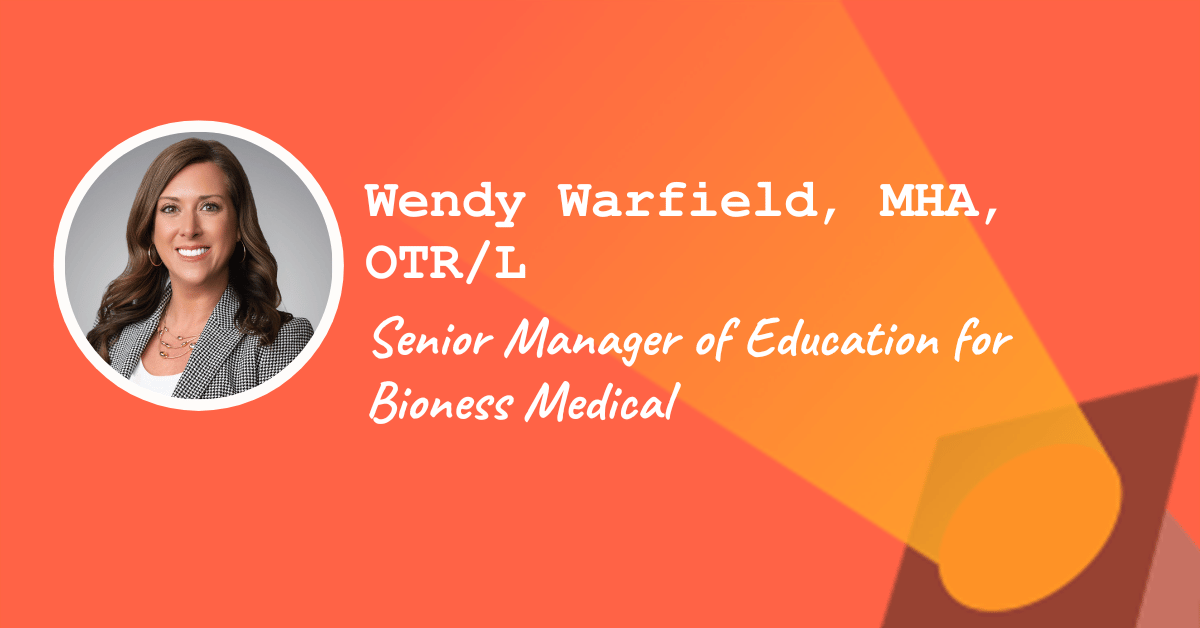
This week’s spotlight is on Wendy Warfield, MHA, OTR/L, a non-clinical occupational therapist who is now Senior Manager of Education for Bioness Medical!
This post may contain affiliate links or codes. This won’t increase your cost, but it helps keep TNCPT alive, and free of annoying ads! Thank you for your support. 🙂
What is your full name, title, and company name for your current, primary role?
Wendy Warfield, MHA, OTR/L, Senior Manager of Education at Bioness Medical

What additional roles do you currently have?
McDaniel College Advisory Board Member for Occupational Therapy Program Development, Independent Contractor at Restorative Therapies
Where are you located?
York, PA
Please refrain from contacting our spotlight participants on social media. There are thousands of readers just like you out there. 🙂 Please ask your questions in the comments on this blog post.
If you’re a Non-Clinical 101 student or Go Non-Clinical member, you can network with many of our spotlight participants in our community!
Where did you go to OT school, and what year did you graduate?
I received my Bachelor of Science in Occupational Therapy from Elizabethtown College (Elizabethtown, PA) in 2003, and my Master’s in Healthcare Administration from the University of Maryland in 2013.
What did you do when you first finished school, and for how long?
My first position as an occupational therapist was at Adventist Rehabilitation Hospital in Rockville, Maryland, where I worked in inpatient rehabilitation with a mixed neurologic and orthopedic population. It was an excellent introduction to clinical practice, as therapists were assigned to physician-led teams.
I was part of the medical director’s team, which provided the opportunity to work with a wide range of diagnoses and manage complex patient cases. I worked there for 1.5 years and then went into travel occupational therapy to further diversify my experience.
In what setting(s) did you work, and what types of patients did you treat?
Throughout my full-time roles and time as a travel contract occupational therapist, I gained experience across a wide range of clinical settings. These included inpatient rehabilitation with mixed neurologic and orthopedic populations (e.g., stroke, MS, TBI, amputations, joint replacements), inpatient brain injury on a locked unit, acute care, pediatric feeding disorders, pediatric brain injury, and both adult and pediatric outpatient spinal cord injury (intensive activity based, day treatment program).
In addition, I worked per diem in sub-acute and long-term care settings. For approximately seven years following graduation, I maintained evening and weekend per diem roles while working full time, allowing me to develop a broad and diverse clinical skill set across the full continuum of care.
What did you enjoy about your early roles? What didn’t you enjoy?
Early in my career as an occupational therapist, I really enjoyed the opportunity to work with a wide variety of patient presentations and diagnoses.It was especially exciting to discover my passion for neuro early on. Working with individuals with stroke, MS, TBI, and spinal cord injury was incredibly meaningful and helped shape my clinical focus.
What I didn’t enjoy, looking back, was the limited availability of technology at the time. When I began practicing in 2003, the field was much more focused on compensatory strategies rather than optimizing recovery potential.
It’s been incredibly rewarding to see that paradigm shift over the years toward promoting neuroplasticity, long-term health, and functional recovery. Being part of that evolution—particularly through education—has been a highlight of my career.
What else have you done since then, prior to your current role?
In addition to working for medical device companies, I have provided consulting support to startup organizations across a range of areas, including business development and regulatory strategy. I have also served as a guest lecturer at universities, with a particular focus on functional electrical stimulation, delivering both didactic education and hands-on lab experiences.
I strongly believe that advancing clinical practice begins in academia, and it is essential that educational curricula evolve alongside innovation and emerging technologies. Preparing clinicians to effectively utilize advanced technologies in neurologic rehabilitation is critical to improving patient outcomes.
This commitment has also led me to serve as an advisory board member at McDaniel College in Westminster, Maryland, where they are launching a new occupational therapy program. In this role, I contribute to curriculum development to help ensure the program reflects current best practices and supports the continued advancement of the profession.
When and why did you decide to do something non-clinical?
Following my early clinical roles, I developed a strong interest in rehabilitation technology—particularly functional electrical stimulation (FES)—during my time at the Kennedy Krieger Institute’s International Center for Spinal Cord Injury. There, I worked within an intensive activity-based restorative therapy program focused on stimulating muscles below the level of injury and promoting nervous system activation through FES to restore movement in paralyzed muscles.
During this time, I had the privilege of working under the exceptional leadership of Dr. John McDonald and Dr. Cristina Sadowsky. Dr. McDonald had previously worked closely with Christopher Reeve following his spinal cord injury, and Reeve became one of the first prominent public figures to challenge the limitations of neuro rehabilitation in the 1990s, which was largely focused on compensatory strategies.
Through his work with Christopher Reeve, Dr. McDonald played a pivotal role in shifting the paradigm of spinal cord injury rehabilitation—from a primarily compensatory approach to one centered on recovery. Along with other thought leaders, his vision and unwavering belief in the potential for recovery beyond traditional expectations were incredibly influential.
He emphasized the critical role of technologies like functional electrical stimulation (FES) in driving neuroplasticity and strongly advocated for individuals living with paralysis to have access to these tools not only in clinical settings, but also in their homes to support long-term health, recovery, and overall quality of life.
Through my own patients, I witnessed firsthand the profound impact of FES—not only in improving functional mobility and independence, but also in maintaining physical health and, perhaps most importantly, restoring a sense of hope. Seeing paralyzed muscles contract and knowing we had tools to influence recovery potential was incredibly powerful.
During this time, there was also close collaboration between Kennedy Krieger and Restorative Therapies. Engineers from Restorative Therapies would regularly work alongside clinicians at Kennedy Krieger to develop and refine new FES technologies. Being part of that creative process—watching ideas evolve into real-world solutions that improved patient outcomes—was both exciting and inspiring. That experience ultimately led me to pursue a role in industry as a clinical educator at Restorative Therapies.
Since then, I have remained deeply passionate about advancing the use of FES and all neuro rehab technologies and educating clinicians in their value. When I first entered the field, FES was significantly underutilized, but over the past 15–20 years, it has been incredible to see its rapid adoption becoming a standard of care in neuro rehab practices. I strongly believe that education is a driving force behind paradigm shifts and advancing clinical practice, which is why I’ve dedicated my career to sharing knowledge and helping clinicians integrate these technologies to improve patient outcomes worldwide.
What are you doing these days?
In my current role overseeing education at Bioness Medical, I’ve had a unique opportunity to reimagine and elevate the organization’s educational strategy. My focus has been on advancing educational offerings in more modern, accessible ways to better reach clinicians.
One key accomplishment has been the implementation of a learning management system—Bioness Academy—which serves as a centralized hub for CEU-accredited web-based courses, educational webinars, and a comprehensive library of clinical resources. The strong demand for education in both physical and occupational therapy was evident, with over 1,000 clinicians self-enrolling within the first six months of launch.
As Bioness continues to expand its neurorehabilitation product portfolio through both internal development and the acquisition of new technologies, I’ve also had the opportunity to support the scaling of the organization by building educational frameworks that keep pace with rapid innovation. A key focus is ensuring clinicians are equipped with the knowledge and skills needed to effectively integrate these technologies into practice, promoting adoption and ultimately improving patient outcomes.
I also greatly value the opportunity to collaborate with our talented internal team of clinicians across sales, education, and marketing, fostering a culture of shared learning and growth. Additionally, I enjoy partnering with key opinion leaders and experts in neurorehab, providing a platform for them to share their knowledge and contribute to the ongoing advancement of clinical practice.
Are you still treating patients, or are you solely non-clinical?
My current role is solely non-clinical, but I still have access to patients while collaborating with the Bioness medical field team during clinic training visits and other educational opportunities.
What percentage of your time is spent clinically vs. non-clinically?
My time is 100% non-clinical.
How long have you been in clinical education roles?
I’ve been in industry since 2010 and transitioned fully into non-clinical roles in 2012. I served as a Clinical Educator and then Director of Clinical Education at Restorative Therapies for 13 years, then spent a year at Medscape/WebMD as a Clinical Strategist in CME/medical education. Since April 2025, I’ve been in my current role at Bioness.
What do you wish you would’ve known before going into this role?
Honestly, there isn’t anything specific I wish I had known beforehand. My experience transitioning into this type of role has been incredibly positive. Everything about working in industry—especially with the team at Bioness Medical—has been engaging, dynamic, and aligned with my interests.
If anything, I might say I didn’t fully appreciate just how collaborative and multifaceted the role would be. The opportunity to work cross-functionally with teams across engineering, marketing, sales, and clinical education has been both exciting and rewarding. It’s a constant learning experience, which is something I really value.
Overall, I feel that my clinical background prepared me well, and the transition has reinforced that this is exactly the kind of work I’m passionate about.
Did you get any special certifications or training along the way to help you get into your current role?
I completed my Master’s in Healthcare Administration while practicing full-time as an occupational therapist, which provided valuable insight into business management and development within the healthcare setting. This knowledge has been especially beneficial in my roles within the medical device industry. During my time in clinical practice, I also completed certification in physical agent modalities, further supporting my expertise in FES and other modalities commonly used in neurorehabilitation.
However, the most impactful influence on my career has been mentorship. Learning from experienced clinicians—many of whom also held roles in industry—provided critical guidance, support, and perspective, serving as a catalyst for my professional growth.
How did you find your job? Did you apply or find it through a connection?
I became aware of the opportunity for my current role at Bioness Medical through a mutual connection within my professional network. This connection stemmed from prior collaborations and relationships with individuals in leadership at Bioness, whom I had worked with in previous roles.
Did you do anything special to your resume and cover letter to land the job?
In preparing to apply for my current role, I made significant updates to my CV to better reflect the breadth of my experience. In my previous position, I held responsibilities across multiple departments—including collaboration with engineering teams for product development, collaboration with marketing, working closely with regulatory and quality teams, supporting and training sales teams, developing educational programs, and contributing to international business initiatives. I wanted to ensure these experiences were clearly highlighted while still keeping my CV concise and well-organized.
In my cover letter, I focused on conveying my passion for neurorehabilitation technologies and the importance of educating clinicians to effectively adopt these tools to improve patient outcomes. It was important for me to communicate not only my professional experience, but also my personal mission—supporting patients in achieving better outcomes and helping clinicians enhance their practice while reducing burden. Aligning my values and passion with the company’s mission was a key part of how I presented myself as both a clinician and an individual.
What was the interview like for the Senior Manager of Education role?
The interview process at Bioness Medical was well-organized and seamless. I had the opportunity to interview with my current supervisor, the Director of HR, and connect with other members of the team. Throughout the process, I was asked to discuss my clinical practice experience, as well as my previous roles in industry and education.
A key focus of the discussion was my experience developing educational programs, particularly with an emphasis on adult learning principles. I was able to clearly articulate how I have designed and implemented educational initiatives in the past and how those experiences aligned with the needs of Bioness Medical for this role.
What are some of the things you did to stand out, take initiative, and advance in your career?
While I’ve only been in my current role at Bioness for just over a year, I can share perspective from my previous experience at Restorative Therapies, where I worked for 13 years. I began as a clinical educator and was able to grow within the organization by consistently taking initiative and seeking opportunities to collaborate beyond my core responsibilities.
I actively engaged with cross-functional teams—including R&D, marketing, sales, and regulatory—which allowed me to expand my role beyond education into areas such as product development and supporting both domestic and international sales initiatives. Being open to taking on responsibilities outside of my immediate comfort zone was a key driver of my growth and helped demonstrate initiative and value to the organization.
Over time, this led to advancement into leadership roles, first as Clinical Manager and eventually as Director of Clinical Education. I spent approximately 10 years as part of the leadership team, contributing to corporate strategy and broader organizational initiatives. This experience reinforced the importance of adaptability, collaboration, and a willingness to step into new challenges as essential components of career advancement.
I have also worked as a consultant and independent contractor. In these roles, I learned the importance of clearly communicating the value of your unique skill set and experiences. Building and maintaining strong professional relationships is critical, as it creates opportunities to connect your expertise with organizational needs. I cannot emphasize enough the importance of cultivating and sustaining a broad professional network, as it often serves as the foundation for identifying and accessing new opportunities.
How have people reacted to you leaving patient care?
I’ve often been asked whether I miss clinical practice since transitioning to a full-time role in industry. Honestly, I’ve had such a rich and fulfilling experience that I haven’t felt a sense of loss. I’ve remained closely connected to patient care in many meaningful ways—whether through supporting clinicians in developing plans of care and integrating technology, working directly with patient volunteers during CEU courses, or assisting individuals using devices in their home environments.
While I may not be the treating clinician, I’ve continued to have a direct impact on patient outcomes over the years. That connection has remained incredibly meaningful and continues to be a rewarding part of my work.
What’s a typical day or week in the life like for you? What types of tasks and responsibilities fill your time?
A typical week in my role is very dynamic and varies based on current priorities. I may be working from home collaborating with cross-functional teams, developing educational content, managing CEU accreditation processes, or partnering with industry experts to design programs such as webinars. I also spend time implementing educational tools for our internal team and contributing to initiatives like abstract submissions.
Other weeks may include attending professional conferences, presenting posters, or traveling for meetings such as our national sales meeting or providing new hire training at our headquarters. The variety in responsibilities makes the role both exciting and rewarding—there’s always something new to focus on.
What are some of the rewards of your Senior Manager of Education role? What are the biggest challenges?
One of the most rewarding aspects of my role is being able to provide resources, tools, and support to our internal teams—whether in marketing, sales, or education—to help them be as effective and efficient as possible to achieve success in their unique roles. I really enjoy the cross-functional collaboration, as it creates constant opportunities to learn and grow. It’s also incredibly fulfilling to work directly with clinicians—providing education, gathering feedback, and identifying gaps to help advance the profession. Additionally, I value the opportunity to collaborate with thought leaders and global distributors, helping expand access to neurorehabilitation technologies and elevate clinical practice worldwide.
The biggest challenges tend to be managing competing priorities and balancing multiple initiatives at once. It requires strong prioritization, focus, and effective delegation. Navigating complex processes—such as CEU accreditation across different states—and occasional technical or system-related challenges can also be demanding. However, these challenges ultimately serve as valuable growth opportunities, and overall, the rewards of the role far outweigh them.
How did your clinical background prepare you for this role? Which skills transferred?
My clinical background prepared me well for this role through the range and diversity of my experience. I spent seven years working full-time and in multiple per diem roles as an occupational therapist across the continuum of care. Although I specialized in neurorehabilitation, I treated a wide range of diagnoses, strengthening my clinical judgment and giving me a comprehensive understanding of the healthcare system.
One of the most transferable skills was my ability to translate complex clinical concepts into practical application—something that became essential as I moved into education and product development. My foundation in activity analysis, biomechanics, and normal human movement was especially impactful. I didn’t initially expect how critical that would be, but it became central to one of the most rewarding projects of my career: the development of the Xcite FES therapy system during my time at Restorative Therapies.
In that role, I collaborated closely with a team of brilliant engineers in R&D, along with other neuro rehab clinical specialists on my team, to conceptualize and develop a multi-channel (12-channel) functional electrical stimulation (FES) therapy system designed to support complex, functional movement patterns in neurorehabilitation. At the time, nothing like this existed on the market, and it addressed a significant unmet need in neuro rehab.
I contributed clinical insight to the backend software development, helping ensure the system could deliver coordinated, dynamic movement patterns while remaining intuitive and easy for clinicians to use. This included guiding how movements such as sit-to-stand and forward reach and grasp should be sequenced, including precise muscle activation timing and coordination, as well as providing input on optimal electrode placement.
This work required applying detailed knowledge of activity analysis, biomechanics, and movement patterns in a way that could be effectively translated into both software design and clinical therapy protocols.
Beyond development with the R&D and clinical teams, I also worked cross-functionally with marketing and sales teams to shape messaging and education around the technology, ensuring it was both clinically meaningful and accessible to end users. I was also involved in the FDA approval process and product launch.
Overall, my clinical experience enabled me to bridge the gap between clinicians, engineers, and business teams—ensuring that what we developed was both innovative and truly impactful for patients and providers.
Seeing the product successfully adopted by hundreds of clinics worldwide has been one of the most rewarding experiences of my career.
Roughly speaking, how are the hours and pay compared to patient care?
After 15 years advancing my career in industry, I would say the compensation is higher than what I would expect in full-time patient care. In terms of hours, I often work more than 40 hours per week, but the nature of the work is much more flexible. I have the ability to work from home and travel as needed, which makes those longer hours more sustainable.
Overall, that flexibility significantly reduces burnout compared to full-time clinical practice, at least in my experience.
What type of person do you think would do well in your Senior Manager of Education role?
I think someone who does well in this role is first and foremost passionate about education, technology, and improving clinical practice to ultimately enhance patient outcomes—that sense of purpose really drives the work.
It’s also important to be someone who connects well with others and enjoys collaborating across multiple teams, including clinical, engineering, sales, and marketing. Strong communication skills, flexibility, and the ability to adapt to different perspectives are key.
In addition, curiosity and a willingness to continuously learn are essential. This is a space that’s constantly evolving, so being open to change and excited about new challenges is critical.
Finally, being driven, hardworking, and dedicated—while also being a thoughtful and supportive team member—goes a long way in both personal success and helping others succeed.
Do you work remotely or onsite?
I primarily work remotely, but my role does involve travel depending on the need. I attend professional conferences, participate in business meetings, and occasionally travel to our headquarters in California for trainings. I also spend time in the field with our clinical teams for observations and trainings, which helps me better understand real-world needs and develop more effective educational programs for both our internal team and for clinicians. So while my day-to-day work is remote, there is a flexible in-person component as well.
Does your organization hire PT, OT, or SLP professionals into non-clinical roles? If so, what type of roles?
Absolutely, yes. Bioness Medical truly recognizes the unique skill set that clinicians bring and how transferable those skills are beyond direct patient care. We have over 60 clinicians within the organization working in a variety of non-clinical roles, including sales, education, marketing, and patient support.
Bioness also provides strong learning and growth opportunities for clinicians to expand into other areas of interest, such as sales or marketing, making it a great environment for career development beyond the clinical setting!
Did you read any books, take any courses, or do anything special overall to get you where you are today?
I stay current through reading and ongoing learning in my areas of interest, particularly keeping up with research to inform evidence-based educational programming.
What is a typical career path for someone in your Senior Manager of Education role?
In my experience, the career path for someone in this type of role can vary quite a bit. The most important foundation is having strong, well-rounded clinical experience. That depth of experience is essential for roles like clinical specialist or educator, especially in areas like neurorehabilitation and advanced technologies, where understanding real-world patient care and clinician challenges is critical.
For me, having hands-on experience in neurorehab allowed me to not only relate to clinicians’ needs, but also identify opportunities to improve and tailor educational programs to better support clinical practice.
From there, the path can branch in many directions depending on your interests. Some clinicians, like myself, gravitate toward education and remain in industry, while others may transition into academia as professors in PT or OT programs. There are also opportunities to move into areas like sales, marketing, or product development.
So while there isn’t one “typical” path, most start with a strong clinical foundation and then evolve based on individual interests and strengths.
What is next for you? What are your high-level career aspirations?
I’m currently very excited about my role at Bioness and the opportunity to continue growing and evolving the educational programs as the company’s product portfolio expands. Organizations like Bioness are playing a key role in shifting paradigms of care—helping improve efficiency for clinicians while integrating innovative technologies that ultimately enhance patient outcomes. Being part of that kind of impact is something I find very meaningful.
Looking ahead, I see myself continuing to grow in this space for many years. I’m particularly passionate about mentorship, coaching, and education, and I’d like to expand my involvement in supporting other clinicians—especially those early in their careers or interested in transitioning into industry roles. That includes continuing guest lecturing at universities and offering mentorship or coaching to help others navigate their own career paths.
What would you recommend to someone who is considering going into a role like yours? Do you have any words of wisdom for the readers?
My biggest advice would be to follow what you’re genuinely passionate about. There are so many different paths you can take—whether it’s product development and innovation, education, sales, or marketing—and each one allows you to leverage your clinical background in a different way. The key is to reflect on your interests and strengths and think about how you can apply them in a non-clinical role while still building on your clinical experience.
What makes a career truly fulfilling is having that sense of passion and purpose in what you do every day.
I would also strongly encourage talking to as many people as you can in different roles. Especially early in your career, you may not even be aware of all the opportunities that exist. Learning from others’ experiences and building a strong professional network can really open doors and help you discover paths you hadn’t considered.
What would you like to change most in your profession, and why? How would you propose doing so?
If I could change one thing about my profession particularly with regard to neuro rehab, it would be to expand clinicians’ understanding and adoption of advanced technologies. These tools have the potential not only to make clinical practice more efficient and effective, but also to significantly improve patient outcomes beyond the current standard of care.
I would especially like to see more education around these technologies integrated into occupational therapy programs in academia, so that clinicians enter the field already familiar with the full range of tools available to them.
Equally important is increasing awareness around home use of these technologies. For many patients with neurological conditions—often lifelong conditions involving weakness or paralysis—recovery doesn’t stop when formal therapy ends. Access to tools like FES can play a critical role in supporting long-term recovery, health, and overall quality of life.
While insurance and payer systems can present limitations, I believe clinicians have a responsibility to educate patients on all available options. Patients deserve to understand the full range of tools that could benefit them, regardless of cost or perceived barriers, so they can make informed decisions about their care.
Ultimately, education is the key driver of this change—for both clinicians and patients—and will be essential in advancing the future of neurorehabilitation.
What career advice would you give yourself that you wish you had during school?
If I could give advice to myself during school, it would be to continue following my clinical interests and passions while actively exploring the full range of opportunities available. There are so many different paths you can take with a clinical background, and understanding those options earlier can help you find a role that provides long-term purpose and fulfillment.
I naturally transitioned into an industry role as I developed a strong interest in education and the adoption of neurorehabilitation technology. However, if I had been more intentional at the time, I would have spent more effort learning about the different career pathways available and more actively pursuing the areas I was most passionate about.
Ultimately, I would remind myself to stay curious, be open to new opportunities, and intentionally align my career path with what excites and motivates me most.
Do you have any special advice for others who want to follow in your footsteps?
Never stop pursuing what you’re passionate about until you find a role that is both meaningful and fulfilling. If you’re unhappy in your current position, remember there are many paths available—don’t be afraid to explore them. Embrace change and keep moving forward until you find the right fit!
