
Published:

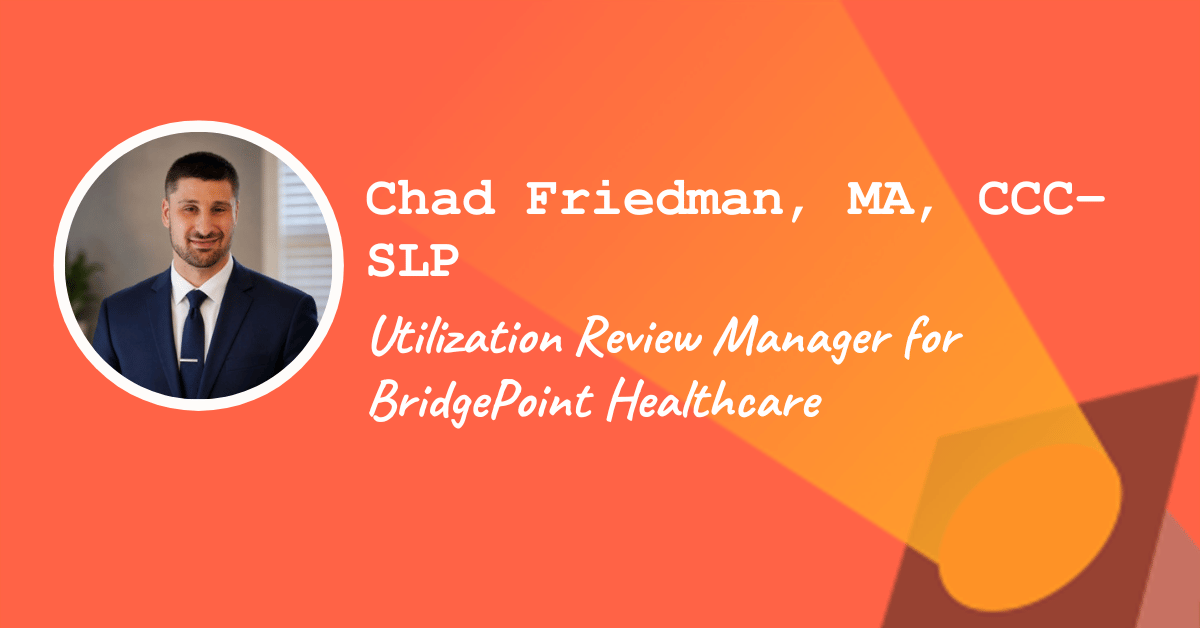
This week’s spotlight is on Chad Friedman, MA, CCC-SLP, a non-clinical speech-language pathologist who is now Utilization Review Manager for BridgePoint Healthcare!
We’re excited to share that BridgePoint Healthcare is a hiring partner of Go Non-Clinical, our community for clinicians exploring non-clinical careers! You can explore their current openings on BridgePoint’s careers page.
This post may contain affiliate links or codes. This won’t increase your cost, but it helps keep TNCPT alive, and free of annoying ads! Thank you for your support. 🙂
What is your full name, title, and company name for your current, primary role?
Chad Friedman, MA, CCC-SLP — Utilization Review Manager for BridgePoint Healthcare
Where are you located?
Pittsburgh, Pennsylvania
Where did you go to SLP school?
I completed my master’s degree in Speech-Language Pathology at West Chester University of Pennsylvania.
What did you do when you first finished school, and for how long?
After graduate school, I completed my Clinical Fellowship Year at a rural medical center in central Pennsylvania. It provided a broad clinical foundation early in my career, as it was a unique opportunity to work across acute care, long-term care, and outpatient rehabilitation settings. After earning my Certificate of Clinical Competence (CCC-SLP) and Pennsylvania licensure, I relocated back to the Pittsburgh area to be closer to family and continued to build my career across a variety of adult medical settings.
In what setting(s) did you work, and what types of patients did you treat?
Throughout my clinical career, I worked exclusively with adult patients across nearly every major medical setting, including acute care, inpatient rehabilitation, skilled nursing, home health, outpatient rehabilitation, and long-term acute care hospitals (LTACHs). My patients ranged from individuals recovering from stroke, traumatic brain injury, and neurological disorders to medically complex patients with swallowing, communication, cognitive, and voice disorders.
What did you enjoy about your early roles? What didn’t you enjoy?
One of the things I enjoyed most was building relationships with patients and their families. Home health was incredibly rewarding because you become part of people’s home life during some of their most challenging moments. Many of those relationships extended well beyond discharge, and I keep in touch with several former patients and families today.
I also discovered early in my career that I genuinely enjoyed documentation. My supervisor during my graduate school externship at a Level I trauma center really emphasized the importance of concise, detailed, and supportive clinical documentation, and that interest stuck with me. I have always enjoyed translating complex clinical situations into well-written documentation that accurately reflected patient needs and supported quality care.
As much as I loved patient care, I eventually realized I was equally interested in the operational side of healthcare. I found myself asking questions about why certain processes existed, how documentation influenced decision-making, and how systems could be improved to better support both clinicians and patients.
What else have you done since then, prior to your current role?
One of the accomplishments I’m most proud of was establishing the first Speech-Language Pathology program at Bucktail Medical Center. As the organization’s first speech-language pathologist, I spent a great deal of time educating physicians, nurses, therapists, and administrators about the role of the speech-language pathologist while developing workflows, building referral relationships, and creating processes that helped the program grow and serve patients within the community for more than a decade.
I was also selected to participate in a healthcare leadership conference and a global panel discussing operational challenges facing home health organizations across the country. Those experiences broadened my perspective beyond direct patient care and reinforced my interest in healthcare operations and leadership.
When and why did you decide to do something non-clinical?
Throughout my career, I enjoyed understanding the “why” behind clinical decision-making and wanted to learn how medical necessity was evaluated from the payer perspective. I was curious about why some services were approved while others were denied and what criteria were being used to make those decisions.
I transitioned into my first non-clinical role in 2023 when I accepted a position as a utilization reviewer for a large national insurance company. The transition felt natural because documentation had always been one of my greatest professional interests and strengths.
That experience gave me an entirely new perspective on healthcare and strengthened my understanding of how clinical decisions, operational processes, and payer requirements work together to improve patient care.
What are you doing these days?
I currently serve as the Utilization Review Manager for BridgePoint Healthcare, an organization that operates long-term acute care hospitals. My role focuses on evaluating hospital referrals for medically complex patients to determine whether they meet the clinical and financial criteria for admission into an LTACH. I also assist with appeals and authorization issues as needed.
One of the things I enjoy most about my current position is that it combines clinical knowledge with operations, collaboration, and problem-solving. I work closely with executive leadership, our admissions team, and clinical liaisons to support appropriate admissions and care transitions.
Beyond my daily responsibilities, I recently took the initiative to evaluate our admissions process from start to finish and develop recommendations for improvement. It was rewarding to see leadership accept those recommendations for implementation because it reinforced the impact clinicians can have on process improvement.
Are you still treating patients, or are you solely non-clinical?
I am solely non-clinical.
How long have you been in your current Utilization Review Manager role?
I have been in my current role since August 2025.
What do you wish you would’ve known before going into this role?
I already had a strong knowledge base of Medicare guidelines and level-of-care criteria for home health, acute inpatient rehabilitation, and SNF settings before my current role. However, long-term acute care hospitals (LTACHs) have their own unique admission criteria, reimbursement considerations, and operational workflows that required a significant amount of independent learning. Looking back, I think it’s important for clinicians to recognize that non-clinical roles come with a learning curve.
Did you get any special certifications or training along the way to help you get into your current role?
I completed a formal utilization review training program designed for clinicians pursuing non-clinical careers before I transitioned into utilization management in 2023. The course covered topics such as a day in the life of a utilization reviewer, appeals and denials, Medicare guidelines, resume development, and interview preparation.
I had already had significant experience reviewing documentation and completing chart audits, which ultimately became one of my strongest transferable skills that helped with the transition into utilization review.
How did you find your job? Did you apply or find it through a connection?
Several years ago, I reached out to an occupational therapist on LinkedIn to offer support after learning she had been laid off. I didn’t know her personally and wasn’t looking for anything in return. We stayed in touch over the years, became friends, and continued supporting each other through career changes and life events.
A few years later, she contacted me about an opportunity with her organization and asked whether I would consider the position if it could be made remote. After speaking with her leadership team, I was invited to interview and ultimately accepted the role.
That experience reinforced that networking isn’t just about exchanging business cards or making connections when you need something. It’s about investing in relationships, supporting people without expecting anything in return, and staying connected over time. You never know where those relationships may lead. My last three roles came through professional relationships.
Did you do anything special to your resume and cover letter to land the job?
I maintain several versions of my resume that are tailored to different types of healthcare leadership and non-clinical roles. I spend time understanding what success looks like in the position, what challenges the department and hiring manager are likely facing, and how I’ve solved similar problems before applying for a position.
I made sure my resume emphasized my achievements in reviewing clinical documentation, chart auditing, rehospitalization prevention, interdisciplinary collaboration, as well as any relevant independent learning before applying to my first utilization review role.
Once I had utilization management experience, I made sure my resume reflected experiences that a recruiter or hiring manager would be actively looking for, such as making appropriate level-of-care determinations, managing appeals and denials, and using decision-support tools such as InterQual® or MCG (formerly Milliman Care Guidelines).
What was the interview like for the Utilization Review Manager role?
The interview process was straightforward but thorough. I first met with the Vice President of Recruitment, followed by a Zoom interview with the CEOs overseeing two long-term acute care hospitals. Our conversations focused on my prior experience in utilization management, clinical judgment, ability to meet the quick turnaround times required by referral hospitals, and my ability to collaborate with interdisciplinary teams. After the interviews, I received an offer, and we spent a few days discussing compensation and answering a few additional questions before I accepted the position.
How have people reacted to you leaving patient care?
Most people have been supportive. However, many are surprised to learn how many opportunities exist outside of traditional patient care. Some clinicians assume leaving patient care means walking away from healthcare altogether, but I’ve found the opposite to be true.
I still rely on my clinical knowledge every day. I’m simply applying it in a different way to help patients receive care in the appropriate clinical setting.
What’s a typical day or week in the life like for you? What types of tasks and responsibilities fill your time?
Each morning begins with a multidisciplinary meeting that I often facilitate alongside our market CEO, chief medical officer, director of business development, admissions director, and clinical liaisons to discuss referral status, barriers to admission, and next steps. During the rest of the day, I review clinical documentation, collaborate with our interdisciplinary team on challenging cases, and assist with payer authorization issues and appeals when needed.
More recently, I independently initiated a process improvement project after identifying opportunities to improve our admissions workflow. I developed a comprehensive assessment of the current process, developed evidence-based recommendations, and presented them to leadership. Those recommendations have been accepted for implementation next month.
What are some of the rewards of your Utilization Review Manager role? What are the biggest challenges?
One of the most rewarding aspects of the role is helping ensure that patients receive care in the most appropriate setting while also improving the processes that support those decisions. I enjoy combining clinical knowledge with operational problem-solving and collaborating with teams across the organization.
The biggest challenge is balancing multiple priorities in a fast-paced environment where clinical, financial, and operational considerations all intersect. Every referral has its own unique circumstances, so flexibility and communication are essential.
How did your clinical background prepare you for this role? Which skills transferred?
My clinical experience gave me a strong understanding of disease processes, rehabilitation, documentation, interdisciplinary communication, and medical necessity. Perhaps more importantly, it taught me how to analyze complex clinical information, prioritize competing demands, communicate effectively with physicians and other healthcare professionals, and advocate for patients. Those skills have transferred directly into utilization management and healthcare operations.
Roughly speaking, how are the hours and pay compared to patient care?
Work-life balance has improved considerably. When I worked in home health, my day rarely ended when I left a patient’s home. Evenings and weekends often involved documentation, scheduling visits, returning phone calls, coordinating with physicians, and preparing for the next day. There was never really an “off switch.”
Although I still work more than 40 hours during the week, my work is much easier to separate from my personal life. Once I shut down my computer at the end of the day, I’m generally finished until the following morning. I’ve also experienced an increase in compensation compared to my previous clinical positions.
What type of person do you think would do well in your Utilization Review Manager role?
Someone with strong critical thinking skills, attention to detail, and the ability to make objective decisions based on clinical evidence would likely do well in utilization management. The role requires sound clinical judgment, the ability to interpret and apply medical necessity criteria, and effective collaboration with physicians, admissions teams, and insurance companies.
Clinicians considering this transition should also understand that a significant portion of the day is spent reviewing medical records and documentation rather than interacting directly with patients or families. The work can become repetitive at times, so it’s important to genuinely enjoy documentation, clinical analysis, and focused independent work. It can be an extremely rewarding career for people who enjoy applying their clinical knowledge more analytically.
Do you work remotely or onsite?
My current role is 100% remote. I completed orientation onsite at our Washington, DC location, where I had the opportunity to meet several members of the team face to face.
Does your organization hire PT, OT, or SLP professionals into non-clinical roles? If so, what type of roles?
Yes, BridgePoint Healthcare hires clinicians from all medical backgrounds across a variety of roles.
Editor’s note: You can find all open positions at BridgePoint Healthcare, and hundreds of other companies, on the private Go Non-Clinical community job board. Members can also contact our hiring partners directly and get a head start on the application process.
Did you read any books, take any courses, or do anything special overall to get you where you are today?
I don’t think there was one specific book or course that led me here. Instead, I’ve always tried to stay curious. I developed a genuine interest in clinical documentation as a graduate student, and over time I expanded that interest by learning more about Medicare guidelines, medical necessity, utilization management, and healthcare operations.
More recently, I’ve invested a significant amount of time understanding healthcare operations, workflow optimization, and process improvement. Looking back, I think my willingness to keep learning outside of my day job has been one of the biggest contributors to my career.
What is a typical career path for someone in your Utilization Review Manager role?
The skills developed in utilization management translate well into leadership roles in clinical operations, care management, quality improvement, population health, and other areas of healthcare administration. Some professionals also leverage those skills to transition into healthcare consulting or clinical informatics as they gain additional experience.
What is next for you? What are your high-level career aspirations?
My long-term goal is to continue growing into healthcare operations leadership. I enjoy solving complex problems, making workflows more efficient, improving collaboration across teams, and finding ways to improve how care is delivered. While I value my current role, I’m energized by opportunities that combine clinical expertise with leadership, strategic planning, and organizational improvement.
What would you recommend to someone who is considering going into a role like yours? Do you have any special words of wisdom for the readers?
Make sure you’re transitioning toward something you’re excited about, and not just simply trying to escape patient care. Additionally, it is important to understand that utilization management is still very much a clinical role. You are reviewing documentation, interpreting insurance guidelines, evaluating medical necessity, and helping patients receive care in the appropriate clinical setting. Utilization management can be an excellent fit if you enjoy analyzing documentation, applying medical necessity criteria, and making objective clinical decisions.
What would you like to change most in your profession, and why? How would you propose doing so?
I think one of the biggest challenges facing speech-language pathology is awareness. Most people associate speech-language pathology with articulation or speech therapy, but the scope of practice extends far beyond that. Speech-language pathologists play critical roles in swallowing disorders, cognitive and communication disorders, voice disorders, tracheostomy and ventilator management, respiratory muscle strength training, oral-motor skills, and many other areas that directly affect patient safety and quality of life.
Even within healthcare, many professionals don’t fully appreciate the breadth of what speech-language pathologists do. I would love to see greater emphasis on interdisciplinary education and earlier involvement of speech-language pathologists in patient care so that both healthcare providers and patients better understand the value our profession brings.
What career advice would you give yourself that you wish you had during school?
I would remind myself that your first job doesn’t have to define your entire career. Healthcare offers far more opportunities than most graduate programs discuss.
The clinical skills you develop as a therapist translate into roles in healthcare operations, quality improvement, utilization management, consulting, healthcare technology, account management and sales, data analysis, and many other career paths. Be curious, continue learning, and don’t be afraid to explore opportunities that weren’t part of your original plan.
What would you teach to today’s graduate students in your profession, if you had the opportunity?
Graduate programs do an excellent job of preparing students clinically, but I would love to see more education around how healthcare actually functions.
Topics like productivity expectations, reimbursement, insurance, documentation, healthcare operations, quality improvement, and interdisciplinary collaboration have a tremendous impact on daily practice, yet many clinicians don’t encounter them until they’re already working. Having a stronger understanding of those concepts before entering the workforce would make the transition much smoother.
Do you have any special advice for others who want to follow in your footsteps?
My biggest piece of advice is not to rush the transition simply because you’re feeling burned out. Try different clinical settings first.
You may discover that the issue isn’t patient care, but simply that you may not have found the right environment yet.
If you ultimately decide you’d like to pursue a non-clinical career, spend time evaluating your strengths, interests, and the parts of your current job that energize you. There are countless non-clinical opportunities in healthcare, and understanding what motivates you will help you identify the path that’s the best fit.
