
Published:

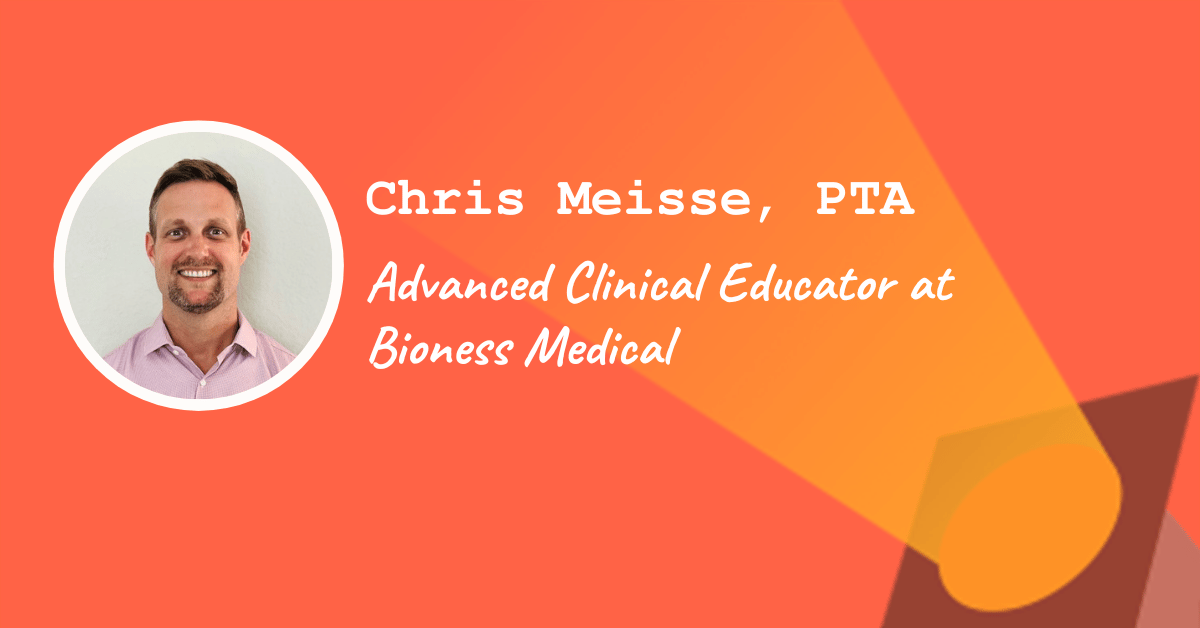
Chris Meisse, PTA, is an Advanced Clinical Educator at Bioness Medical, which develops rehab technology for people recovering from stroke and brain injury, including functional electrical stimulation devices, robotic systems, and software-based therapy programs. Its customers include rehab hospitals and outpatient clinics, along with patients who use some of the devices at home.
Chris teaches the therapists at those facilities to use the company’s technology with their own patients, one of the non-clinical jobs open to PTAs. Our guide to clinical specialist careers covers the wider group of device-company jobs that involve training clinicians on equipment.
This post may contain affiliate links or codes. This won’t increase your cost, but it helps keep TNCPT alive, and free of annoying ads! Thank you for your support. 🙂
What is your full name, title, and company name for your current, primary role?
Chris Meisse, PTA — Advanced Clinical Educator for Bioness Medical
Where are you located?
Cape Coral, FL
Where did you go to PTA school, and what year did you graduate?
Broward College, Class of 2009
What did you do when you first finished school, and for how long?
Shortly after graduating, I jumped right into my role as a PTA and landed a job at the skilled nursing facility where I had completed my clinical rotation.
In what setting(s) did you work, and what types of patients did you treat?
I worked across a variety of therapy settings, including skilled nursing, outpatient, home health, and inpatient rehabilitation. Through these diverse experiences, I had the opportunity to work with patients with neurological, orthopedic, and memory care needs, each presenting with distinct diagnoses and clinical challenges.
What did you enjoy about your early roles? What didn’t you enjoy?
What I enjoyed most throughout my career was the connection I was able to build with each patient and their families. In every setting I worked, I had the opportunity to make a difference in someone’s life, often during some of the most difficult moments they would face.
One of my biggest challenges was stepping away from my role as a treating clinician. However, I still have opportunities to experience that same sense of purpose when I educate clinicians in facilities. While I may no longer be the hands-on therapist providing direct patient care, I am able to use my clinical knowledge and experience to help support and educate the next generation of treating therapists.
When and why did you decide to do something non-clinical?
I decided to step away from my hands-on clinical role and found that I truly enjoyed teaching and guiding clinicians as they learned to incorporate innovative technologies into their practice.
What are you doing these days?
I’m enjoying the challenge of balancing the demands of the job with life outside of work. Being a husband and a father is just as important to me, so finding that balance while traveling and managing the responsibilities of my role has been a big part of this new chapter. Overall, I feel very fortunate to be in a position where I can enjoy what I do for work while still making time for my family.
Are you still treating patients, or are you solely non-clinical?
At this point in my career, I am no longer treating patients directly, primarily because my current role requires extensive travel and leaves little flexibility to take on additional clinical responsibilities.
How long have you been in your current Advanced Clinical Educator role?
I started in May of 2025.
How did you find your job? Did you apply or find it through a connection?
I actually found my way into this role in a pretty unexpected way. At the time, I was working as a treating clinician at a new facility. Our marketing team approached me and asked if I would be interested in showcasing some of the technology we were using in the therapy world through creative content to help get the word out about the facility.
What started as simply demonstrating the technology turned into something more. I began using patient scenarios to show how the technology could actually be used in therapy and what it could look like with real patients. I really enjoyed being able to explain the technology, talk through different clinical situations, and show it in action.
That experience helped me realize how much I enjoyed teaching and sharing my clinical knowledge with other therapists. Eventually, I was approached by Bioness about the role I’m in now, and it felt like a natural next step for me.
It allowed me to take everything I had learned from being a treating clinician and use that experience to help other therapists. While I’m not treating patients directly anymore, I still feel connected to patient care by helping clinicians understand how to use innovative technology and apply it to the patients they work with every day.
How have people reacted to you leaving patient care?
This was a very emotional next step for me. I have always had a real passion for the sense of community within a workplace, and of course, for the patients I was treating. Leaving my facility meant saying goodbye to many good friends, coworkers, and patients who had been such an important part of my life.
It was definitely a heartfelt goodbye, but I knew this was an opportunity to take the next step in my career and explore something new. Even today, I still keep in touch with the facility and as many of my former coworkers as possible. The relationships and connections I built there are something I will always value.
What’s a typical day or week in the life like for you? What types of tasks and responsibilities fill your time?
In my current role, most of my time is spent traveling throughout the East Coast of the U.S., providing education and training on our portfolio of technologies to different facilities. A big part of my day is also spent behind the scenes coordinating everything that goes into those trainings. I spend a lot of time scheduling training dates, communicating with facilities through email, and connecting with teams through video calls.
It’s definitely a different pace and structure than being a treating clinician, but I really enjoy the variety. No two facilities or training days are exactly the same, and I get to work with clinicians from many different backgrounds and experience levels. I enjoy being able to take my clinical experience and use it to help others feel more comfortable and confident with the technology they are using with their patients.
What are some of the rewards of your Advanced Clinical Educator role? What are the biggest challenges?
One of the biggest rewards of my role is the opportunity to meet so many new people and build relationships with clinicians across different facilities. I especially enjoy seeing that moment when a team gets excited about the technology and starts thinking about how they can use it to enhance patient care. Knowing that I can share my clinical experience and help give therapists another tool to improve the care they provide is really rewarding.
The biggest challenge is probably the travel and everything that comes with it. I have to be able to pivot when things change and make sure I can get where I need to be for trainings. Flights get delayed, schedules change, and sometimes things happen that are completely out of my control. A big part of the job is being flexible, figuring things out on the fly, and making sure I can still show up and support the facility when they are counting on me.
How did your clinical background prepare you for this role? Which skills transferred?
Coming from a clinical background has been a big part of what makes my current role so rewarding. The clinicians I work with know that I’m a clinician just like them and that I’ve actually used the technology I’m teaching with real patients. I’m able to share my own experiences and talk through situations they may be seeing with their patients.
I think that creates a level of trust because they know I’ve been in their shoes. I’m not just teaching them how the technology works; I can also help them understand how to use it from a clinical perspective. That connection makes each interaction more meaningful and, hopefully, gives them the confidence to take what they learned and use it with their patients.
What type of person do you think would do well in your Advanced Clinical Educator role?
For this particular job, I think you need to be really organized, extremely flexible, and dedicated to what you do.
There are a lot of moving parts, and there’s always the chance that something will go sideways, whether it’s a travel issue or the technology deciding not to cooperate while you’re onsite.
You have to be comfortable thinking on your feet and being able to pivot when things don’t go as planned. Having been through both good and bad experiences definitely helps because you learn how to troubleshoot, stay calm, and figure out a way to make the situation work.
I also think you have to genuinely care about the job. It’s not just about knowing the technology; it’s about being prepared, connecting with the clinicians you’re working with, and doing everything you can to make sure they walk away feeling confident and supported.
Do you work remotely or onsite?
I get to work remotely. Because of that, just about anywhere I happen to be can become my office for the day. Some days that means working from home, and other days it might be an airport, hotel, clinical site, or wherever I can set up and get some work done.
Did you read any books, take any courses, or do anything special overall to get you where you are today?
A big part of my story and how it led me down this path has been creating content and showing clinicians how we can add new tools to our clinical toolbox. I really enjoy taking the technology and showing how it can fit into what they’re already doing with their patients.
For me, it always comes back to the patient and what we can do to help them reach their goals. Whether it’s improving an outcome, helping someone become more independent, or simply giving a patient another opportunity to succeed, I like showing clinicians how these technologies can become another tool they can use to make a difference.
What is a typical career path for someone in your Advanced Clinical Educator role?
I think the career path for an Advanced Clinical Educator can look a little different depending on the person. For me, having a strong clinical background was a big part of getting into the role. I spent years working as a treating clinician across different settings, which gave me a lot of hands-on experience and helped me understand the challenges therapists face day to day.
I really believe that personality and attitude are things you can’t teach. Those are just part of who someone is. The skills needed for a job can always be learned with the right training and experience.
To me, having a good attitude, being willing to learn, and being able to connect with people are much harder to teach than the technical skills of the job.
What is next for you? What are your high-level career aspirations?
I’m still pretty new to this role, and I’m really enjoying the change of pace and getting to connect with new people every day. For now, I’m just enjoying the ride—teaching, learning, and showcasing everything our technologies can offer to help clinicians and their patients.
I’m excited to see where this role takes me. I don’t have a specific end goal in mind right now, so I’m enjoying the opportunity in front of me and seeing what’s on the horizon.
What to read next
- Wendy Warfield, Senior Manager of Education at Bioness Medical — an OT on overseeing education at the same company.
- Karen Bonney on the Area Sales Manager job at Bioness Medical — a PT on selling the rehab technology Chris teaches.
- How to get a non-clinical job, from the hiring managers making the decisions — what they look for in resumes, interviews, and follow-up.
- The Non-Clinical Jobs Report, from Go Non-Clinical — last quarter’s hiring data for PTs, OTs, SLPs, and assistants, with clinical specialist and product education roles tracked as their own career path.
More resources for your non-clinical career
If you’re finding your own way through the non-clinical transition, we’ve created these FREE resources to help you get your bearings.
- Our weekly jobs newsletter: 100+ fresh non-clinical job postings every week, plus new spotlights, our latest articles, and hiring partners recruiting straight from our community.
- Four Secrets to Landing a Fulfilling Non-Clinical Healthcare Job: our free mini-course, delivered to your inbox.
- Our free career quiz: 15 questions, and you’ll come out with a much clearer picture of which non-clinical sectors suit you.
If you’d rather follow a step-by-step roadmap than piece this together on your own, that’s exactly why we made Non-Clinical 101. It’s our course & community teaching rehab pros how to make the switch in half the time with twice the confidence.
