
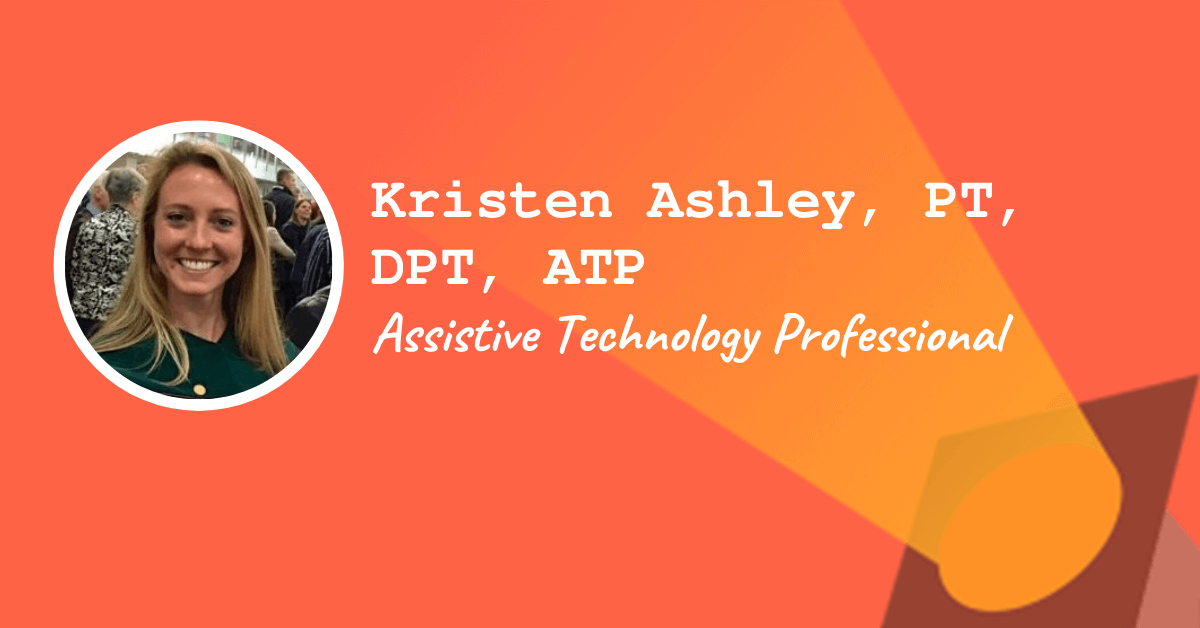


This week’s spotlight is on Kristen Ashley, PT, DPT, ATP, a non-clinical physical therapist who is now Assistive Technology Professional for Numotion!
This post may contain affiliate links or codes. This won’t increase your cost, but it helps keep TNCPT alive, and free of annoying ads! Thank you for your support. 🙂
What is your full name, title, and company name for your current, primary role?
Kristen Ashley, PT, DPT, ATP — Assistive Technology Professional for Numotion

Where are you located?
Salt Lake City, Utah.
Where did you go to PT school, and what year did you graduate?
Northeastern University, 2016.
Please refrain from contacting our spotlight participants on social media. There are thousands of readers just like you out there. 🙂 Please ask your questions in the comments on this blog post.
If you’re a Non-Clinical 101 student or Go Non-Clinical member, you can network with many of our spotlight participants in our community!
What did you do when you first finished school, and for how long?
After graduating, I moved to Utah. I worked at the VA in acute/subacute rehab for five years prior to transferring to acute rehab in the community. At Rehab Without Walls (RWW), I worked with clients with spinal cord injuries, brain injuries, and stroke.
While I was working with RWW, I also started working for a company called The Wheelchair Clinic. This is a company of mobile therapists who perform in-depth wheelchair evaluations for clients who are not currently on case loads or are working with therapists who are uncomfortable with complex rehab technology. I did these two jobs for three years prior to getting my ATP license with Numotion and transitioning to the assistive technology role.
In what setting(s) did you work, and what types of patients did you treat?
I worked in a variety of settings, including home, outpatient therapy, hospitals, acute rehabs, SNF, and LTACs. We provided a variety of equipment to people of all ages, from one to 100, with diagnoses such as:
- Spina bifida
- Spinal cord injuries
- Stroke
- Cerebral palsy
- Amputation
- Muscular dystrophy
- ALS
What did you enjoy about your early roles? What didn’t you enjoy?
I loved working with people and the intellectual challenge of the human body. I enjoyed fast-paced work, but the continual increase in productivity requirements, poor reimbursement, and scheduling difficulty was difficult to maintain without burnout.
What else have you done since then, prior to your current role?
I have tried outpatient orthopedic physical therapy, personal training, and personal care assistance.
When and why did you decide to do something non-clinical?
I have always been very interested in wheelchairs, seating, and assistive technology and how it can influence posture, efficiency, and function. I loved being present at the deliveries to assist with making adjustments to maximize efficiency and cater to my mechanical brain.
I had thought in the past of going into other realms of assistive technology, but this was a natural transition for me that combined my therapeutic skill as a therapist with my mechanical mind and enjoyment of tooling on equipment.
What are you doing these days?
I am full time with Numotion as an assistive technology professional, working with therapists in the community and local hospitals performing wheelchair evaluations, adjustments, equipment demos, and delivering equipment.
Are you still treating patients, or are you solely non-clinical?
I am solely non-clinical, but I maintain private liability insurance. I have very active friends that get hurt a lot, leading me to do pro bono therapy work on the side.

How long have you been in your current role?
Since April 2024.
What do you wish you would’ve known before going into this role?
I wish I would’ve had a more realistic idea of the driving and the amount of communication needed to maintain an ever-growing caseload.
Did you get any special certifications or training along the way to help you get into your current role?
I received my Assistive Technology Professional (ATP) license. I also participated in Numotion’s development program which, with my PT degree, was a 12-week program.
How did you find your job? Did you apply or find it through a connection?
I worked with Numotion frequently while working with The Wheelchair Clinic.
Did you do anything special to your resume and cover letter to land the job?
I typically try to bring up experiences that are applicable with my cover letter and resume, but I think it was most helpful that Numotion had seen my work ethic and skills while performing evaluations with them.
What was the interview like for the assistive technology professional role?
I had several interviews with hiring directors, direct leaders, and fellow ATPs that have also been clinicians. It was very thorough and beneficial in getting a good idea of what the job entailed.
How have people reacted to you leaving patient care?
I feel that most fellow clinicians are very interested in why I left, the differences between clinical work and non-clinical work, and the monetary opportunities involved.
What’s a typical day or week in the life like for you? What types of tasks and responsibilities fill your time?
My days vary each day. Depending on where my clients are located, I either start my day driving or answering emails. I then perform anywhere from one to five appointments throughout the day, including evaluations, adjustments for growth or progressions, and deliveries or trials of equipment.
When no appointments are scheduled, I complete paperwork for evaluations, answer client questions and requests, or answer questions from internal departments at Numotion. I also use time in the warehouse for assembling equipment and loaners for clients.
What are some of the rewards of your role? What are the biggest challenges?
It is a pretty incredible feeling to provide equipment that can give back the world to clients who have mobility issues. Assistive technology can provide clients independence and sometimes much needed sleep to significantly improve their and their caregivers lives. It is also a sales role; therefore, I receive commission for equipment sales leading to significantly more compensation than available through a clinical role.
My biggest challenge with this position has been the amount of communication I must keep up with. I am often face to face with clients or on the road, making it difficult and sometimes overwhelming. I have never had to maintain this much communication in so many places and from so many people, but I am slowly learning.
How did your clinical background prepare you for this role? Which skills transferred?
My clinical background assists significantly in my ability to:
- Accurately measure
- Assess uses for various equipment and seating
- Foresee progressions of mobility issues according to diagnosis
Ready to launch your own non-clinical career?
Plus, you’ll get early access to curated non-clinical job listings and a bonus lesson on AI!
Roughly speaking, how are the hours and pay compared to patient care?
Overall, the hours are less consistent than clinical care. If you are poor at creating boundaries and keeping up with communication, work can reach you most of the time. I do make significantly more in non-clinical work via commissions, making almost double, but I also work significantly more.
What type of person do you think would do well in your assistive technology professional role?
I feel that someone who likes communicating, does not procrastinate, and is comfortable thinking on the spot and changing gears quickly would do well in this job. There is a lot of equipment to learn, so having a mechanical mind allows you to assess on the spot instead of memorizing every detail of every piece of equipment. You are the face of the company for each client, which can be hard because of the complications with insurance, so providing clear expectations for your clients is important.
Do you work remotely or onsite?
I mostly work onsite, but sometimes I will do paperwork at home if I believe it will be more efficient.
Does your organization hire PT, OT, or SLP professionals into non-clinical roles? If so, what type of roles?
We love hiring therapy professionals into roles such as ATP and education roles.
Did you read any books, take any courses, or do anything special overall to get you where you are today?
Numotion has their own education development program that I participated in that was very thorough. Most everything else I learned from proximity to adaptive equipment and onboarding with The Wheelchair Clinic.
What is a typical career path for someone in your assistive technology professional role?
There are multiple options to progress at Numotion. There are sales director roles and clinical education roles that you can move into all over the country.
What is next for you? What are your high-level career aspirations?
I believe, over time, I would like to slowly transition towards clinical education roles, at either Numotion or for an equipment manufacturer.
I see the deficits in the education of ATPs, therapists, physicians, and clinicians that are involved in getting equipment for clients. This leads to significant delays in equipment and potential detrimental acts. I wish to help smooth out these issues everywhere.
What would you recommend to someone who is considering going into a role like yours? Do you have any special words of wisdom for the readers?
Prior to starting, I would always recommend communicating with people who have been in the role for longer than one year. I would also recommend learning how to set boundaries.
What would you like to change most in your profession, and why? How would you propose doing so?
I would like fewer modes of communication. I would prefer having an EMR that would have communication all in one place, instead of phone calls, texts, teams, teams calls, meetings, and order messages all coming from different places.
What career advice would you give yourself that you wish you had during school?
I always recommend going to school where you would like to work, or doing a clinical in the area or field that you want to work in. I had initial difficulty due to the fact that all of my references and prior jobs were from Massachusetts and not Utah. I also recommend paying attention to the classes you really enjoyed and seeing if there is a niche clinical or non-clinical job that would value those skills.
What would you teach to today’s graduate students in your profession, if you had the opportunity?
I would most likely educate on the therapists’ role in the equipment process and the variety of equipment available to assist with an extensive amount of situations.
Do you have any special advice for others who want to follow in your footsteps?
Having a powerful team behind you is more important than claiming more of the returns of sales.

