
Published:

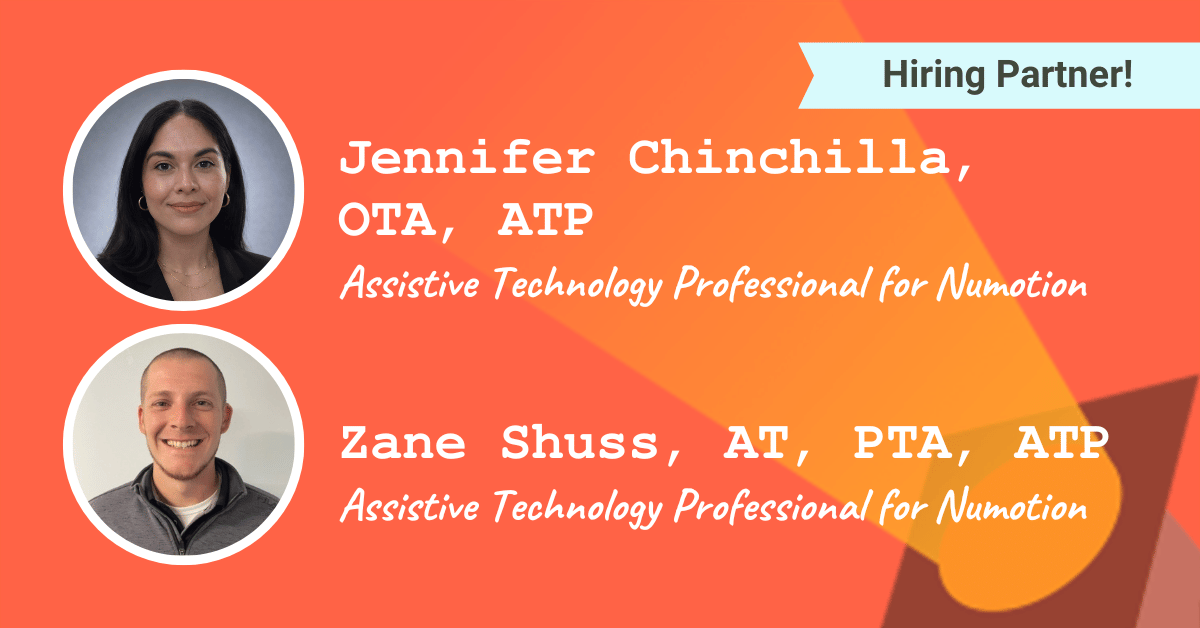
This week’s spotlight is on Jennifer Chinchilla, OTA, ATP, a non-clinical occupational therapist, and Zane Shuss, AT, PTA, ATP, a non-clinical physical therapist who are both now Assistive Technology Professionals for Numotion!
This post may contain affiliate links or codes. This won’t increase your cost, but it helps keep TNCPT alive, and free of annoying ads! Thank you for your support. 🙂
What is your full name, title, and company name for your current, primary role?
Jennifer: Jennifer Chinchilla, OTA, ATP — Assistive Technology Professional for Numotion
Zane: Zane Shuss, AT, PTA, ATP — Assistive Technology Professional for Numotion

Where are you located?
Jennifer: Houston, TX.
Zane: Erie, PA.
Where did you go to PT school, and what year did you graduate?
Jennifer: University of Houston- Downtown, 2012- B.S. in Psychology, HCC Coleman College for Health Sciences, 2015- Associate of Applied Science (OTA).
Zane: Baldwin Wallace University, 2015 (Athletic Training) and Kent State Ashtabula, 2018 (PTA).
Please refrain from contacting our spotlight participants on social media. There are thousands of readers just like you out there. 🙂 Please ask your questions in the comments on this blog post.
If you’re a Non-Clinical 101 student or Go Non-Clinical member, you can network with many of our spotlight participants in our community!
What did you do when you first finished school, and for how long?
Jennifer: I have 10 years of experience working as a PRN therapist, during which I gained diverse clinical exposure across multiple settings, including inpatient rehabilitation, acute care (5 years), skilled nursing (2 years), and pediatric home health (2 years).
Zane: I worked in athletic training for eight years and as a PTA for five years.
In what setting(s) did you work, and what types of patients did you treat?
Jennifer: I worked in a variety of clinical settings, including inpatient rehabilitation, skilled nursing, pediatric home health, and acute care. My patient populations included adults and geriatric patients in inpatient rehab and acute care, geriatric patients in skilled nursing, and pediatric patients in home health.
Zane: I worked in outpatient, inpatient, and home health settings. My patients ranged from pediatric to geriatric.
What did you enjoy about your early roles? What didn’t you enjoy?
Jennifer: I really enjoyed growing my neuro skills in inpatient rehab and getting certified in Neuro-IFRAH and neuro vision treatments. The most rewarding part was watching patients improve over time and helping them relearn how to live independently. At times, the pace and emotional demands of the work could be challenging, especially early in patients’ recovery.
Zane: I enjoyed the age range of patients I treated. It was a great mix of personalities and each patient has a unique story. I also enjoyed the journey of progression in patients from start to finish.
When and why did you decide to do something non-clinical?
Jennifer: After many years in clinical practice, I felt like I had gained a wide range of experience and was ready for something new. I wanted to challenge myself and explore opportunities beyond direct patient care.
Zane: My wife and I moved from OH to PA for our family. I was looking for new challenges with meaningful work. I came across complex rehab technology (CRT) and have enjoyed the challenges and constant knowledge growth that the ATP role provides.
What are you doing these days?
Jennifer: Right now, I’m working as an ATP with Numotion, where I evaluate clients for wheelchairs, power mobility equipment and other CRT. I work with both adults and pediatric patients and collaborate with therapists to determine the best equipment options. I also take measurements to ensure proper customization, and I’m constantly learning in the role.
Zane: I am an ATP for Numotion, assisting clinicians in getting beneficial CRT to their patients.
Are you still treating patients, or are you solely non-clinical?
Jennifer: I am solely non-clinical in my role as an ATP.
Zane: I am solely in the role of ATP, assisting clinicians in getting beneficial CRT to their patients.
How long have you been in your current role?
Jennifer: Since June 2024.
Zane: Since September 2024.
What do you wish you would’ve known before going into this role?
Jennifer: I honestly wish I had known this was an option earlier in my career. It’s such a great fit for my experience, and I probably would have made the transition sooner if I had been aware of it.
Did you get any special certifications or training along the way to help you get into your current role?
Jennifer: Yes, Numotion provided a 12-week ATP development program and helped me prepare for the certification exam.
Zane: Numotion provides a 12-week education program to sit for the RESNA exam to become a certified ATP.
How did you find your job? Did you apply or find it through a connection?
Jennifer: I found the job on LinkedIn.
Zane: I came across the position on LinkedIn and applied directly through Numotion.
Editor’s note: Numotion is a hiring partner of The Non-Clinical PT! If you’re interested in becoming an ATP, check out their ATP Development Program, which provides the training and support you need to earn your certification — even if you don’t have one yet. You can also browse all of their current openings on Numotion’s careers page.
What was the interview like for the role?
Jennifer: I had about three interviews with different managers and directors of the company.
What are some of the things you did to stand out, take initiative, and advance in your career?
Zane: Passing the RESNA exam to become ATP certified.
How have people reacted to you leaving patient care?
Jennifer: Most therapists are curious about how I transitioned into a non-clinical role and often ask about the process. I enjoy educating colleagues on the different opportunities available and encouraging them to explore their options.
Zane: Supportive. CRT is a unique field to work in, and many people may not know what complex rehab technology is.
What’s a typical day or week in the life like for you? What types of tasks and responsibilities fill your time?
Jennifer: My schedule varies depending on the day. Some days I’m traveling throughout the area to complete wheelchair and power mobility evaluations, as well as evaluations for other complex rehabilitation technology (CRT) equipment. I also handle equipment deliveries, adjustments, and repairs. Other days are focused on marketing and networking within the community to build relationships with therapists and support access to appropriate mobility solutions.
Zane: I perform evaluations for CRT, working in collaboration with a clinician. I create specs for CRT that are tailored to each client. I deliver CRT to clients’ homes, clinics, and nursing homes. I also represent the Numotion brand and deliver knowledge to clinicians, explaining what CRT is and how it can help their patients.
What are some of the rewards of your assistive technology professional role? What are the biggest challenges?
Jennifer: One of the most rewarding parts of my role is helping someone regain their independence and reduce the burden on their caregivers. The biggest challenges tend to be with complex pediatric cases. Medically fragile children require a lot of customization, and you have to carefully consider things like oxygen tubing, trachs, IV poles, g tubes and ventilators when designing the right equipment. It takes a lot of detail and planning to make sure everything works safely together.
Zane: Providing a client with mobility is an experience that never gets old. Helping them get the equipment they need will always be a feeling of fulfillment. The biggest challenge is insurance.
How did your clinical background prepare you for this role? Which skills transferred?
Jennifer: My clinical experience has been instrumental in this role. It allows me to better understand diagnoses, anticipate patient needs, and evaluate functional mobility and ADLs, all of which help guide appropriate equipment recommendations.
Zane: My knowledge base of human anatomy transferred well. Practicing as a PTA helps the transition immensely, as posturing and positioning is critical in evaluating for CRT. Also, emotional intelligence and communication with many personalities and ages from my clinical roles assisted in the transition to CRT.
Ready to launch your own non-clinical career?
Plus, you’ll get early access to curated non-clinical job listings and lifetime access to the Go Non-Clinical community!
Roughly speaking, how are the hours and pay compared to patient care?
Jennifer: I really appreciate the consistency and stability of this role as a salaried position. It allows me to stay focused on helping clients and being more involved in the full process. From evaluation to delivery and follow-up, without some of the unpredictability you can have in patient care. I also value the opportunity to build relationships and work more broadly within the community.
What type of person do you think would do well in your assistive technology professional role?
Jennifer: This is a role where people from many different backgrounds can be successful. The most important quality is maintaining a strong focus on what’s best for the client, along with being adaptable, detail-oriented, and solution-focused.
Zane: Someone who has a willingness to learn and is open to accepting new challenges. Paying attention to detail is important, as insurance requires a lot of different documents. Efficient communication with multiple people throughout the different steps of getting CRT is also key.
Do you work remotely or onsite?
Jennifer: My role is primarily remote, with some onsite work in clinics and the office, and I frequently complete evaluations in clients’ homes.
Zane: Onsite.
Does your organization hire PT, OT, or SLP professionals into non-clinical roles? If so, what type of roles?
Jennifer: Yes, there are opportunities for PTs, OTs, and SLPs in non-clinical roles, especially in assistive technology. Roles like ATPs, as well as positions in education, sales, and product support, allow clinicians to still use their clinical knowledge while working in a different capacity.
Zane: Yes.
Editor’s note: You can also find all open positions at Numotion inside on the private job board inside our Go Non-Clinical community, where members can contact hiring managers directly, chat with current ATPs, and get a head start on the application process. Numotion also joins us for live virtual events inside the community, where we talk about the ATP role and discuss interviewing, mentorship, company culture, and more.
Did you read any books, take any courses, or do anything special overall to get you where you are today?
Jennifer: Numotion has provided great training and resources, and I’ve continued to grow through hands-on experience. I also take CEUs with different equipment manufacturers to better understand the technology and stay current, which has been really helpful in this role.
Zane: I have taken continuing education courses throughout my career.
What is a typical career path for someone in your assistive technology professional role?
Jennifer: Many ATPs stay in the role long-term and eventually retire from it, while others move into management or leadership positions. There are also opportunities to grow into more specialized roles, including education or sales within the assistive technology field.
Zane: A typical path is rehab technology specialist to assistive technology professional.
What is next for you? What are your high-level career aspirations?
Jennifer: Right now, I’m focused on continuing to grow and develop as an ATP. I plan to stay in this role long-term and keep building my skills, while remaining open to future opportunities that may come up.
Zane: I want to continue to build CRT in my covering territory.
What would you like to change most in your profession, and why? How would you propose doing so?
Jennifer: I think one area for improvement is increasing awareness of what ATPs do and the full range of assistive technology options available. Many people don’t realize how much impact the right equipment can have. I’d address this by focusing on education, outreach, and stronger collaboration with therapists and healthcare teams to help ensure more patients have access to the right solutions.
Zane: I would like clinicians and attending healthcare professionals to have more influence than the insurance companies in the approval and denial process.
