
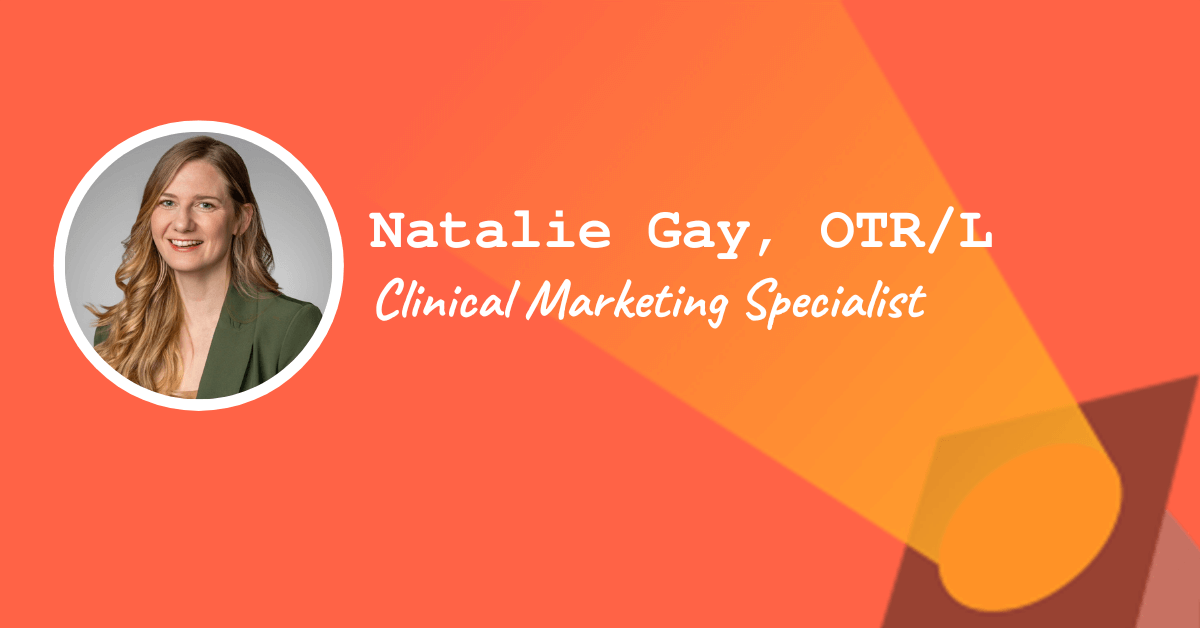


This week’s spotlight is on Natalie Gay, OTR/L, a non-clinical occupational therapist who is now Clinical Marketing Specialist for Bioness Medical!
This post may contain affiliate links or codes. This won’t increase your cost, but it helps keep TNCPT alive, and free of annoying ads! Thank you for your support. 🙂
What is your full name, title, and company name for your current, primary role?
Natalie Gay, OTR/L — Clinical Marketing Specialist for Bioness Medical, Inc.

Where are you located?
Pittsburgh, PA.
Where did you go to OT school, and what year did you graduate?
University of Pittsburgh, School of Health and Rehabilitation Sciences; 2012.
Please refrain from contacting our spotlight participants on social media. There are thousands of readers just like you out there. 🙂 Please ask your questions in the comments on this blog post.
If you’re a Non-Clinical 101 student or Go Non-Clinical member, you can network with many of our spotlight participants in our community!
What did you do when you first finished school, and for how long?
I worked in acute care for one year and home health for six years.
In what setting(s) did you work, and what types of patients did you treat?
My first position as an occupational therapist was in acute care at VCU Hospital in Richmond—a large teaching hospital where the OT team rotated through different units every few weeks. Within a year, I had the opportunity to work across nearly every specialty, including:
- Orthopedics
- Neurology
- Neuro ICU
- General medicine
- Cardiac
- Cardiac ICU
- Burn
- Respiratory ICU
- Trauma
- Trauma ICU
The range of experience I gained in that time was remarkable. I left feeling confident, empowered, and equipped to treat a wide variety of conditions.
From there, I transitioned into home health with Encompass Home Health. I began in general home health and eventually specialized in the assisted living setting, where many of my patients were living with dementia. In that role, the focus shifted from direct patient improvement to caregiver education and environmental modification. Encompass placed a strong emphasis on continuing education and evidence-based practice, which helped ensure our interventions were both current and effective.
Choosing organizations that value growth and professional development has been a solid foundation for my career. I would recommend both VCU and Encompass (now Enhabit Home Health) to anyone building their clinical foundation. My time at VCU taught me that I could work in any setting with any patient population, while Encompass showed me how organizations that prioritize patient outcomes and professional development create lasting success. The companies you choose early in your clinical career build the foundation for everything that comes next.
What did you enjoy about your early roles? What didn’t you enjoy?
In acute care, I loved the flexibility and unpredictability of each day. Every shift brought new challenges and opportunities to problem-solve across different units, which kept me constantly learning and growing. What I didn’t enjoy, however, was that success was often measured by billing units and productivity rather than patient outcomes. Even though I worked for an incredible organization, that focus sometimes felt at odds with the true purpose of therapy.
In home health, I loved the creativity and connection that came with treating patients in their own environments. It required truly getting to know each individual—their interests, routines, and motivations—to deliver meaningful, patient-centered care. What I found difficult was witnessing the barriers some patients faced, especially those with limited caregiver support or access to resources. It was a constant reminder of how much social and environmental factors impact recovery.
What else have you done since then, prior to your current clinical marketing specialist role?
At Encompass (now Enhabit Home Health), I was promoted several times over the six years I was there, serving as Community Care Program Manager, Director of Community Services, and eventually Director of Sales for the Northeast. These roles were my first introduction to the non-clinical side of healthcare and opened my eyes to how therapists can make an impact beyond direct patient care.
When and why did you decide to do something non-clinical?
I can’t pinpoint one exact moment when I decided to move into a non-clinical role—it really evolved over time with the influence of several incredible mentors. Along the way, I was fortunate to be surrounded by leaders who saw potential in me and encouraged me to think bigger: Bobby Johnson, OT; Dawn Meek, PT; Anne Holiday, OT; Shawn Cook, Account Executive; Kasi Hedt, PT; and Josh Mickle, OT.
Each of them shaped my journey in a different way. Dawn gave me confidence, reminding me that any organization would be lucky to have me and that my work spoke for itself. Bobby reflected back to me the positive impact I was having within our team and organization. Anne was the first to directly encourage me to consider a non-clinical path—she even invited me to apply for one. Shawn taught me everything I know about sales and communication. Kasi challenged me to step outside my comfort zone and find creative solutions to problems. And Josh ultimately opened the door for me to join Bioness Medical, Inc., encouraging me to advocate for my future within the company and continuing to support the initiatives I’m involved in today.
Looking back, I didn’t just “decide” to go non-clinical—I was guided there by people who believed in me, challenged me, and helped me see how I could make an impact beyond traditional patient care.
What are you doing these days?
Today, I work as the Clinical Marketing Specialist on our marketing team, serving as a bridge between our field clinicians, our marketing department, the patients who benefit from our technology, and the therapists who rely on it to drive outcomes. I love that my role connects all of these perspectives to help move the field forward.
This year, we launched Bioness Clinical Note—a social media platform designed for busy clinicians who want quick access to tech tips, treatment ideas, and the latest research. Our goal is to make both education and technology more accessible to clinicians and patients alike.
Editor’s note: You can check out Bioness Clinical Note on LinkedIn, Instagram, and Facebook!
No two days are the same. I might be reviewing patient stories, creating digital or social media content, developing new internal platforms to streamline processes, planning national or local events, or supporting research initiatives. The opportunities to advance rehabilitation technology through clinical marketing feel endless, and it’s exciting to see how this space continues to grow.

Are you still treating patients, or are you solely non-clinical?
I’m solely non-clinical at this point, but I still have the privilege of working closely with patients in many ways. I collaborate with them on our success stories, a patient-driven podcast we recently launched, and our YouTube series that provides educational resources for both patients and clinicians. I also have the opportunity to partner with several nonprofits founded by the patients we serve. So while I’m no longer treating directly, patient interaction and clinic-based content remain a meaningful part of my work every day.
How long have you been in your current role?
I’ve been in the clinical marketing specialist role since October 2022. Before that, I was a clinical territory manager at Bioness beginning in December 2019.
What do you wish you would’ve known before going into this clinical marketing specialist role?
I wish I had known just how much I would fall in love with this role. It truly feels like I’ve found my calling. I love what I do and feel like I’m making a meaningful impact on the industry—advocating for both patients and clinicians in new ways.
I’m also incredibly grateful for my manager, Joyden De La Vega, who gives me the flexibility to explore what I’m passionate about and integrate it into our business strategy. When something sparks my curiosity, she supports me fully and sets me up for success. She’s a remarkable leader and a big part of why I love what I do.
Did you get any special certifications or training along the way to help you get into your current role?
Throughout my career, I’ve tried to take advantage of learning opportunities that aligned with my interests and goals. At Encompass (now Enhabit Home Health), I participated in several leadership and professional development trainings, including speaker courses, Enneagram workshops, and sales trainings.
When I joined Bioness Medical, I continued that growth mindset by enrolling in digital and marketing courses to strengthen my skills outside of work. Whenever there was something I wanted to learn more about, I asked—and my leaders were always supportive, whether that meant helping me join a course, getting on a waitlist, or simply allowing me to observe and learn from others.
How did you find your job? Did you apply or find it through a connection?
I actually found my current role through a connection. Josh Mickle and I both graduated from the University of Pittsburgh, and years ago, I even tried to recruit him to the company I was working for at the time. He turned me down—he was genuinely happy at Bioness Medical, Inc.!
A few years later, when industry changes to reimbursement shifted my previous role away from the clinical sales that I loved to just strictly sales, Josh reached out at just the right time to recruit me to Bioness. I started as a clinical territory manager, helping patients gain access to our technology, and eventually transitioned into my current role in clinical marketing.
What was the interview like for the clinical marketing specialist role?
I was very pregnant at the time of my interview—which made it memorable, to say the least! I had to give a full PowerPoint presentation on our technology, which was definitely a challenge but also a great opportunity to show how much I had researched and understood the company. I’ve heard the interview process looks quite different now, but back then, it was clear the goal was to see whether I had truly done my homework.
What are some of the things you did to stand out, take initiative, and advance in your career?
I tend to hold myself to a high standard—to be frank, I am hard on myself. (I am not sure if that is the healthiest answer!) When I noticed I wasn’t meeting productivity or sales goals, I didn’t wait for someone else to bring it up—I went to my manager to talk through what I’d tried and explore new ideas or strategies. I think leaders appreciate when you can recognize an area for improvement and come forward with a plan to address it.
At Encompass, that mindset helped me grow into several new roles. I stayed focused on meeting expectations and valued having clear goals and measures of success—which they were very clear about. Along the way, I leaned on a few great resources like The 4 Disciplines of Execution and Hiring for Attitude, and used the Enneagram as a tool for reflection and professional growth.
How have people reacted to you leaving patient care?
It’s been quite a while since I left direct patient care, so I’m not sure many people even remember the transition! When I first moved into a program manager role, my mom worried that I might not feel fulfilled after working so hard in school to become an OT. She quickly realized that wasn’t the case. Now, as a clinical marketing specialist, my husband often comments that I seem happier and more energized than ever in my career—and he’s absolutely right.
What’s a typical day or week in the life like for you? What types of tasks and responsibilities fill your time?
No two weeks ever look the same—but Tuesdays are definitely my busiest! They’re filled with digital strategy meetings, eblast planning, geotargeting discussions, and of course, my favorite—our Bioness Clinical Note team meetings. I primarily work remotely, but I occasionally get to travel for events, capture clinic video footage, or attend company meetings in person.
Since our company was acquired earlier this year, there have been so many exciting opportunities with new technology, education, and collaborations. Just recently, I worked with a physical therapy influencer to develop treatment ideas using our devices. This week, we launched BITS Functional Reality, our new virtual reality technology that I helped our team to develop and name. Next week, I’ll be interviewing a patient who received access to our technology through a nonprofit started by another one of our users. It’s a busy schedule—but it’s incredibly rewarding.
What are some of the rewards of your role? What are the biggest challenges?
The rewards are truly an everyday thing. Seeing videos of patient successes or helping a field team member reach their goals using resources we built together—those moments top the list. It’s incredibly fulfilling to see the real impact our work has on both clinicians and patients.
The biggest challenge is prioritizing. There are so many possibilities and ideas that it can feel endless at times. We constantly have to step back and ask, “What will make the biggest impact—for the industry, for patient outcomes, and for the therapists we support?” I think this year has been our most successful yet in executing on that goal.
How did your clinical background prepare you for this role? Which skills transferred?
My OT background prepared me for this role in so many ways. Occupational therapy is centered around analyzing the person, their environment, and the activities they’re engaged in—essentially, problem-solving from every angle. That same analytical and adaptive thinking is exactly what’s needed in a fast-paced clinical marketing role.
My experience in pulling and applying research has also been invaluable. We’re not just a DME company—we’re a research-driven organization providing evidence-based education to clinicians. That means I’m constantly using my clinical skills to interpret data, apply findings, and translate them into practical treatment ideas that incorporate technology in meaningful ways.
Ready to launch your own non-clinical career?
Plus, you’ll get early access to curated non-clinical job listings and a bonus lesson on AI!
Roughly speaking, how are the hours and pay compared to patient care?
To be completely transparent, I took a pay cut—twice—at different points in my career in order to move forward. Both of those decisions ultimately paid off. Today, I’m in the best financial position I’ve been in throughout my career, but just as importantly, I feel valued for both my expertise and the impact I make.
I’m part of a team that respects my clinical background, welcomes my ideas, and recognizes contributions openly. The financial reward is meaningful, but the sense of purpose and respect in my current environment is truly priceless.
What type of person do you think would do well in your clinical marketing specialist role?
I think this role is a great fit for someone who’s collaborative, self-driven, and genuinely team-oriented. Our team has a really supportive culture—we celebrate each other’s wins and take pride in shared success. When a teammate launched a major product this year, it actually brought tears to my eyes seeing how proud everyone was. Moments like that remind me how special our team dynamic is.
To do well in this role, you need to enjoy working collaboratively but also be comfortable taking initiative and driving projects forward independently. It’s a fast-paced environment with lots of exciting opportunities, so being proactive and dependable goes a long way.
Do you work remotely or onsite?
I currently work remotely, but I know there will eventually be future opportunities for clinical expertise onsite in Valencia, CA—and I’m excited to see how that evolves!
Does your organization hire PT, OT, or SLP professionals into non-clinical roles? If so, what type of roles?
Yes—Bioness has a long history of valuing PTs and OTs in both clinical and non-clinical roles, which I believe is a big part of why we’ve been so successful in this field. This year alone, we’ve welcomed 58 new team members. We currently have 10 job titles that are non-clinical roles across sales, education, and marketing, employing over 60 clinicians nationwide. While I’m not directly involved in hiring decisions, I can absolutely see SLPs joining our team in the future—especially as our product line continues to expand with new technology launches.
Did you read any books, take any courses, or do anything special overall to get you where you are today?
Two books that really influenced my growth are The 4 Disciplines of Execution and Hiring for Attitude. Both helped shape how I approach leadership, goal setting, and team development throughout my career.
What is a typical career path for someone in your clinical marketing specialist role?
At Bioness, while it’s not a requirement, a great foundation for this role often comes from experience as a clinical territory manager, area sales manager, clinical specialist, or virtual clinical specialist within our organization. Those positions provide valuable insight into our products, patients, and clinicians—which translates really well into the clinical marketing specialist role.
What is next for you? What are your high-level career aspirations?
I once read an analogy about “rock stars” and “super stars” in the workplace. Super stars are driven to keep climbing the ladder and taking on new challenges, while rock stars grow by deepening their expertise within their current role. I’ve always seen myself as a bit of a chronic super star—someone who’s motivated by growth and upward momentum.
As I enter my third year in this position, that drive is still there, but it’s become more focused. My goal is to reach as many patients and clinicians as possible with our life-changing technology and continue advancing that mission. I’m excited to keep growing while making a meaningful impact along the way.
What would you recommend to someone who is considering going into a role like yours? Do you have any special words of wisdom for the readers?
If you’re considering a role like mine, lean into curiosity and growth. Don’t be afraid to ask questions, take on projects that stretch you, and say yes to learning opportunities—even if they’re outside your comfort zone.
The clinical foundation you build early in your career will serve you in ways you can’t imagine, especially when you transition into a non-clinical role.
Also, choose the organizations you work for wisely. The right company will value your clinical expertise, invest in your professional development, and give you the space to explore what you’re passionate about.
And finally—trust the process. Sometimes a step sideways or even a step back financially can open the door to something far more fulfilling in the long run.
What would you like to change most in your profession, and why? How would you propose doing so?
It’s especially difficult to see patients denied access to life-changing technology—even after their physician, therapist, and clinical team provide clear evidence of improvement. Those decisions can feel unnecessarily harsh when safety and independence are on the line. While it’s not directly part of my role, I’m looking forward to partnering with our new Market Access Manager to help spotlight the research and data that prove how rehabilitation technology can meaningfully improve outcomes and overall healthcare value.
What career advice would you give yourself that you wish you had during school?
If I could give my younger self career advice, it would be this: your environment matters more than you realize. You can make great money, but if you’re not being supported in your professional growth, it’s not worth it. Find a clinical setting that invests in your development and values your potential. The right environment will challenge you, build your confidence, and open doors you didn’t even know existed—while the wrong one can drain your passion before your career really begins.
Looking back, I know I’m where I am today because of the companies I chose and the mentors who guided me along the way.
What would you teach to today’s graduate students in your profession, if you had the opportunity?
If I could share one lesson with today’s graduate students, it would be to spend your first year in a setting that truly teaches you. Find a hospital or organization that offers mentorship, balance, and support. Your first year should be about growth and learning, not chasing the highest paycheck.
I’ll admit, early in my career I had a little FOMO seeing colleagues earn more right out of school. But over time, I realized that the slower path—choosing growth and mentorship—set me up for long-term success. Many of those early choices gave me the skills, confidence, and career advancement that led to both greater fulfillment and, eventually, greater financial reward.
Do you have any special advice for others who want to follow in your footsteps?
One of the best pieces of advice I’ve ever received came from Josh Mickle: speak up. Let management know where you see yourself in the next few years and what kind of work truly excites you. When a position opened that leadership wanted me to apply for—but I knew it wasn’t the right fit—I had an honest conversation about what I was really passionate about. Not long after, the company created a role that aligned almost exactly with what I had described.
So my advice is this: don’t be afraid to advocate for yourself. The right leaders will listen—and sometimes the opportunity you want doesn’t exist yet until you help shape it.
