
Published:

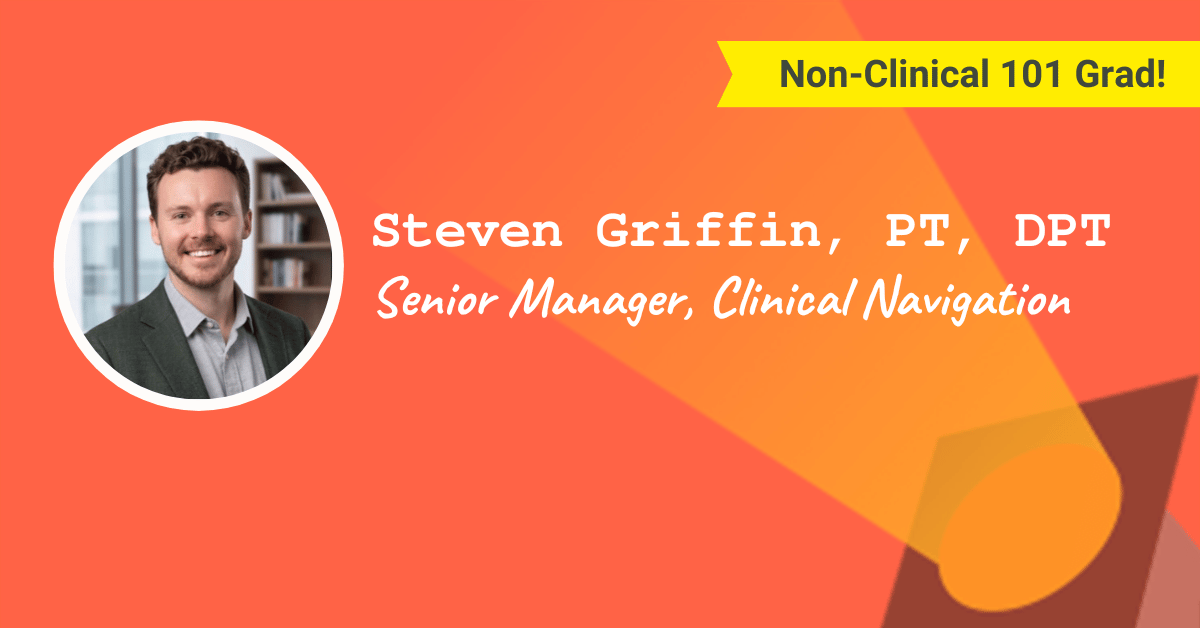
Steven Griffin is Senior Manager, Clinical Navigation at TailorCare, which contracts with health insurers to manage care for patients with joint, back, and muscle pain. Instead of a referral sending someone straight to a specialist, TailorCare assigns them a physical therapist, called a Clinical Navigator, to help them get to the right care the first time. Steven is a non-clinical physical therapist and a Non-Clinical 101 graduate.
Health plans pay for a lot of unnecessary imaging, referrals, and procedures when musculoskeletal pain isn’t triaged well early on, and TailorCare’s pitch to those payers is that a navigator who understands the clinical picture can catch that before it happens.
This post may contain affiliate links or codes. This won’t increase your cost, but it helps keep TNCPT alive, and free of annoying ads! Thank you for your support. 🙂
What is your full name, title, and company name for your current, primary role?
Steven Griffin — Senior Manager, Clinical Navigation for TailorCare
Where are you located?
Alexandria, VA
Where did you go to PT school, and what year did you graduate?
Emory University, 2016
What did you do when you first finished school, and for how long?
I was a physical therapist in outpatient orthopedics for three years, and then was a clinic director at the same clinic for three years.
In what setting(s) did you work, and what types of patients did you treat?
Outpatient orthopedics. I treated the typical mixed caseload you would expect at an insurance-based outpatient orthopedic clinic.
What did you enjoy about your early roles? What didn’t you enjoy?
I enjoyed the problem solving aspect of treating patients. It was rewarding to work through challenges and help patients reach their goals. I also enjoyed being active throughout my day, which is something I miss in my current role.
The most challenging part of my clinical role was the mental and emotional taxation that came from being “on” all day. As a natural introvert, it was tough to interact with people who often weren’t at their best all day every day. It began to affect me negatively in some ways outside of work. Additionally, I struggled to see a path of professional growth beyond where I was at the time of my departure. I craved development and advancement that I was unlikely to attain in my previous position.
When and why did you decide to do something non-clinical?
I began to pursue non-clinical roles in mid year of 2022, after I had been with my company for almost six years. I decided to leave clinical care because I was feeling professionally stagnant, and I wanted to explore positions that would allow me to develop additional skills that my clinical position would not.
What are you doing these days?
I work in the clinical operations department of TailorCare. I lead a team of talented PTs who deliver clinical navigation services to patients. In addition to people leadership, I work cross-functionally with other departments in our organization like product & engineering, data & analytics, growth & market ops, and more to ensure we provide excellent experiences for our patients and our employees.
Are you still treating patients, or are you solely non-clinical?
I do not treat patients in my role.
If you’re still treating patients, what percentage of your time is spent clinically vs. non-clinically?
0%
How long have you been in your current Senior Manager, Clinical Navigation role?
December, 2022. I was promoted from manager to senior manager in April, 2025, but my role responsibilities have not changed drastically.
What do you wish you would’ve known before going into this role?
I wish I had known how quickly things move and change in a healthcare startup company. This was a big change from my relatively stable environment in clinic.
I also wish I had been more thankful for my opportunity to directly impact the lives of my patients. While I love my job now, I do find myself missing the personal interactions and the satisfaction of helping people grow and return to their lives.
Did you get any special certifications or training along the way to help you get into your current role?
I took Non-Clinical 101. I did not take any other courses.
How did you find your job? Did you apply or find it through a connection?
I found my current job through the weekly Non-Clinical PT job postings email.
Did you do anything special to your resume and cover letter to land the job?
I reformatted my resume and ensured that I included relevant skills I’d acquired that would allow me to excel in the role.
What was the interview like for the Senior Manager, Clinical Navigation role?
I had a three-round interview with key members of the clinical operations department. Besides asking about my experiences and qualifications, the interviews went in-depth to ensure I was the right person to fit into the culture of such a new and small organization. The process was also quite swift. I had my first interview in mid-October of 2022 and was given my offer in early November.
If you advanced through a company to get to where you are, what are some of the things you did to stand out, take initiative, and advance in your career?
By my estimation, my advancement within the organization has come through my willingness to take on challenges, seek help from others, and learn from mistakes. Doing all of these things is uncomfortable, but it allows me to grow and prove my value to other team members. Additionally, I’ve formed many connections in the organization that allow me to navigate the complex startup environment and more effectively perform my role.
How have people reacted to you leaving patient care?
People within the profession have been understanding and curious about my journey. People like family members and non-PT friends were initially surprised and struggled to understand my decision. However, given that I still work in healthcare, the decision isn’t quite as difficult to digest for people as I imagine it would be if I’d left healthcare altogether.
What’s a typical day or week in the life like for you? What types of tasks and responsibilities fill your time?
To be honest, a good majority of my days consists of various meetings. As I mentioned previously, I am involved in many cross-collaborative projects, and these meetings typically center around:
- Daily operations
- Clinical model strategy
- Quality assurance
- Product enhancements
- Data analysis
- External partner meetings
However, despite these projects, team leadership is still my primary responsibility. The rest of my day consists of ensuring my team members have everything they need to be successful in their roles and to meet our organizational goals.
What are some of the rewards of your Senior Manager, Clinical Navigation role? What are the biggest challenges?
For me, the biggest reward is being able to work with talented PTs who are excellent at what they do both for their patients and with the additional responsibilities they’re given. My team makes me look good every day, and without them, TailorCare wouldn’t be where it is today.
In addition to working with talented and hard-working people, I love that my role allows me to continue growing professionally. While I’m grateful that I do not feel stagnant, the other side of this coin is that growth can be very challenging and uncomfortable at times. I’m frequently reminded that I still have a lot to learn from others and that I must always be at my best to perform up to standards in this position.
How did your clinical background prepare you for this role? Which skills transferred?
By far, the biggest transferable skill that has helped me excel has been communication. Obviously, in order to be an effective PT, you must become an expert in communicating with many, many personality types. Communication skills allow you to build rapport with people, and that is key for my role.
Additionally, since I am still in the MSK sector of healthcare, clinical knowledge has served me well in my role. I’ve been able to influence our clinical model, hold discussions with other departments with clinical consideration in mind, and assist team members in discussions with patients.
Roughly speaking, how are the hours and pay compared to patient care?
The hours are roughly the same over time. The schedule is more flexible, so while I remain available for 10 hours throughout the work day, I’m not working every moment of that most days. However, there are days when I work significantly more than eight hours and I do occasionally travel and perform weekend work.
What type of person do you think would do well in your Senior Manager, Clinical Navigation role?
Adaptability and willingness to grow are two traits I feel are necessary to be successful in this role and this environment. Things change so rapidly, and the ability to adjust your plans, your actions, your expectations, and your communication is key to success. Additionally, you must be willing to learn from others and from your experiences. Because things move quickly, you are frequently asked to take care of things that you may not have prior knowledge on or experience with. I have been fortunate to work for TailorCare, whose leaders trust me to work through these challenges, but it certainly has not come without some pain for me in the process.
Do you work remotely or onsite?
Remotely
Does your organization hire PT, OT, or SLP professionals into non-clinical roles?
Technically, all of our roles are non-clinical because we do not provide direct patient care. However, there are a few instances where clinicians have been hired into roles that are not patient facing. Another colleague and myself have managerial roles with the responsibilities I have mentioned. There is another DPT who was recently hired as a director of market operations, but he’s had experience in that role type for quite a while. Additionally, our VP of clinical operations is an SLP who had extensive experience in the value-based care sector prior to joining TailorCare. Finally, we had another DPT who was hired as an associate product manager; however, she was the second PT hired at the organization behind me and I would not consider her career path common at TailorCare moving forward.
Did you read any books, take any courses, or do anything special overall to get you where you are today?
Besides Non-Clinical 101, I did not take any courses to get me to my role. I read several books on communication prior to researching and accepting my role, but these were not specifically for the purpose of obtaining this role. These books included:
- How to Win Friends and Influence People
- The Next Conversation
- Verbal Judo
- Never Split the Difference
- Leaders Eat Last
What is a typical career path for someone in your Senior Manager, Clinical Navigation role?
I’m still figuring that out. Given that this is my first non-clinical stop, I do not have a lot of steps to look back on and lay out a specific path.
What is next for you? What are your high-level career aspirations?
I want to continue learning more skills related to operations. My biggest goal is to develop a toolbox that is versatile enough to ultimately give me options to qualify for a greater variety of jobs in the future, whether that’s with my current organization or beyond. I have also enjoyed learning what it takes to start a company from almost the ground up, and am looking forward to seeing what it takes for the organization to be successful at scale.
What would you recommend to someone who is considering going into a role like yours? Do you have any special words of wisdom for the readers?
The number one piece of advice I have is to put yourself out there. The main reason I am where I am today is because I was willing to take a chance on a very young organization who was willing to take a chance on me. It has required me to be frequently uncomfortable, from applying to and accepting the position all the way to present day where I am still working on internal growth and organizational changes.
Embrace the discomfort that comes with growth, rejection, and being vulnerable.
What would you like to change most in your profession, and why? How would you propose doing so?
There are so many answers here, but ultimately, the thing I would like to change most is creating a healthcare system that places more importance on patient empowerment and preventative health. I think as PTs/OTs/SLPs, we see a lot of patients who are experiencing challenges that ultimately could have been avoided if the right actions were taken in their past. Once they come to us, it can be very difficult to undo years of decisions and habits in a matter of eight to 12 visits. Additionally, those of us therapists who pour our hearts and souls into those patients often do not see any additional reward or acknowledgment as opposed to peers who provide subpar care.
If value-based care is delivered appropriately and consistently over time, everyone can win.
What career advice would you give yourself that you wish you had during school?
Stop protecting your ego. You don’t know much right now, but you will learn. You just have to be willing to put yourself out there, fail, and grow.
What would you teach to today’s graduate students in your profession, if you had the opportunity?
For me, I wish I’d been taught more about human psychology and motivational interviewing. School does a good job at teaching us tests, measures, interventions, and all of the practical applications of therapy. However, the longer I practiced in clinic, and even in my role now, I realized that connecting with people, finding out what motivates them, and employing actionable solutions is what drives meaningful results.
A suboptimal plan done consistently is more effective than an optimal plan done inconsistently or not at all.
While our profession is physical (or occupational or speech) therapy, I often feel as though it’s more psychological therapy. As such, I think we should teach this in more detail in school.
Do you have any special advice for others who want to follow in your footsteps?
I’ve already given advice around putting yourself out there and learning communication skills, so I’ll leave one final piece of advice:
If you are still clinical and feel desperate to find a non-clinical role, I hear you. But I urge you to be thankful for the opportunity to help others who aren’t at their best. We have a tendency to allow the negative aspects of our role outweigh the positives in our minds. From someone who is currently non-clinical, I can tell you that I do love what I do, but I also took for granted that daily positive impact I had on others. Please do not let your pursuit of something different jade your view of your work and the meaningful impact you have on your patients.
What to read next
- How to Get a Non-Clinical Job: Advice From the Hiring Managers Making the Decisions — what the people on the other side of the table are actually looking for.
- How to Create a Non-Clinical Resume (for PTs, OTs, and SLPs) — a template for turning clinical experience into results a hiring manager can use.
- Donna Lampke’s spotlight as a Cross Market Care Coordinator at naviHealth — another value-based care navigation role, from the individual-contributor side.
- Dylan Allen’s spotlight as a Medical Home Care Manager — a different care-management model, with its own take on the manager track.
More resources for your non-clinical career
If you’re finding your own way through the non-clinical transition, we’ve created these FREE resources to help you get your bearings.
- Our weekly jobs newsletter: 100+ fresh non-clinical job postings every week, plus new spotlights, our latest articles, and hiring partners recruiting straight from our community.
- Four Secrets to Landing a Fulfilling Non-Clinical Healthcare Job: our free mini-course, delivered to your inbox.
- Our free career quiz: 15 questions, and you’ll come out with a much clearer picture of which non-clinical sectors suit you.
Steven went through Non-Clinical 101 on the way to this role. It’s our course & community teaching rehab pros how to make the switch in half the time with twice the confidence — a step-by-step roadmap rather than piecing it together on your own.
