
Published:

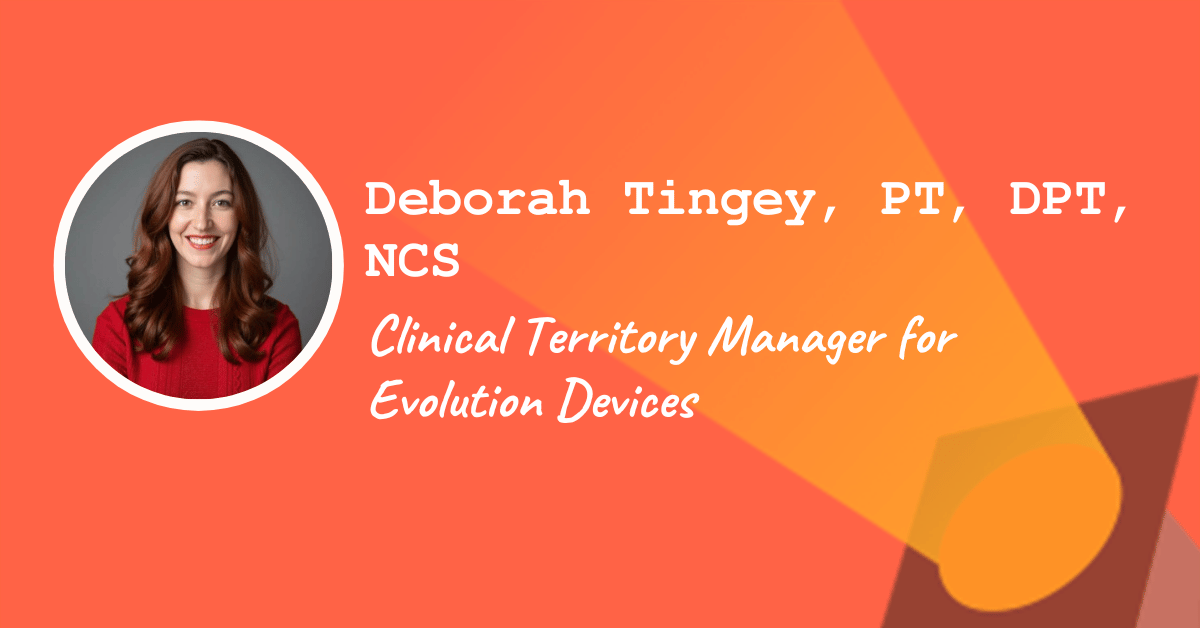
Deborah Tingey, PT, DPT, NCS, is Clinical Territory Manager for Evolution Devices, which makes a wearable device that uses electrical stimulation to help people with foot drop, from stroke, MS, or spinal cord injury, walk more easily. The device is FDA-cleared, and the company sells it directly into rehab clinics and hospitals, training the physical and occupational therapists who fit patients with it and track their progress.
She’s a non-clinical physical therapist now in medical device sales, selling directly to the therapists who prescribe the device. Ten years of inpatient neuro rehab made her the obvious person to sell it. Getting out of the clinic mindset, she says, was the harder part.
Evolution Devices is a Go Non-Clinical hiring partner, and its careers page is one to watch if this kind of company interests you. If you want to make a move like hers, join the Go Non-Clinical community, where rehab pros work through the same switch and hiring partners recruit directly.
This post may contain affiliate links or codes. This won’t increase your cost, but it helps keep TNCPT alive, and free of annoying ads! Thank you for your support. 🙂
What is your full name, title, and company name for your current, primary role?
Deborah Tingey, PT, DPT, NCS — Clinical Territory Manager for Evolution Devices
Where are you located?
Austin, TX.
Where did you go to PT school, and what year did you graduate?
University of St Augustine for Health Sciences, 2015.
What did you do when you first finished school, and for how long?
I worked in clinical settings, primarily inpatient rehab, for about 10 years and as a Faculty Lab Instructor for six years.
In what setting(s) did you work, and what types of patients did you treat?
I primarily worked at inpatient rehab settings with a little bit of outpatient and LTAC mixed in. My primary focus since graduating has been neuro patient populations.
What did you enjoy about your early roles? What didn’t you enjoy?
What I enjoyed was what pushed me into becoming a PT in the first place: helping individuals regain independence and quality of life through targeted interventions. I also loved working with PT students and having the chance to mentor and teach.
Like most in our profession, the lack of career progression outside of managerial roles, alongside difficulty maintaining work/life balance, began to hit hard after 10 years of clinical work.
When and why did you decide to do something non-clinical?
After COVID, I began to look into other opportunities outside of the clinic. I was ready for a change and a new challenge.
What are you doing these days?
My current role focuses on leading regional field sales operations, establishing Evolution Devices’ presence across Southern State. I have the opportunity to play a foundational role in shaping the company’s regional field sales playbook and driving early growth in a new territory.
Are you still treating patients, or are you solely non-clinical?
For the first time since I graduated PT school, I am able to focus on one job.
Prior to my current role at Evolution Devices, I worked full-time plus PRN shifts and assisting at the University of St Augustine. I am now solely non-clinical.
How long have you been in your current Clinical Territory Manager role?
I joined the company in January of 2025.
How did you find your job? Did you apply or find it through a connection?
I found this role on LinkedIn.
How have people reacted to you leaving patient care?
Excitement overall, with a desire to learn more about the process to transition to non-clinical roles.
What’s a typical day or week in the life like for you? What types of tasks and responsibilities fill your time?
Each day varies, but I have the freedom to structure my time and travel into a schedule that prioritizes the goal I have set for myself that week.
What are some of the rewards of your Clinical Territory Manager role? What are the biggest challenges?
Rewards of this role are the continuous growth opportunities and recognition for the work I put into it. I have been supported in my professional growth, and it is reflected in my role at the company.
The biggest challenge has been the initial transition out of the PT Clinic mindset.
The skills I learned as a healthcare professional tie in well to this role, but it does take active thinking and training to successfully translate those skills.
How did your clinical background prepare you for this role? Which skills transferred?
Yes, my role as a PT, especially with a neuro background, made me an excellent candidate for this role. Our company provides access to dual-channel FES to support gait in those with UMN injury. My clinical expertise is used daily with clients, physicians, and therapists I interact with.
What type of person do you think would do well in your Clinical Territory Manager role?
Qualities that are helpful to succeed in this role include strong attention to detail, flexible with the ability to pivot quickly for changes, a “people person” who is comfortable seeking out and building relationships with physicians and rehab teams, and internal drive and self-motivation to succeed. Many great PTs/OTs/SLPs already possess these skills, as it is necessary in order to be successful in the healthcare world.
Do you work remotely or onsite?
Much of my time is spent in clinics and hospitals throughout my territory. When I am not at a facility, my work is fully remote.
Did you read any books, take any courses, or do anything special overall to get you where you are today?
I read many of the testimonials and blog entries through The Non-Clinical PT.
What is a typical career path for someone in your Clinical Territory Manager role?
I didn’t take a typical career path for this role and am creating my own journey forward.
What is next for you? What are your high-level career aspirations?
I am excited to continue to grow in this role and move up in the company. As we grow, being able to mentor new clinicians transitioning into non-clinical spaces will be incredibly rewarding.
What to read next
- Territory Manager — Sheila Mallon — the same job title at a different device company, selling DME instead of a neuro FES device.
- Training Clinicians on a Stroke Device at Vivistim: James Sloan on the Therapy Development Specialist Job — a neuro device company, from the training side of the job rather than the sales side.
- How to Get a Non-Clinical Job: Advice From the Hiring Managers Making the Decisions — what device and healthcare-tech hiring managers actually screen for.
- The Non-Clinical Jobs Report, from Go Non-Clinical — how sales and business development roles like hers compare to the rest of the non-clinical job market right now.
More resources for your non-clinical career
If you’re finding your own way through the non-clinical transition, we’ve created these FREE resources to help you get your bearings.
- Our weekly jobs newsletter: 100+ fresh non-clinical job postings every week, plus new spotlights, our latest articles, and hiring partners recruiting straight from our community.
- Four Secrets to Landing a Fulfilling Non-Clinical Healthcare Job: our free mini-course, delivered to your inbox.
- Our free career quiz: 15 questions, and you’ll come out with a much clearer picture of which non-clinical sectors suit you.
If you’d rather follow a step-by-step roadmap than piece this together on your own, that’s exactly why we made Non-Clinical 101. It’s our course & community teaching rehab pros how to make the switch in half the time with twice the confidence.
