
Published:

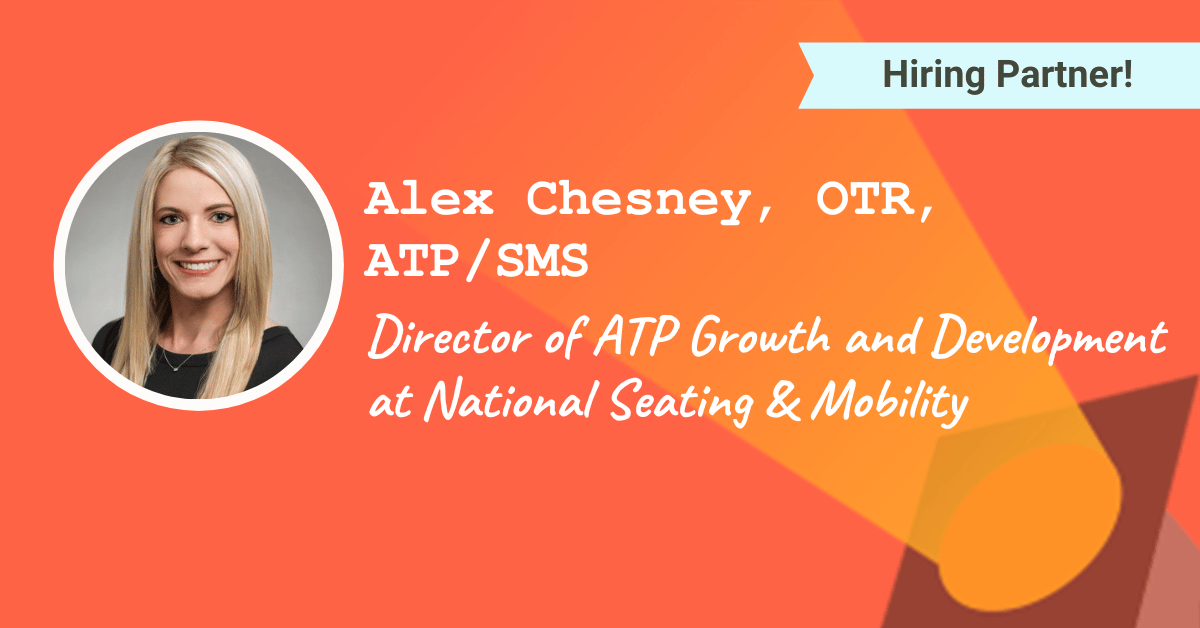
Alex Chesney, OTR, ATP/SMS, is Director of ATP Growth and Development at National Seating & Mobility, which provides custom power and manual wheelchairs, custom seating, and additional assistive technologies to people with disabilities.
At NSM, an Assistive Technology Professional (ATP) evaluates what a client needs and helps them choose a wheelchair, custom seating, or other complex rehab technology (CRT), working collaboratively with the client’s therapist and physician. NSM brings clinicians into the ATP career pathway through its ATP Development Program, a mentorship track toward certification, and Alex walks through her part in it below. She’s a non-clinical occupational therapist, and outside NSM she’s Vice President of the Rehabilitation Services Volunteer Project, a nonprofit.
National Seating & Mobility is a hiring partner of Go Non-Clinical. You can join the private community to chat with their hiring managers, and their open roles are on the Go Non-Clinical job board as well as NSM’s own careers page.
This post may contain affiliate links or codes. This won’t increase your cost, but it helps keep TNCPT alive, and free of annoying ads! Thank you for your support. 🙂
What is your full name, title, and company name for your current, primary role?
Alex Chesney, OTR, ATP/SMS — Director of ATP Growth and Development for National Seating & Mobility
What additional roles do you currently have?
Vice President of a nonprofit: Rehabilitation Services Volunteer Project.
Where are you located?
Houston, TX.
Where did you go to OT school, and what year did you graduate?
Texas Woman’s University Houston Med Center, graduated in 2013.
What did you do when you first finished school, and for how long?
Inpatient Neurological Rehab for SCI at TIRR in Houston for six years.
In what setting(s) did you work, and what types of patients did you treat?
Inpatient rehab: spinal cord injury, TBI/CVA, amputee, neuro-degenerative diseases.
What did you enjoy about your early roles? What didn’t you enjoy?
The fast-paced inpatient rehab world and especially neuro recovery. I loved neuromuscular re-education technologies, and working with the most extreme cases like patients on ventilators, etc., and being part of helping them find independence and recovery.
What else have you done since then, prior to your current role?
I was a clinical education director for seven years at a major power wheelchair manufacturer, where I traveled across the country educating on advanced complex rehab technologies and power mobility/alternative drive controls, etc. I briefly returned to TIRR working on patient safety and quality for eight months before my current role.
When and why did you decide to do something non-clinical?
I loved inpatient rehab, but also enjoyed teaching through various education events and was told I was a good speaker, lol. My manufacturer rep for one of the wheelchair manufacturers asked me if I’d ever thought of anything outside of the clinic, and I took a chance and never looked back as I fell in love with the CRT world.
What are you doing these days?
Now I get to help be part of the future of the CRT industry and take what I’ve learned and continue to learn to instill that in clinicians looking to transition to an ATP, or in helping current ATPs be the best in the industry. This role allows me to be a continuous learner, be involved in business development and educating, along with fostering mentorship of others who are interested in complex rehab technologies.
For free, I’m very actively involved in many organizations. I’m a VP of a nonprofit, RSVP, where we provide clinical and equipment services to those unfunded or underfunded with neurological conditions. I sit on the board in addition to helping run the equipment division days.
I also am a member of the Clinician Task Force (CTF) and sit on their federal workgroup, and participate as a member of the Academy of Spinal Cord Injury Professionals (ASCIP) advocacy committee and a co-chair of a task force for that organization.
Are you still treating patients, or are you solely non-clinical?
Essentially non-clinical, but get to interact with the community patients through RSVP.
How long have you been in your current role?
I’ve been in the CRT space with my ATP/SMS for seven years, and most currently at NSM since May 2026.
What do you wish you would’ve known before going into this role?
Before going non-clinical, I just wish I knew there were roles like the ones I’ve been fortunate to have. I wish I would have had more knowledge on how therapy skills translate into business and leadership.
Did you get any special certifications or training along the way to help you get into your current role?
I had wanted to take my ATP but hadn’t yet, and otherwise I just got involved in education opportunities and ASCIP.
How did you find your job? Did you apply or find it through a connection?
I fell into this space based on connections and grew those over time.
Did you do anything special to your resume and cover letter to land the job?
I maintained a professional attitude and stayed a can-do resource for many, which eventually led to me being recommended for my current role. I did have many things to add to my resume that helped, like my nonprofit leadership and active participation in other committees, etc.
What was the interview like for the Director of ATP Growth and Development role?
Interviews were casual, but you needed to really represent yourself and be able to promote your talents without being pushy, but it’s important to be able to be confident in what you can bring to the table with direct or indirect skills. I had five interviews with different team members and leaders of the organization.
If you advanced through a company to get to where you are, what are some of the things you did to stand out, take initiative, and advance in your career?
At my previous company, I had good growth by taking initiative and being a do-er, along with communicating what I was accomplishing along the way through monthly reports to help visibility of impact.
How have people reacted to you leaving patient care?
It’s very interesting how you get treated. My former co-workers still know I stay incredibly active in organizations related to patient care, so they know I’ve stayed up to date on best practice and the “pulse” of spinal cord/neuro rehab. Within other groups there can be judgement of you went to “sales,” but mainly my experience is valued as a clinician due to the exposure I’ve had that many do not even get in school, and it’s all around the client and maximizing function.
No one is selling anything in CRT, or I don’t see it that way.
You are educating on the options patients have for independence and are the resource for meeting those needs and within the client’s insurance, or explaining options outside of that. You can’t just buy CRT products or not if you expect to use insurance and have maintenance/repair, etc.
What’s a typical day or week in the life like for you? What types of tasks and responsibilities fill your time?
This is all over the place: I can be interviewing clinical candidates; meeting with current clinicians in our ATP program regarding mentoring, NSM systems, client scenarios, exam prep. I can be making a subject matter expert clinical and policy documentation and funding presentations that go out to 700 employees with follow-up office hours; or making handouts to share that information with external sources. Keeping a pulse on the industry, ethics, products, and best practice to keep our ATPs in the know.
Or I could be traveling to a branch and working with an ATP in client evals, helping with tricky cases, or to see workflow processes we can improve. Organizing an educational symposium with educators across the country and the content needed to be presented. Learning about new pressure map technology and training ATPs and clinicians on its use. Flying in to corporate to meet with leaders on business development, pilot programs, learning and development goals, etc.
What are some of the rewards of your Director of ATP Growth and Development role? What are the biggest challenges?
The biggest reward is being a resource, but also being able to learn from so many others across the world and connecting with clinicians, ATPs, manufacturers, funders, etc. The biggest challenge at first (eight years in, it’s not a problem) is figuring out a workflow in an unstructured autonomous remote role.
How did your clinical background prepare you for this role? Which skills transferred?
My clinical role made me very dynamic and adaptable, which helps with the fluctuation of tasks and day-to-day workflow. I also feel activity analysis is the same as process improvement, where you are looking at a goal and creating out the steps to achieve that.
I also feel from navigating the dynamics of many patients, families, cultures, and work groups that this makes me very good at listening and understanding the perspectives of different areas. I can have my opinion but be neutral or even adapt to a plan if it differs from what I might think is ideal.
Roughly speaking, how are the hours and pay compared to patient care?
You have way more pay potential and flexibility overall, but the first few years you are hustling, and when you work across time zones sometimes there are after-hours needs, etc., so you have to be good at that flexibility and knowing certain periods are a crunch time, or when you first start you will be working extra at first while learning. It’s just like going from the new experience of being a student to a practicing therapist.
What type of person do you think would do well in your role?
Specific to being an ATP, you have to be very self-driven and motivated. You need to be good at using your resources, as there isn’t a true blueprint or hand-holding. You need to take initiative to learn. You need an outgoing personality who is not afraid to talk to those who don’t know what you do and be able to describe that.
You have to be a good communicator in all ways, including talking on the phone. Expert at time management. Passionate about CRT or helping patients. It’s incredibly rewarding but not glamorous if you are not passionate about it.
Do you work remotely or onsite?
Remotely; all ATPs cover a region or city, and you go all over that area. In my personal role as a director, I’m primarily remote but do travel to our corporate office and other states.
Does your organization hire PT, OT, or SLP professionals into non-clinical roles? If so, what type of roles?
We welcome all PT, OT, and we do have a few SLPs in this role. We currently also look at OTA and PTAs who have their ATP credentialing already. We have a program to help you have the materials to study and become a practicing ATP. We focus on practice in key recruitment areas with a mentor, and then your own business ramp up over a year. There are also roles in home access like ramps and stairlifts, funding specialists, customer service roles, technicians, marketing development, etc.
Did you read any books, take any courses, or do anything special overall to get you where you are today?
I found belonging to professional organizations, even clinically focused, were beneficial on networking, confidence, and leadership skill development. I did do a white belt Lean Six Sigma certification through The Joint Commission that was great and included change management. For a role as an ATP there are great resources to learn more and to help in studying for the certification, like the Seating and Wheeled Mobility: A Clinical Resource Guide textbook by Michelle Lange and Jean Minkel.
What is a typical career path for someone in your role?
My career path has been very “by chance,” but I’d say my career path would be continuing in leadership or business development. There is also continued growth in learning and development roles. For ATP roles, they traditionally stay in that role after building such a strong network and community of clients with good career longevity, but some go into branch management or regional director roles; working at manufacturer groups in education or sales reps. If someone wants more leadership/business development, there are roles for that, you just have to build that skill set. I’ve seen people go into many roles within a company based on good skill sets.
What is next for you? What are your high-level career aspirations?
Honestly, as long as I can continue being a resource and a lifelong learner who has impact on clients, that’s my goal. I would probably like to be a VP title at some point, but honestly titles don’t matter. I still debate getting my MBA again for more learning, and my career aspirations are very entwined with policy and advocacy work within the CRT space. I’m fortunate to say this role was a dream role I could have never described or known existed, so I’m just open to potential!
What would you recommend to someone who is considering going into a role like yours? Do you have any special words of wisdom for the readers?
Going into a role in CRT, I think the biggest advice would be that you know more than you think, but you also have no idea the possibility. You have to take the fear with doing something new and dive into learning, admitting what you don’t know, but find someone who can mentor you or give you a resource, take accountability for your growth, and try it. If you don’t like something, you can always go back to the clinic, or you see new opportunities you didn’t know existed.
When I first started as a clinical educator, I was shocked that no one ever told therapists about this world. Now with groups like this, you get to see and learn and explore options before fully leaping.
What would you like to change most in your profession, and why? How would you propose doing so?
I would like to change policy/insurance, haha, but that’s a problem for everyone. Truthfully, in the world of CRT I would love to change the trajectory. Many who started this industry are aging and will have a large sector retiring. They truly built this world: making custom seating in their garages; learning to do plaster molds; making power wheelchairs with seat functions. They made accessibility and adaptive equipment something that opens doors for all.
I want to bring more clinicians into this space because we have the mindset and the skills to help carry this legacy.
Clinicians just don’t know about it, and unfortunately there are so few wheelchair seating clinics to expose therapists to this.
What career advice would you give yourself that you wish you had during school?
Always listen to an opportunity. It’s advice I did take, but I think as someone type A and always had a plan, it can be confusing to think of “what’s next,” but the answer is to just be open-minded and hear things out.
What would you teach to today’s graduate students in your profession, if you had the opportunity?
Still would be teaching on wheelchair seating and mobility, because SO many therapists and clinics still don’t provide this for their patients when it truly impacts everything.
Do you have any special advice for others who want to follow in your footsteps?
Get involved. Join the committee. You don’t have to talk or do much at first, and you might be confused, but show up, learn the structure, learn the people, and see if you have a role to grow in it. Take the courses, not because you need CEUs, but because you actually want to learn.
What to read next
- Merrillee Millar’s spotlight at Myomo — another OT and ATP whose job is now training other clinicians, in her case on a myoelectric arm orthosis.
- Janice Gross’s spotlight at Reliable Medical — the ATP job itself, from an OT who also started on an inpatient SCI team.
- The Non-Clinical Jobs Report, from Go Non-Clinical — Assistive Technology Professional made its list of the top 12 job titles for Q2 2026.
- How to get a non-clinical job, with advice from hiring managers — what the people doing the hiring say they look for in a clinician.
More resources for your non-clinical career
If you’re finding your own way through the non-clinical transition, we’ve created these FREE resources to help you get your bearings.
- Our weekly jobs newsletter: 100+ fresh non-clinical job postings every week, plus new spotlights, our latest articles, and hiring partners recruiting straight from our community.
- Four Secrets to Landing a Fulfilling Non-Clinical Healthcare Job: our free mini-course, delivered to your inbox.
- Our free career quiz: 15 questions, and you’ll come out with a much clearer picture of which non-clinical sectors suit you.
If you’d rather follow a step-by-step roadmap than piece this together on your own, that’s exactly why we made Non-Clinical 101. It’s our course & community teaching rehab pros how to make the switch in half the time with twice the confidence.
