
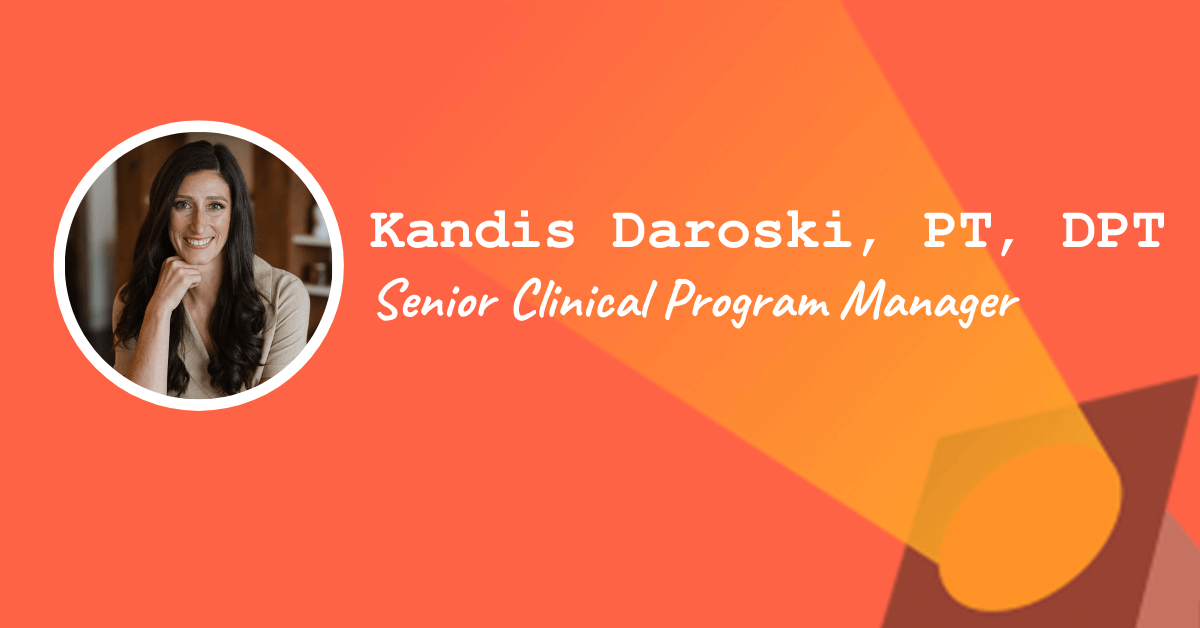


This week’s spotlight is on Kandis Daroski, PT, DPT, a non-clinical physical therapist who is now Senior Clinical Program Manager for Medbridge!
This post may contain affiliate links or codes. This won’t increase your cost, but it helps keep TNCPT alive, and free of annoying ads! Thank you for your support. 🙂
What is your full name, title, and company name for your current, primary role?
Kandis Daroski, PT, DPT — Senior Clinical Program Manager for Medbridge

Where are you located?
Canfield, OH.
Where did you go to PT school, and what year did you graduate?
West Virginia University, 2016.
Please refrain from contacting our spotlight participants on social media. There are thousands of readers just like you out there. 🙂 Please ask your questions in the comments on this blog post.
If you’re a Non-Clinical 101 student or Go Non-Clinical member, you can network with many of our spotlight participants in our community!
What did you do when you first finished school, and for how long?
I started out the first one and a half years of my career working on an acute rehab unit. I then transitioned to working in the outpatient setting.
In what setting(s) did you work, and what types of patients did you treat?
In acute rehab, I treated patients in the hospital after complex medical events, like stroke and ICU stays. When I transitioned to outpatient, I saw a variety of chronic and acute musculoskeletal injuries, vestibular conditions, and post-operative patients.
Early in my career, I sought out additional education and training in pelvic health physical therapy and began treating predominantly women and men with pelvic health concerns.
What did you enjoy about your early roles? What didn’t you enjoy?
I absolutely loved patient interactions. Not a day went by as a treating clinician that I did not feel honored to be a part of someone’s healing journey. Connecting with patients in that meaningful way filled up my cup.
I didn’t like witnessing patients experience all the barriers to receiving my care. The long waitlist, the forced scheduling, the long commutes, the time off from work to come to appointments; the list goes on and on.
I found myself bearing a lot of the stress of trying to make the traditional model work for everyone when sometimes it just didn’t work
What else have you done since then, prior to your current role?
After transitioning from outpatient, I joined Hinge Health, where I started out providing virtual PT but quickly transitioned into my role as a PT product consultant. I worked alongside the product, clinical operation, and marketing and sales team from the inception, launch, and implementation of their Women’s Pelvic Health Program.
When and why did you decide to do something non-clinical?
I learn the most through experience. The patient barriers I saw in outpatient settings led me to pursue a telehealth role. I am always very honest when I share that I was skeptical about it. But what I quickly found was how well that style of care worked for certain patients. It inspired me to think about other ways to transform care.

When the opportunity to step away from direct patient care came to work within the product, I knew I had to be involved. Now, I have the opportunity to make an impact on a bigger level and to reach more patients.
What are you doing these days?
Today, I work as a clinical program manager at Medbridge, where I lead the development, implementation, and continuous improvement of clinical programs within Medbridge’s care product suite. I serve as the voice of both the patient and our clinicians who use our care products to ensure that the solutions and products we build are clinically effective and engaging.
Are you still treating patients, or are you solely non-clinical?
I am solely non-clinical.
How long have you been in your current senior clinical program manager role?
I have been in this role since October 2024.
What do you wish you would’ve known before going into this role?
To never think small. Our experience as clinicians has so many transferable skills that are so valuable across any role. Skills like communication, problem-solving, flexibility, and creativity go a long way.
Show up and listen. Take time to learn how those around you communicate, what is important to them, and how your skills can work collaboratively with their skills. And never be afraid to ask the hard questions or professionally challenge an assumption!
Did you get any special certifications or training along the way to help you get into your current role?
Yes. I received pelvic health rehabilitation training through Herman and Wallace Rehabilitation Institute.
How did you find your job? Did you apply or find it through a connection?
I found the job on LinkedIn and applied online.
What was the interview like for the senior clinical program manager role?
It was a series of interviews with those on my direct team, peers, and upward managers. I was given a lot of opportunities to speak about my past experience and answer more tactical questions about product strategy, etc.
What are some of the things you did to stand out, take initiative, and advance in your career?
I listened intently to those who had more experience than I did. And I said, “Yes” to opportunities to collaborate even if I didn’t feel “ready.”
How have people reacted to you leaving patient care?
I have always shouted loudly about my love and excitement for patient care and interaction. So, I think people were surprised.
I am often asked if I miss patient care, to which I always reply, “No” because I am still providing care, just in a different way!
What’s a typical day or week in the life like for you? What types of tasks and responsibilities fill your time?
My job has a lot of variety! I spend time meeting with clients to understand their needs and to get feedback on our care products. I work directly with our content creation team to ensure the education and exercises we create speak directly to what our patients need. I also collaborate with our product team to ensure what we create gets delivered to the patient in an engaging and seamless experience.
What are some of the rewards of your role? What are the biggest challenges?
I get to connect with clinicians all over the country and learn about the amazing work they are doing! I also get exposed to other sides of healthcare that I otherwise would have been blinded to, such as the business side, innovation, etc.
The challenge is always wearing many hats and switching them frequently, but I have learned to implement many processes over the years that help.
How did your clinical background prepare you for this role? Which skills transferred?
All of it! One of the biggest is customer service. In any role, you are providing a service, and knowing how to do that in the most effective way goes a long way.
Also, in every patient experience, you are essentially selling to the patient that PT is a good option for them. In the product world, there are so many times you need to convince someone internally or externally that what you have to offer is valuable.
Eager to launch your own non-clinical career?
Plus, you’ll get early access to curated non-clinical job listings and a bonus lesson on AI!
Roughly speaking, how are the hours and pay compared to patient care?
The hours are the same, but I save a lot of time in commuting as I work remotely. The pay is better than my previous patient care roles.
What type of person do you think would do well in your senior clinical program manager role?
Someone who is flexible. Someone who is willing to look past their preconceived ideas of what care has traditionally looked like and look at how we improve. Someone who is not afraid to communicate ideas or opinions.
Does your organization hire PT, OT, or SLP professionals into non-clinical roles? If so, what type of roles?
Yes, it is something I value about Medbridge. We have rehab professionals working across many departments and in leadership roles.
Did you read any books, take any courses, or do anything special overall to get you where you are today?
I am always learning! I often listen to podcasts like Lenny’s Podcast and the Women at Work podcast. My current obsession is the book Unreasonable Hospitality by Will Guidara!
What is a typical career path for someone in your senior clinical program manager role?
To be determined! There is no predefined path for someone in my role, but I feel confident that the things I am learning and the ways I am trying to stretch myself will lead to something exciting.
What is next for you? What are your high-level career aspirations?
My aspiration is always to “do cool things.” For me, that usually centers on transforming the way we think about care and meeting patients where they are in life with effective solutions!
I dream of a day when women across this country have access to high quality care across the spectrum of in-person to virtual care, so that they get the care they need, when they need it, and in the way that they prefer it.
What would you teach to today’s graduate students in your profession, if you had the opportunity?
I would love the opportunity to teach students about the care spectrum and how to best serve patients along it (virtual, hybrid, in person). Not only what it is, but what are the best practices for each!
Do you have any special advice for others who want to follow in your footsteps?
Don’t be limited. Don’t be limited by your geography, past experience, and most importantly, don’t be limited by the belief you have in yourself.
