
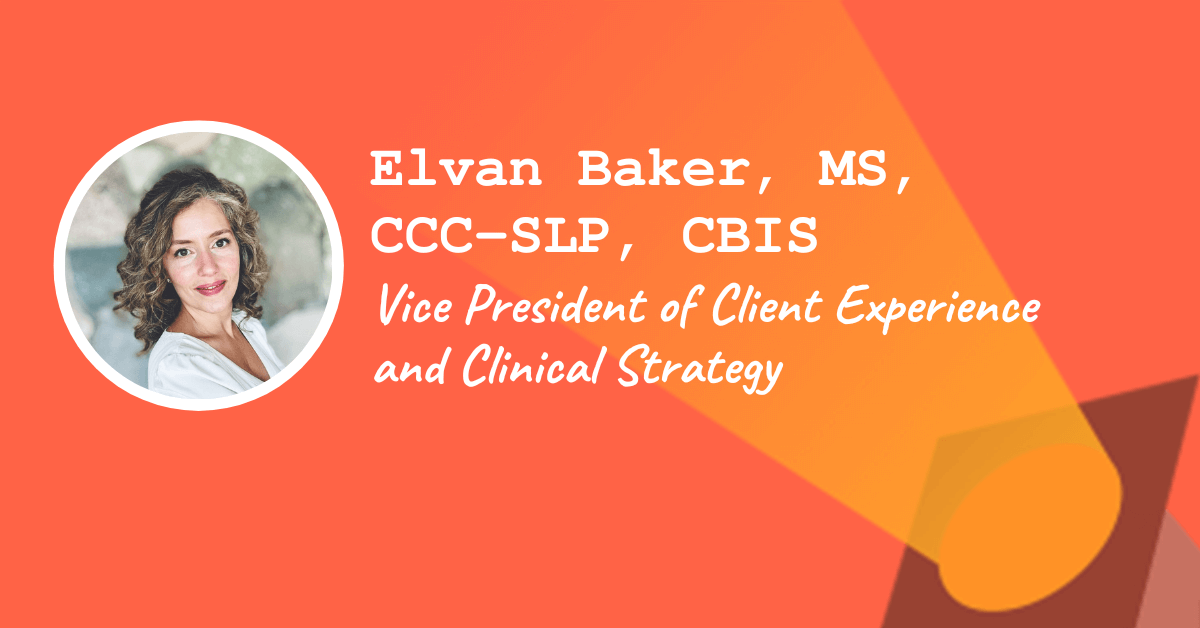


This week’s spotlight is on Elvan Baker, MS, CCC-SLP, CBIS, a non-clinical speech-language pathologist who is now Vice President of Client Experience and Clinical Strategy for Rubato-Life!
This post may contain affiliate links or codes. This won’t increase your cost, but it helps keep TNCPT alive, and free of annoying ads! Thank you for your support. 🙂
What is your full name, title, and company name for your current, primary role?
Elvan Baker, MS, CCC-SLP, CBIS — Vice President of Client Experience and Clinical Strategy for Rubato-Life
What additional roles do you currently have?
Proud mother of a two-year-old girl, Ayla Baker and wife to Jared Baker, OTD, OTR/L, CLT.
Where are you located?
Northern Michigan.
Where did you go to SLP school, and what year did you graduate?
I went to University of Montana-Missoula and graduated in 2011. GO GRIZ!!!
Please refrain from contacting our spotlight participants on social media. There are thousands of readers just like you out there. 🙂 Please ask your questions in the comments on this blog post.
If you’re a Non-Clinical 101 student or Go Non-Clinical member, you can network with many of our spotlight participants in our community!
What did you do when you first finished school, and for how long?
I was a SNF SLP for the CFY year, and then an outpatient, inpatient, and home health SLP for another two years prior to transitioning into a leadership role.
In what setting(s) did you work, and what types of patients did you treat?
I have worked in:
- Subacute rehab
- Inpatient rehab
- Senior living outpatient
- Home health
- Private practice
What did you enjoy about your early roles? What didn’t you enjoy?
In my early roles, what I enjoyed most was the human connection. I grew up very close to my grandmother, and that gave me a deep appreciation for the wisdom and humor that come with age and experience.
In my bedside roles, I felt honored to care for patients in that same way—giving them the attention, affection, and respect they deserved from the next generation.
What I found more challenging was the administrative side: reducing those meaningful experiences into numbers, CPT codes, documentation, and billing. While I understood the necessity, it sometimes felt at odds with the personal, human aspect of the work that I valued so highly.
What else have you done since then, prior to your current role?
Prior to my current role, I served as:
- Forensic Audio Analyst
- Therapy Program Manager
- Rehab Agency Administrator
- Care Transition Manager
- Senior Living Executive Director
- Compliance Coordinator
- Director of Compliance
- Director of Clinical Success and Compliance
When and why did you decide to do something non-clinical?
After working in a few different clinical settings, I realized that what energized me most wasn’t just the direct patient care, but the problem-solving and systems improvement side of the work.
I found myself drawn to asking how processes could be more efficient, how teams could collaborate better, and how outcomes could be improved on a larger scale.
With that interest—and a growing desire to lead teams—I made the jump into a non-clinical role where I could focus on those areas and create impact beyond individual patient interactions.

What are you doing these days?
I’m currently the Vice President of Client Experience and Clinical Strategy at Rubato-Life, a healthtech startup that offers an AI-based, algorithmically personalized Music Based Intervention for stress reduction in patients under the care of clinicians.
In this role, I work cross-functionally:
- Supporting therapy teams in the field
- Collaborating with scientists/researchers on clinical studies
- Contributing to product management and development
- Ensuring operational and compliance stability both within and outside the company
It’s a role that allows me to bridge clinical expertise with innovation and strategy, which is something I’m very passionate about.
Are you still treating patients, or are you solely non-clinical?
I am mainly non-bedside, but clinical knowledge and clinical decision making runs through all parts of my position.
How long have you been in your current VP of Client Experience and Clinical Strategy role?
Since October 2024.
What do you wish you would’ve known before going into this role?
What I wish I had known going into this role is just how unique and challenging the startup environment can be—especially in healthtech. It truly is like ‘building the plane while in flight.’
The pace is fast, priorities can shift quickly, and you have to be comfortable with ambiguity. That said, it’s also what makes the work so energizing—you’re constantly learning, adapting, and shaping something new.
Did you get any special certifications or training along the way to help you get into your current role?
No, I would have loved to have such amazing resources (Non-Clinical 101, crash courses, etc.) when I first pivoted out of bedside roles.
How did you find your VP of Client Experience and Clinical Strategy job? Did you apply or find it through a connection?
I actually came across Rubato-Life while I was reviewing the regulatory and functional compliance of their product at my previous company. That experience gave me a firsthand look at the value of the innovation, and I was impressed enough that when the opportunity arose, I decided to join the team.
How have people reacted to you leaving patient care?
The reactions have been mixed. I think it’s becoming more acceptable now to step away from bedside care. COVID really shifted perspectives on that—which has been encouraging.
Early on, some people struggled to understand why someone would pursue a professional/trade degree in such a well-defined career path only to pivot out of it. For me, though, I’ve always seen clinical work as part of my growth path, not the final destination.
There is nothing worse than being stuck at a place you don’t belong or one that doesn’t belong in your heart, head, desires, and hopes because you are afraid of other’s reactions.
What’s a typical day or week in the life like for you? What types of tasks and responsibilities fill your time?
In my role, I wear a lot of different hats, so no two days look the same.
Some days are very strategy focused. I might be in back-to-back management or executive meetings aligning on priorities and making high-level decisions. Other days are more collaborative, where I’m meeting with researchers, helping guide projects, or supporting their work. And then there are times when I’m hands-on troubleshooting technology for a customer to make sure everything runs smoothly or discussing the invoice changes.
What I enjoy most is that mix—I get to balance strategic leadership, cross-functional collaboration, and practical problem solving, which keeps the role dynamic and really engaging.
What are some of the rewards of your role? What are the biggest challenges?
One of the biggest rewards of my role is getting to collaborate with incredibly talented individuals—investors, executives, engineers, therapists, and scientists—all working together on groundbreaking innovations that aim to deliver superior patient outcomes. It’s inspiring to be part of that kind of mission-driven work.
At the same time, that diversity of expertise and perspectives brings its own challenges. With so much talent and so many priorities at play, it can be a balancing act to align stakeholders and keep everyone moving in the same direction.
In a way, the reward and the challenge are the same—the variety of voices and skills that make the work exciting also makes coordination essential. I have to be able to zoom out to see the big picture and zoom in to oversee the littlest pieces of the puzzle to configure fit.
How did your clinical background prepare you for this role? Which skills transferred?
Anything I learned in academia and everything I experienced as a clinician played a role in preparing me for this role. As clinicians, we have superior problem-solving, critical-thinking and project management skills.
Those same skills transfer directly here. The difference is that now I apply them at a different scale, across teams and initiatives rather than individual patients, but the mindset and discipline are very much the same.
Ready to launch your own non-clinical career?
Plus, you’ll get early access to curated non-clinical job listings and a bonus lesson on AI!
Roughly speaking, how are the hours compared to patient care?
My hours vary with the needs of the company.
What type of person do you think would do well in your VP of Client Experience and Clinical Strategy role?
Someone who has the mindset of building a plane while in flight.
Do you work remotely or onsite?
I am mainly remote with some onsite customer visits.
Does your organization hire PT, OT, or SLP professionals into non-clinical roles? If so, what type of roles?
Yes, that is all I hire.
What is a typical career path for someone in your VP of Client Experience and Clinical Strategy role?
This role is new for this company and the needs of the business will decide its future and path.
What is next for you? What are your high-level career aspirations?
I have never been the one who hoped for a specific title as a career aspiration, which explains the many pivots and plot twists on my journey that is quite non-traditional. I would like to continue to grow my clinical strategy and operations skills and see where it continues to take me.
What would you recommend to someone who is considering going into a role like yours? Do you have any special words of wisdom for the readers?
“No” is a complete sentence, to deliver gracefully and to receive humbly. It served me greatly as I grew into the shoes that were always meant for me but once were too big to fill.
What would you teach to today’s graduate students in your profession, if you had the opportunity?
Learn business operations inclusive of numbers management, marketing/sales, customer retention, etc.
