
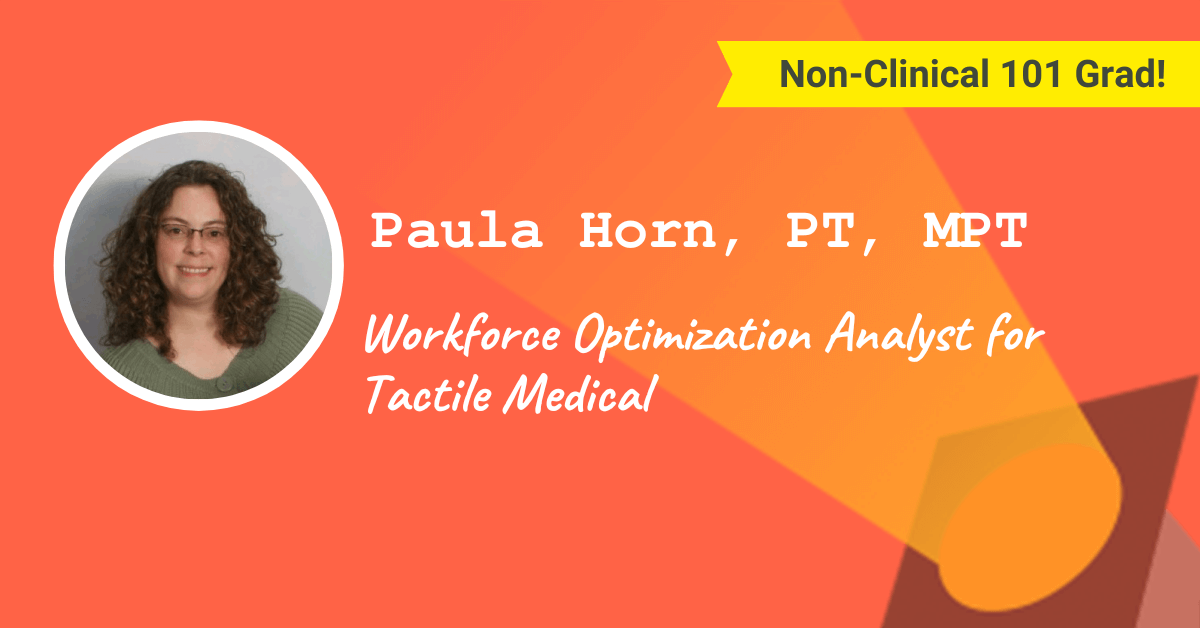


This week’s spotlight is on Paula Horn, a Non-Clinical 101 graduate and Physical Therapist who is now a Workforce Optimization Analyst for Tactile Medical.
We’re thrilled to feature Paula for her second spotlight! Keep reading for details on her non-clinical career growth.
This post may contain affiliate links or codes. This won’t increase your cost, but it helps keep TNCPT alive, and free of annoying ads! Thank you for your support. 🙂
What is your name, title, and company name for your current role?
Paula Horn, PT, MPT – Workforce Optimization Analyst for Tactile Medical.
Where are you located?
Georgia
What are you doing these days?
I recently transitioned into my new role as Workforce Optimization Analyst in January 2026. I was able to showcase my data analytic skills while in the role of Patient Education Supervisor, which helped me move into this new role. It’s been a personal goal for the past several years.
In this new role, I will be running reports and analyzing data to help with process improvement, workforce optimization, and resource allocation. This information will be delivered to C-suite executives.
Are you still treating patients, or are you solely non-clinical?
I am solely non-clinical.
How long have you been in your current role?
I just started in my current role, but was in the Patient Education Supervisor for nearly three years prior to transitioning to the analyst role.

Editor’s Note: Paula shares much more about her Patient Training Supervisor role in her first spotlight!
How did you find your job?
I found my initial role with Tactile Medical through Indeed. I happened to apply at a time that Tactile Medical was expanding the Patient Training Department, and with my background, I was able to obtain an interview.
Once with Tactile Medical, I utilized my experience and skills to move into other positions as they became available. My current position is a newly created role within the organization, which means that I get to help shape the role as we move forward.
What upskilling did you do prior to becoming a Workforce Optimization Analyst?
In an effort to expand my skill set, I have become certified in several areas:
- Executive Certificate in Home Modifications (ECHM)
- Certified Kinesio Taping Practitioner (CKTP)
- I am currently enrolled in a certification program for Healthcare Informatics and Data Analysis. I am expected to complete the certification in May 2026.
While all of these may not seem to be related, they really look at the patient as a whole person to identify their overarching needs for living a functional independent life.
What was the interview like for your role?
The questions were very much about experience with:
- Analyzing data
- Creating reports from that analysis
- Extrapolating trends and identifying gaps to address
- Conveying information to senior leadership including the executive level
- Thinking outside the box at any given time
What are some of the things you did to stand out, take initiative, and advance in your career?
First and foremost, I communicated to the Vice President of our department that my professional goal was to be the process improvement specialist and data analyst for the Patient Education Department.
When the VP created a work group to address employee productivity, I volunteered to be a member of that group. During my work in this group, I was able to showcase my skills and experience with collecting and analyzing data, creating concise reports, and showing where we could make improvements.
What’s a typical day or week in the life like for a patient training supervisor?
Since I am just starting in my new role, I can’t really give a day in the life just yet but in the supervisor role, it is meetings, documentation audits, coaching, developing guidelines for job duties, and a variety of projects to move the company to the next level.
What are some of the rewards of your role? What are the biggest challenges?
I find it very rewarding to work for a company that provides a very valuable product to an underserved patient population.
While I am still learning my new role, I can speak to the supervisor role. One of the biggest challenges as a remote supervisor is learning a new style of leadership if you have not done that before. Developing team building skills takes an out-of-the-box idea as we aren’t in an office and can’t just stop by to see how things are going.
How did your clinical background prepare you for this role? Which skills transferred?
For my new role, my clinical background allows me to provide a patient perspective to those in the organization that have not worked in the arena of direct patient care. When making decisions as a medical organization, it is important that the patient not get lost in the minutiae when making procedural decisions.
In the supervisor role, my experience providing patient education about therapy, rehabilitation, and the purpose and function of DME was invaluable in coaching my team on how to improve their patient interactions. This helped to not only build their confidence, but also build the patient’s confidence in their ability to be independent with their at-home treatment.
Roughly speaking, how are the hours and pay compared to patient care?
In my new role, the hours are much better, as the schedule is flexible and entirely up to me to make. The pay is comparable to a therapist salary depending on your location and cost of living.
For the supervisor role, the hours are also better as the schedule is flexible, but you do need to make sure that you are available for your team if they need assistance. The pay was slightly lower but I did not mind as I am fully remote—so no having to commute and I can work from anywhere. These perks were worth to me.
What type of person do you think would do well in your role?
For the analyst role, you need to:
- Be able to work independently, collecting and analyzing data and creating reports
- Be comfortable presenting your reports to senior leadership
- Have good written and verbal communication skills to clearly explain your results
- Be able to provide solutions for any gaps you identify
For the patient trainer role and the supervisor role, you need to:
- Be compassionate and patient with patients and their families, as oftentimes they are navigating a situation where they are just learning about their lymphedema, or processing the news that they have cancer
- Be creative with problem solving in situations where the patient has significant mobility issues or no support system to assist with their treatments
- Have good time management, as you need to be able to adjust priorities as assignments change
- Be a change agent, as the one constant is change!
Do you work remotely or onsite?
Fully remote
What is next for you? What are your high-level career aspirations?
Develop my new role as it is a newly created position within the company. Where that takes me in a few years is a mystery but I am excited about the journey.
