
Published:

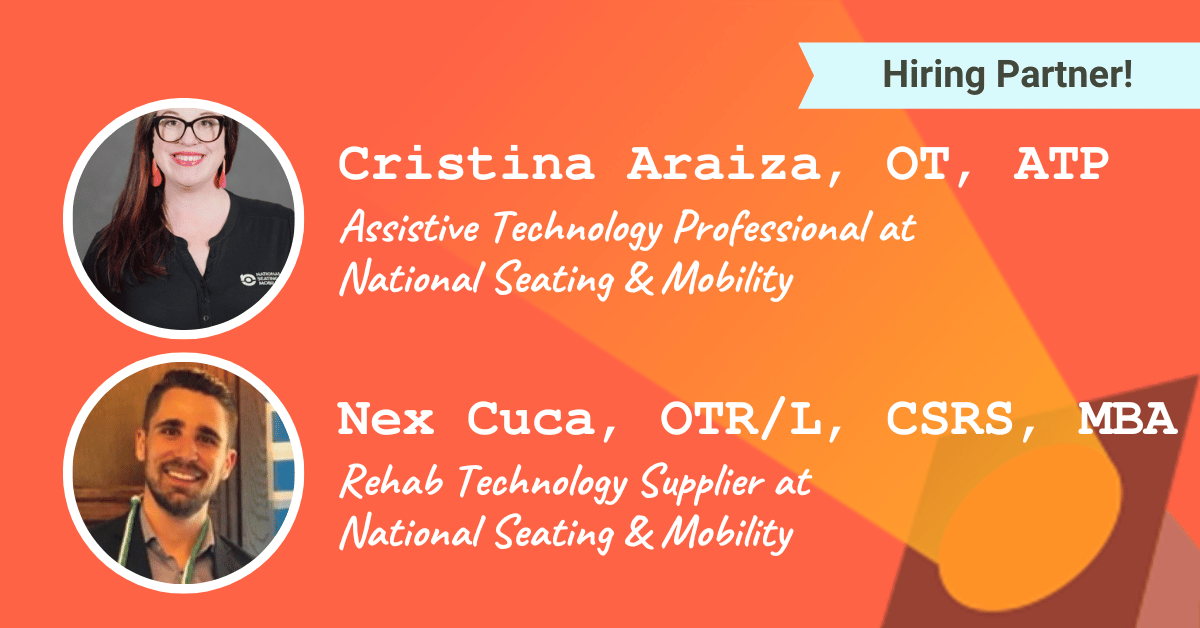
Cristina Araiza, OT, ATP, and Nex Cuca, OTR/L, CSRS, MBA, work at National Seating & Mobility, which provides wheelchairs and custom seating for people with disabilities, along with other adaptive equipment and repairs. Cristina is an Assistive Technology Professional (ATP), and Nex is a Rehab Technology Supplier (RTS).
When a therapist or physician sends a letter of medical necessity for a power wheelchair, it goes to a supplier like National Seating & Mobility (NSM). The ATP is NSM’s person on that order. They evaluate the client and take their measurements, the order waits on approval from insurance or another payer, and the ATP checks the fit when the equipment is delivered. Nex works as an RTS while he studies for his ATP certification. NSM’s ATP Development Program lets new hires start preparing for the ATP before they’re certified, with study materials and a mentor.
NSM is a Go Non-Clinical hiring partner. Its open roles are on the Go Non-Clinical job board as well as NSM’s own careers page, and members can talk with its hiring managers in our private community.
They each mention a book of business, meaning the referring clinicians and clients they work with. Both are occupational therapists, and they answer the same questions from opposite ends of the job: one well into it, one just starting out.
This post may contain affiliate links or codes. This won’t increase your cost, but it helps keep TNCPT alive, and free of annoying ads! Thank you for your support. 🙂
What is your full name, title, and company name for your current, primary role?
Cristina: Cristina Araiza, OT, ATP — Assistive Technology Professional (ATP) for National Seating & Mobility
Nex: Nex Cuca, OTR/L, CSRS, MBA — Rehab Technology Supplier (RTS) for National Seating & Mobility
What additional roles do you currently have?
Nex: Father of two.
Where are you located?
Cristina: Dallas, Texas metroplex.
Nex: Chicago.
Where did you go to OT school, and what year did you graduate?
Cristina: Texas Woman’s University, Denton, 2010 with MOT.
Nex: I went to the New York Institute of Technology (NYIT) and graduated in 2018.
What did you do when you first finished school, and for how long?
Cristina: Inpatient rehab, SNF, acute care, neuro rehab, 15 years and still practicing PRN.
Nex: After graduating, I worked full-time as an outpatient neuro OT at NYU, treating adults with a variety of neurological conditions.
In what setting(s) did you work, and what types of patients did you treat?
Cristina: The entire adult continuum with a specialty focus in home and community neurorehabilitation.
Nex: My background is primarily in outpatient neuro, working with adults with different neurological conditions and helping them improve their function and independence in their daily lives.
What did you enjoy about your early roles? What didn’t you enjoy?
Cristina: I still love being an OT. I did not enjoy blurry ethics, productivity demands, and command-and-control leadership.
Nex: What I enjoyed most was working directly with patients, building relationships with them, and helping them get back to the activities that were important to them. The part I enjoyed less was dealing with the administrative side of things, especially insurance appeals.
What else have you done since then, prior to your current role?
Cristina: I was a non-treating therapy supervisor in a day neuro setting for about two years.
Nex: Completed multiple CEUs, including CSRS, and went back to school to get my MBA.
When and why did you decide to do something non-clinical?
Cristina: I lost my management job in 2024 and was working multiple PRN jobs when I was recruited by NSM for their clinical ATP pilot program. It has been a perfect transition for me and my experience.
Nex: I was managing the wheelchair clinic during my last job and felt like I could do more for patients by going into a non-clinical role.
What are you doing these days?
Cristina: ATP with National Seating & Mobility.
Nex: I’m an RTS studying to get my ATP.
Are you still treating patients, or are you solely non-clinical?
Cristina: I work PRN in acute care on the weekends.
Nex: Solely non-clinical.
If you’re still treating patients, what percentage of your time is spent clinically vs. non-clinically?
Cristina: Varies based on how many weekends per month I pick up.
How long have you been in your current role?
Cristina: August 2024.
Nex: August 2026.
What do you wish you would’ve known before going into this role?
Cristina: I had little to no experience with complex seating and rehabilitation technology and wish I had known a little more, although the training program was very comprehensive.
Nex: Multiple moving parts and how vast wheelchair options are.
Did you get any special certifications or training along the way to help you get into your current role?
Cristina: NSM paid for my training hours, ATP examination, and certification with RESNA.
Nex: I’m currently studying for my ATP certification through RESNA. My background in OT gave me a good clinical foundation, and I’m continuing to build on that knowledge as I learn more about complex rehab equipment and assistive technology.
How did you find your job? Did you apply or find it through a connection?
Cristina: I was contacted by an NSM recruiter on Indeed.
Nex: Through a mutual connection.
Did you do anything special to your resume and cover letter to land the job?
Nex: Focused more on my clinical skills as they relate to the wheelchair clinic.
What was the interview like for the role?
Cristina: Three-step virtual interview process (recruiter, VP of learning and development, and regional manager) followed by an in-person meeting with local management.
Nex: Multiple-step interview with varying levels of management.
How have people reacted to you leaving patient care?
Cristina: I have utilized my clinical connections to grow my book of business, so my multifaceted experience has worked to my advantage.
Nex: Overall welcoming experience.
What’s a typical day or week in the life like for you? What types of tasks and responsibilities fill your time?
Cristina: No two days are the same. I work in multiple clinical settings across the adult rehab continuum, in homes and facilities. I collaborate on seating and mobility evaluations with PTs and OTs.
Nex: Very dynamic, from wheelchair evals to fittings to home deliveries.
What are some of the rewards of your role? What are the biggest challenges?
Cristina: I love being in variable settings. Learning the terminology and technical aspects of this role has been a steep learning curve, but I have been well supported, more so than I ever experienced as a clinician.
Nex: One of the most rewarding parts of my role is helping people improve their mobility and independence, both at home and in the community. It’s great to be able to help someone find the right equipment to make their everyday life easier. One of the biggest challenges so far has been learning all the different equipment options and navigating the various insurance requirements and funding sources.
How did your clinical background prepare you for this role? Which skills transferred?
Cristina: Very much so, particularly the ability to therapeutically meet clients and clinicians “where they are” in their knowledge and educate and empower using my clinical background. I think this role would be challenging for a clinician with limited diversity of and years of experience in the field.
Nex: Most, if not all, skills transferred. My ability to understand the patient and their occupation is key.
Roughly speaking, how are the hours and pay compared to patient care?
Cristina: The hours vary based on how much you hustle and if you’re growing your own book of business or inheriting; the pay is comparable to that of a clinician with room to earn commission, which takes time.
Nex: One thing I really enjoy about this role is the flexibility. I’m able to organize my schedule around patient needs and appointments. As my book of business grows, my hours will increase, but I have more control over how I manage my time. Compensation is also different from traditional patient care because there’s a direct connection between the work I put in and what I earn, which is something I really appreciate.
What type of person do you think would do well in your role?
Cristina: I think someone needs to first and foremost be curious, growth-minded, and eager to learn. A clinician-to-ATP should have a teaching heart, good communication skills, and be easy to get along with.
Someone who is authoritarian, a know-it-all, or pushy would not do well.
Nex: Dynamic and organized person.
Do you work remotely or onsite?
Cristina: Both.
Nex: Onsite, but do a lot from my home office.
Does your organization hire PT, OT, or SLP professionals into non-clinical roles? If so, what type of roles?
Cristina: PT and OT for clinical ATPs. Sometimes assistants, but I also think this would be difficult as we collaborate with evaluating clinicians.
Nex: Yes, ATP role.
Did you read any books, take any courses, or do anything special overall to get you where you are today?
Cristina: NSM created a six-month training program that included books, online modules, and hands-on mentorship.
Nex: Before joining NSM, I had some hands-on experience with wheelchairs and assistive technology through my previous role as an OT. NSM also has a six-month training program, which has been a great transition from being a therapist to working in the ATP field. The training is very hands-on, and it’s been really helpful in learning the equipment, understanding the process, and becoming more comfortable in the role.
What is a typical career path for someone in your role?
Cristina: One could grow their book of business to as much capacity as they can handle and organize. There is opportunity to earn significant commission, especially if one establishes a consistent rotation in a clinic.
Nex: I think a big part of the role is continuing to learn and build your book of business over time. As you gain experience, you become more comfortable with the equipment, develop stronger relationships with referral sources, and learn how to manage the process from the initial evaluation through delivery.
What is next for you? What are your high-level career aspirations?
Cristina: I would love to return to working just one job and consistently earn within my desired range; I also am open to internal development and educational roles within the complex rehab technology field at large.
Nex: For now, I want to continue building my ATP knowledge and skills while growing my book of business. My goal is to become a strong resource for both my patients and referral partners and continue helping people find the equipment they need to be as independent as possible.
What would you recommend to someone who is considering going into a role like yours? Do you have any special words of wisdom for the readers?
Cristina: OTs are a great fit for this role as this is a great way of empowering participation.
Nex: I would say follow your interests and don’t be afraid to explore something different. OT and PT backgrounds translate really well into the ATP role because you already have many of the clinical skills needed to be successful. You get to use that clinical knowledge in a different way while still making a real difference in people’s lives.
Be willing to learn, embrace the business side of the role, and remember that building relationships is just as important as knowing the equipment.
What would you like to change most in your profession, and why? How would you propose doing so?
Cristina: I would foster greater collaboration with clinicians to increase understanding of the complex rehab technology assessment and procurement process, as many just do not have the experience in their clinical settings. I did not.
What would you teach to today’s graduate students in your profession, if you had the opportunity?
Cristina: The importance of partnering with ATPs to empower those we serve to achieve the most efficient means of functional mobility and participation in their environments.
Do you have any special advice for others who want to follow in your footsteps?
Cristina: Make friends with your local ATP. I have never met a more friendly group of professionals.
Nex: Going into a non-clinical role is not as daunting as most think it is. You’ll still be able to use your clinical skills, just in a different capacity.
What to read next
- Alex Chesney’s spotlight at National Seating & Mobility — the same company from the side that mentors clinicians through NSM’s ATP program.
- Janice Gross’s spotlight at Reliable Medical — another OT working as an ATP, at a different supplier, who wants OT programs to teach more about wheelchairs and seating.
- Merrillee Millar’s spotlight at Myomo — an OT and ATP who moved into a company role training orthotists and prosthetists on a myoelectric arm brace.
- The Non-Clinical Jobs Report, from Go Non-Clinical — the latest hiring data on which non-clinical roles for PTs, OTs, and SLPs are open.
- How to get a non-clinical job, with advice from hiring managers — what the people who screen and hire clinicians say they look for.
More resources for your non-clinical career
If you’re finding your own way through the non-clinical transition, we’ve created these FREE resources to help you get your bearings.
- Our weekly jobs newsletter: 100+ fresh non-clinical job postings every week, plus new spotlights, our latest articles, and hiring partners recruiting straight from our community.
- Four Secrets to Landing a Fulfilling Non-Clinical Healthcare Job: our free mini-course, delivered to your inbox.
- Our free career quiz: 15 questions, and you’ll come out with a much clearer picture of which non-clinical sectors suit you.
If you’d rather follow a step-by-step roadmap than piece this together on your own, that’s exactly why we made Non-Clinical 101. It’s our course & community teaching rehab pros how to make the switch in half the time with twice the confidence.
