
Published:

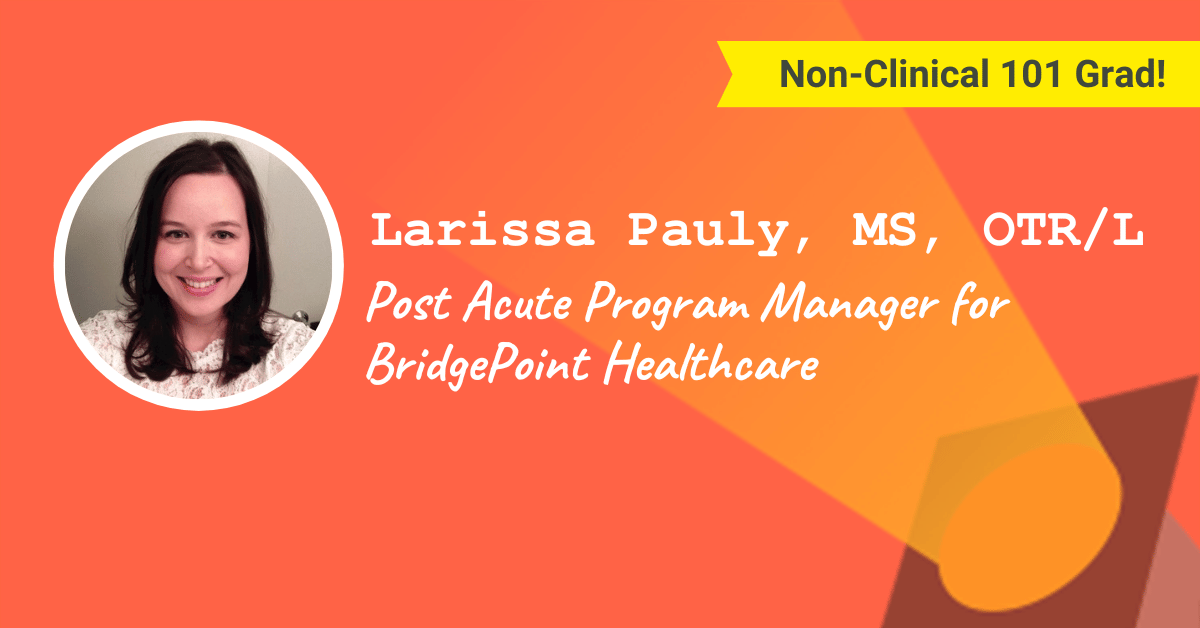
This week’s spotlight is on Larissa Pauly, MS, OTR/L, a Non-Clinical 101 graduate and non-clinical occupational therapist who is now Post Acute Program Manager for BridgePoint Healthcare!
We’re excited to share that BridgePoint Healthcare is a hiring partner of Go Non-Clinical, our community for clinicians exploring non-clinical careers!
This post may contain affiliate links or codes. This won’t increase your cost, but it helps keep TNCPT alive, and free of annoying ads! Thank you for your support. 🙂
What is your full name, title, and company name for your current, primary role?
Larissa Pauly, MS, OTR/L — Post Acute Program Manager for BridgePoint Healthcare
Where are you located?
Annapolis, MD.
Where did you go to OT school, and what year did you graduate?
Ithaca College, BS 2010, MS 2011.
What did you do when you first finished school, and for how long?
I worked in acute care as an OT at a regional hospital system for several years.
In what setting(s) did you work, and what types of patients did you treat?
I’ve worked in acute care, outpatient hand therapy, early intervention, mobile outpatient, home health, and consulting.
What did you enjoy about your early roles? What didn’t you enjoy?
I answered this at length in my first spotlight as a Post Acute Operations Specialist/STEM for Signify Health.
What else have you done since then, prior to your current role?
I’ve had the privilege to hold several non-clinical roles now, as highlighted in my previous spotlights.
Editor’s note: Larissa’s journey is a great example of non-clinical career growth! Check out her first spotlight as a Post Acute Operations Specialist/STEM for Signify Health and her second as SNF Network Manager for Kaiser Permanente to see where she’s been, then read on to see how her career has grown since then!
When and why did you decide to do something non-clinical?
Like everyone, I wanted to make positive change and fix our broken healthcare system. I wanted to treat the system as a whole through policy and process changes versus patient by patient.
What are you doing these days?
I am the Post Acute Program Manager for my company’s LTACH system in Washington, DC.
Are you still treating patients, or are you solely non-clinical?
I am solely non-clinical.
How long have you been in your current Post Acute Program Manager role?
After working at Kaiser Permanente, I transitioned to this current role at BridgePoint Healthcare in May of 2025.
Did you get any special certifications or training along the way to help you get into your current role?
None. Everything I’ve been able to accomplish in my career has been based solely off of my master’s degree in OT.
How did you find your job? Did you apply or find it through a connection?
I found my current role through a connection. At the time, I had no plans of leaving Kaiser and very much enjoyed working for my boss and had wonderful teammates I worked with.
My former VP, who was previously my skip-level boss at Kaiser, had left the company for a CEO position at BridgePoint. He reached out and asked me to apply for the role.
I felt very honored that he valued my work at our prior company and saw the value in bringing my skillset over to our current company.
Editor’s note: BridgePoint Healthcare is a hiring partner of The Non-Clinical PT! You can explore their current openings on BridgePoint’s careers page.
What was the interview like for the Post Acute Program Manager role?
I interviewed with the CEOs of both LTACH hospitals. We discussed my prior roles and how that could translate into the needs of the hospital system, how it would complement my skillset, and how it would benefit my future career growth.
What I appreciated in the discussion was that they then gave me time to consider the role and follow up with additional questions after the interview was over. We had a period of ongoing discussions before I formally accepted the role.
How have people reacted to you leaving patient care?
I’ve discussed this at length in my prior spotlights. Initially, I received a lot of pushback and questions as to why I would want to leave, the feasibility about returning to patient care if I ever needed to, why would a company hire me if I left clinical care and then returned, etc.
Now I mostly get questions asking me how I got to where I am now and if I can help them make the transition.
What’s a typical day or week in the life like for you? What types of tasks and responsibilities fill your time?
I have a lot of flexibility in my role and schedule. Some days I’m out in the hospitals with our Business Development teams discussing the benefits of LTACH for medically complex and high-risk patients as well as program pathways with hospital leadership teams.
Other days I’m visiting our partner skilled nursing facilities educating staff on our readmission avoidance pathways. Some days I’m in the LTACH working on hospital strategy, working with various departments on program development, attending length of stay meetings, and building a post acute performance network for the LTACH to foster shared accountability for our high-risk patients.
What are some of the rewards of your Post Acute Program Manager role? What are the biggest challenges?
Some of my biggest “wins” I’ve found rewarding are when one of my programs directly benefits a high-risk patient and helps provide some sense of stability to both the patient and their family. I also enjoy when a process I’ve put together makes things easier on our doctors and team.
How did your clinical background prepare you for this role? Which skills transferred?
As an OT I would say task analysis and being able to easily grade activities is my biggest asset that translated into success in my non-clinical roles. With my OT eye I’m able to look at a problem or pain point at a higher level to see the big picture and then make changes operationally to fix or fill the gap that then benefits the organization.
I would also say I use my OT “therapeutic use of self” to meet leaders and teams where they’re at, get buy-in for the project, and help the team get where they need to be to achieve success.
Roughly speaking, how are the hours and pay compared to patient care?
My hours are more flexible than patient care, and I make more than a therapist.
What type of person do you think would do well in your Post Acute Program Manager role?
Above all, I would say that flexibility is key. Opportunities pop up in ways you wouldn’t expect and you need to be able to pivot to seize the moment and make it impactful and successful.
I’ve said yes to many opportunities and projects outside of the day-to-day job responsibilities of my job description that have expanded my skillset and introduced me to people that have been pivotal in my career growth and development.
Do you work remotely or onsite?
Hybrid. It’s a mix of being onsite at the hospital, out in the field visiting our partners, and remote.
Does your organization hire PT, OT, or SLP professionals into non-clinical roles? If so, what type of roles?
Yes, we currently have PTs, OTs, SLPs, and assistants working in non-clinical roles within the company. It’s all about how you’re able to speak to the skills you’ve learned in the clinic and build upon them and how they translate to the role you’re applying to.
I was actually able to refer Chad for his current position after initially networking with him after my first spotlight and maintaining that relationship through my layoff and subsequent roles.
Editor’s note: You can also find all open positions at BridgePoint Healthcare on the private job board inside our Go Non-Clinical community, where members can contact hiring managers directly and get a head start on the application process.
Did you read any books, take any courses, or do anything special overall to get you where you are today?
No, just a lot of hard work and networking.
I did not formally take any additional classes or obtain any additional certifications. As outlined in my prior spotlight, I did purchase the Non-Clinical 101 course to better understand what types of non clinical careers were out there and what I might enjoy as well as tips on retooling my resume. Since then all my career growth has been based on hard work, skills development and networking.
Editor’s note: Larissa took Non-Clinical 101 ahead of her first non-clinical role. Read her first spotlight to hear why she says it was “SO WORTH IT”!
What is a typical career path for someone in your Post Acute Program Manager role?
My career path has been very unique. Every job I’ve held has built upon and broadened my skillsets as well as expanded my professional network. From that growth, I’ve gained the experience needed to access the opportunities that led me to be where I am today.
What is next for you? What are your high-level career aspirations?
I don’t have any specific pathway I’m targeting at the moment, and honestly, every time I try to guess what comes next for me, life presents an unexpected opportunity and takes me in a different direction.
Overall, I would love to continue to learn new skills and network with new people to obtain an elevated position in the operations/strategy/program development space.
What would you recommend to someone who is considering going into a role like yours? Do you have any special words of wisdom for the readers?
Always be open to opportunities presented to you. You don’t know where it will lead and who you will meet along the way that then offers you additional opportunities for career growth.
I always tell people looking to transition to non-clinical work that “your career is a journey and not a destination.” Many therapists think they’ve “made it” when they first transition to a non-clinical role.
You will continue to grow and evolve, sometimes it’s small baby steps and sometimes it’s a large pivot, but change is always constant. You experience new things and find new areas you want to explore that may lead you away from that initial non-clinical job.
What career advice would you give yourself that you wish you had during school?
Diversify your classes to broaden your skillset. It will give you more opportunities versus limiting yourself to a specific patient population.
What would you teach to today’s graduate students in your profession, if you had the opportunity?
Allow yourself to experience as many patient populations and settings as you can. Take extra CEU classes. It is important to always be learning and teachable. The more experience you gain the more well rounded you become which becomes valuable in the job market.
Do you have any special advice for others who want to follow in your footsteps?
Never burn bridges. Healthcare is a small world and while it can be stressful it’s important to maintain relationships with everyone.
You never know who you may run into or might be sitting across from you at a panel interview or on a team project.
