
Published:

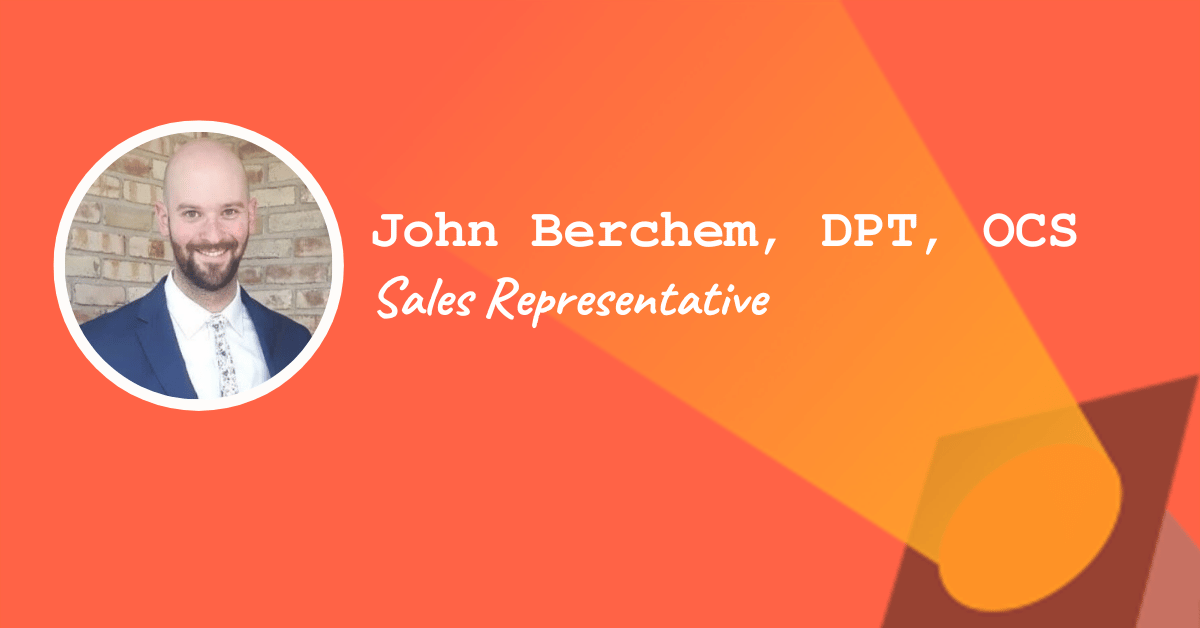
John Berchem, DPT, OCS, is a non-clinical physical therapist who is now a Sales Representative for Axogen, covering hospitals and surgery centers around St. Paul after more than a decade in outpatient orthopedics.
Nerve repair is a small corner of the surgical world, and one most rehab clinicians never see from the industry side. When a surgeon reconstructs a damaged peripheral nerve, they can bridge the gap with a graft or shield the repair with a protective wrap, and companies like Axogen make those products. The customer is the surgeon.
If job postings in this world read like a foreign language to you, here is the vocabulary. A territory is the set of hospitals and surgeons you are responsible for. Case support means standing in the operating room while the surgery happens, answering the surgeon’s questions about your product in context of the patient they’re treating. And the word sales is doing strange work in this job title, which John gets into himself.
His answers are below.
This post may contain affiliate links or codes. This won’t increase your cost, but it helps keep TNCPT alive, and free of annoying ads! Thank you for your support. 🙂
What is your full name, title, and company name for your current, primary role?
John Berchem, DPT, OCS — Sales Representative for Axogen
Where are you located?
St. Paul, MN
Where did you go to PT school, and what year did you graduate?
University of Minnesota, 2015
What did you do when you first finished school, and for how long?
I worked in a clinical setting for over 10 years and also was a clinical instructor for the last seven years.
In what setting(s) did you work, and what types of patients did you treat?
Outpatient orthopedics, seeing a fairly even split of spine and extremity (both surgical and non-surgical).
What did you enjoy about your early roles? What didn’t you enjoy?
The thing I enjoyed the most in my clinical role was the knowledge that my work was directly improving the lives of others and helping people get back to the things in life they loved the most. I also loved working with PT students and having the chance to mentor and teach.
The aspects of my job I did not enjoy were the rigorous documentation standards without corresponding time to complete notes, the lack of flexibility in schedule/PTO, and the constant increase in productivity expectations that were becoming difficult to manage.
When and why did you decide to do something non-clinical?
I had always anticipated a transition to a non-clinical role at some point in my career. Within the last few years, I began thinking about a transition more seriously and began actively looking towards the end of 2025.
What are you doing these days?
I am now working as a sales representative with Axogen (a biotech company that is the market leader in research and production of peripheral nerve repair solutions).
Are you still treating patients, or are you solely non-clinical?
Solely non-clinical.
How long have you been in your current Sales Representative role?
Seven months.
Did you get any special certifications or training along the way to help you get into your current role?
I did not have any special training, although I took advantage of the numerous free offerings that The Non-Clinical PT has to offer!
How did you find your job? Did you apply or find it through a connection?
Networking: I reached out to a connection in the industry who was aware that Axogen was hiring and connected me with the hiring manager.
Did you do anything special to your resume and cover letter to land the job?
I spent A LOT of time revamping my resume and cover letter to emphasize the aspects of sales and marketing that exist within a clinical role.
I also highlighted the work that goes into relationship building (surgeons, patients) within a PT practice and the skills of multi-tasking/project management that would be transferable as well.
What was the interview like for the Sales Representative role?
There were three rounds of interviews. The first two were conversational with different levels of the management team.
The third interview was more of a roleplay in which I was given a clinical paper supporting the efficacy of Axogen’s flagship product and asked to prepare a presentation as if I was meeting with a surgeon target.
How have people reacted to you leaving patient care?
It was really a tough decision for me to leave patient care, feeling like I was leaving behind years of schooling and hard work for something so different. But everyone I talked to about the switch was extremely supportive and excited for me!
I have even run into a few healthcare providers in my new role who are also considering a switch, and I’ve enjoyed being able to encourage them as they think through the process themselves.
What’s a typical day or week in the life like for you? What types of tasks and responsibilities fill your time?
My primary responsibility is case support in the OR for the surgeons using our products.
While the role is technically ‘sales,’ I feel much more like a consultant in surgical cases, being present with our portfolio of products (everything from nerve protection technologies to cadaveric nerve allografts) to aid the surgeon in decision making and implementation of nerve repair techniques for each case.
Beyond that, I handle inventory management for all the accounts in my territory. I work with the area sales managers to identify and implement growth strategies for the territory as well.
What are some of the rewards of your Sales Representative role? What are the biggest challenges?
The biggest reward is experiencing a much healthier work-life balance. I have loved the autonomy and flexibility with daily and weekly schedules compared to my clinical role.
It is much easier to make time for appointments, family events, and last-minute PTO than previously.
I also still feel connected to meaningful health care and know that my work is making a difference in people’s lives by improving their post-surgical outcomes.
The biggest challenge is that the schedule can change unpredictably and overall is fairly short-term compared to the routine of clinical care. I often do not know of surgical cases more than a few days in advance, and it’s common to have cases added on very short notice.
Learning how to balance the flexibility with the unpredictability has been a key for me. There also is day travel all over the territory, and only very rarely am I gone overnight.
How did your clinical background prepare you for this role? Which skills transferred?
Throughout the interview process my company expressed strong interest in me because of my clinical background. My expertise in anatomy and physiology, experience in clinical decision making, and familiarity with ‘selling’ to surgeons were all factors that gave me an edge over other applicants.
My skills of time management, multi-tasking, building/maintaining relationships with surgeons, and effective communication have all transferred into this new role as well.
Roughly speaking, how are the hours and pay compared to patient care?
The hours vary based on surgery schedule. Some days/weeks are lighter and some are quite busy. Even the busy weeks do not exceed more than 40-45 hours.
Another perk is that this role does not involve any trauma surgeons, so I never work nights/weekends and am never on call!
The pay is much better as well. My current role came with roughly a 20% increase from what I was paid as a clinician. My company provides a lot of opportunity for career growth as well, and the pay would increase significantly as I progress into higher roles.
What type of person do you think would do well in your Sales Representative role?
Qualities that are helpful to succeed in this role include strong attention to detail, flexible with the ability to pivot quickly for frequent changes, a ‘people person’ who is comfortable to seek out and build relationships with surgeons/medical teams, and internal drive/self motivation to succeed.
Do you work remotely or onsite?
Much of my time is spent in hospitals/surgery centers throughout my territory. When I am not at a facility my work is fully remote.
Did you read any books, take any courses, or do anything special overall to get you where you are today?
Just reading many of the testimonials and blog entries through The Non-Clinical PT!
What is a typical career path for someone in your Sales Representative role?
The sales representative role is a normal entry point for this company. The goal would be a readiness to move into an area sales manager position within 12-24 months.
Beyond this, there are numerous ways to grow within the company (continued vertical growth in sales, transition into sales training, marketing, or clinical education).
What is next for you? What are your high-level career aspirations?
Within the biotech space, I see myself continuing to work up the sales ladder for the next number of years before likely transitioning to a non-sales role. With how much I enjoyed teaching and mentoring PT students, I do think a role with sales training/mentoring is something I’d really enjoy.
What would you recommend to someone who is considering going into a role like yours? Do you have any special words of wisdom for the readers?
I would say don’t shortcut the preparation before you start applying for non-clinical positions. The time upfront in researching potential career paths, learning about a new industry, and resume/interview prep was invaluable to me in landing this position.
Go into your job search knowing that leaders/hiring managers in other fields value our expertise and experiences, and in many cases are actually really looking for it.
Ultimately, I’d just really encourage anyone who is considering a non-clinical role to be bold and go for it! It didn’t take long for me to realize that I absolutely made the right choice for my career and I am very grateful for where I ended up.
Editor’s note: John welcomes outreach on LinkedIn from clinicians looking to make a similar move. Our advice before you reach out: take what he said above to heart. Do your research first, and know why this type of work appeals to you and what you bring to the table. People in a position to mentor others never have a shortage of folks asking for help, so show them you’ve already invested in yourself before you ask them to do the same.
What John’s move says about OR-based roles for PTs
Two things in John’s answers are worth pulling out for anyone considering their own move.
The first is what he did with his resume. He didn’t go looking for sales experience he didn’t have — he went back through what he already had and reframed it, calling out the relationship building he’d done with surgeons and patients and the project management buried in running a caseload. If you’ve been staring at postings assuming you have nothing to put on the page, that’s the exercise.
The second is how the door opened. John didn’t find this on a job board. A connection knew Axogen was hiring and made the introduction to the hiring manager. That isn’t a reason to stop applying to postings, but it does say something about the most accessible paths into any given company. If you don’t yet know anyone working at the employers with operations near you, that is a few months of deliberate conversations away, and it may move you further than another round of applications.
What to read next
- Our full guide to medical sales careers for rehab clinicians — the wider field John stepped into, and how you can do the same.
- What non-clinical roles paid last quarter, in The Non-Clinical Jobs Report, from Go Non-Clinical, where Medical Device Sales Representative was among the twelve most-posted titles.
- Josh Young, a PT covering joint reconstruction cases at Stryker — the same operating room, a different company and a different product line.
- How to build a non-clinical resume — the exercise John describes above, laid out step by step.
- What hiring managers actually look for — advice from the people making the decisions.
More resources for your non-clinical career
If you’re finding your own way through the non-clinical transition, we’ve created these FREE resources to help you get your bearings.
- Our weekly jobs newsletter: 100+ fresh non-clinical job postings every week, plus new spotlights, our latest articles, and hiring partners recruiting straight from our community.
- Four Secrets to Landing a Fulfilling Non-Clinical Healthcare Job: our free mini-course, delivered to your inbox.
- Our free career quiz: 15 questions, and you’ll come out with a much clearer picture of which non-clinical sectors suit you.
If you’d rather follow a step-by-step roadmap than piece this together on your own, that’s exactly why we made Non-Clinical 101. It’s our course & community teaching rehab pros how to make the switch in half the time with twice the confidence.
