
Published:

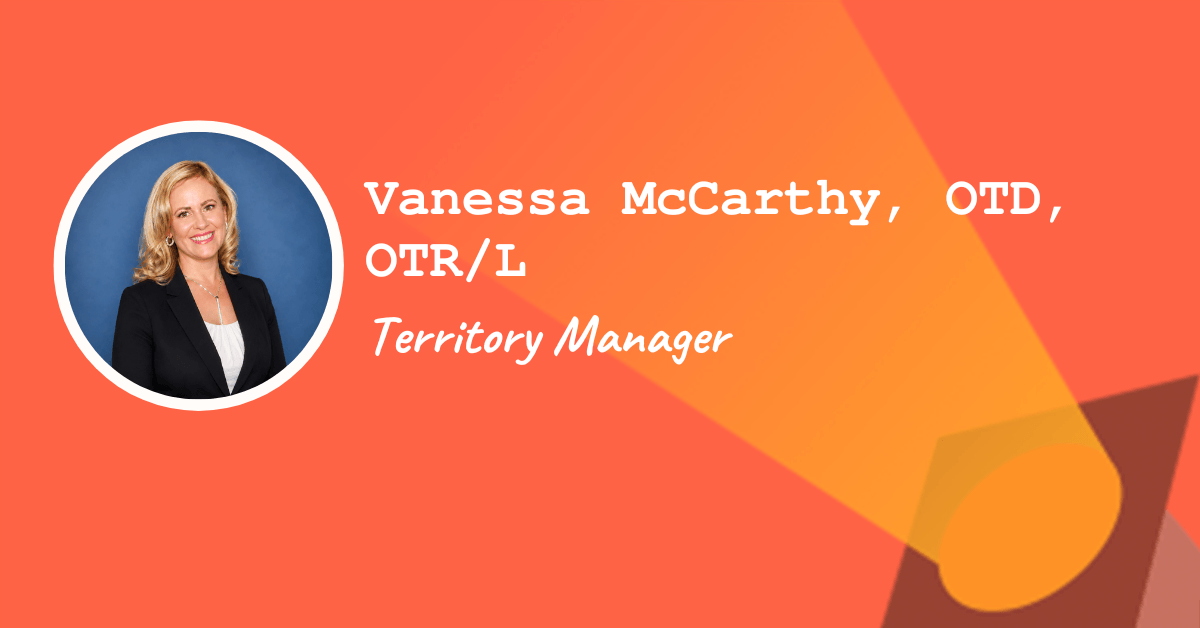
Vanessa McCarthy, OTD, OTR/L, is a non-clinical occupational therapist working as Territory Manager for Game Ready at Avanos Medical, a medical device company.
Game Ready’s cold compression systems live in two very different worlds: professional sports sidelines, where athletic trainers use the units on their own athletes, and the physical therapy clinics, orthopedic practices, and surgical recovery plans where the device becomes part of an actual patient’s plan of care.
Vanessa’s own introduction to Game Ready was the second kind — not as a rep pitching it, but as a patient receiving it, in a physical therapist’s care, well before the company had an opening she could apply for.
Going from that clinic visit to a sales territory meant a real jump into medical device sales — a path more clinicians take than most people realize. Her route there wasn’t a straight line: years of trying different things, in and out of patient care, before Game Ready ever entered the picture. What that path actually looked like, in her own words, is below.
This post may contain affiliate links or codes. This won’t increase your cost, but it helps keep TNCPT alive, and free of annoying ads! Thank you for your support. 🙂
Territory Manager for Game Ready, and then some
What is your full name, title, and company name for your current, primary role?
Vanessa McCarthy, OTD, OTR/L — Territory Manager, Game Ready (West Region), for Avanos Medical.
What additional roles do you currently have?
I am also a PRN Clinical Liaison for Reunion Rehabilitation Hospital in Peoria.
Where are you located?
I live in Phoenix, AZ.
Where did you go to PT/OT/SLP/A school, and what year did you graduate?
I attended A.T. Still University for my Master’s in OT, graduating in 2010. I returned and received my post-professional OTD in 2016.
What she loved about home health OT, and what stayed with her
What did you do when you first finished school, and for how long?
I worked at a smaller private hospital in Phoenix as their OT in acute rehab. I would also help out in acute care as needed. I was there for about a year.
In what setting(s) did you work, and what types of patients did you treat?
I transitioned to home health and worked with adults and pediatrics. I would see kiddos with sensory processing issues as well as complex rare medical conditions. For adults, I would see patients with cardiac conditions, general debility, and neurological conditions.
What did you enjoy about your early roles? What didn’t you enjoy?
As an OT, I absolutely loved working with patients in their natural environments. No guessing how to simulate the shower setup. It was right there!
I also loved the flexibility. I could (for the most part) schedule patients around things I needed to do and support my family’s schedule.
I struggled the most with seeing some of the unsafe living conditions my patients were in, knowing that without more help than we could provide, they would end up back in the hospital. My heart would also break for my kiddos whose parents would refuse to be present for the therapy session.
A bit of everything, and two roles that stuck
What else have you done since then, prior to your current role?
I have actually done a bit of everything! I worked multiple PRN jobs so that I could be present for my special needs kiddo. I also had a hard time deciding what I loved the most. Eventually, I landed on low vision and was, before COVID, running my own low vision practice. During COVID and for a while after, I was honored to lead an amazing team of therapists as a DOR.
When and why did you decide to do something non-clinical?
When I was running my low vision practice, I came across a Clinical Specialist role for an eye care company. I loved it, but it was a temporary role. A few years later, LinkedIn notified me of a Clinical Specialist role while I was in my DOR position. I was so torn, but I accepted the Clinical Specialist role for Bioness and have never looked back to clinical care.
What are you doing these days?
Today, I work as a Territory Manager for Game Ready.
Are you still treating patients, or are you solely non-clinical?
I am solely non-clinical.
How long have you been in your current role?
I am brand new to Game Ready. I started February of 2026.
From patient to hire, with nothing but support
How did you find your job? Did you apply or find it through a connection?
I found Game Ready as a patient first. I was in a car accident and needed hip surgery. My PT used Game Ready with my therapy. She had to talk me into it because my body does not tolerate cold.
One session with Game Ready, and I was hooked!
When I saw there was an opening a little over a year later, I had to apply.
What do you wish you would’ve known before going into this role?
I feel like I was prepared for my current role with Game Ready. I do wish I was more prepared with my first full-time non-clinical role with Bioness. I did not realize my role consisted of any sales until after I started!
Did you get any special certifications or training along the way to help you get into your current role?
I did not take any additional courses to help me get into my current role.
Did you do anything special to your resume and cover letter to land the job?
I highlighted my sales success, military background, and used AI to make sure I presented it in the best light for the role.
What was the interview like for the role?
I had three virtual interviews with the hiring manager, another National Director of Sales, and the marketing lead. I then had an in-person interview at the company headquarters with the hiring manager and the National Director of Sales and Marketing.
How have people reacted to you leaving patient care?
I have had nothing but support from friends and family. I do get asked often if I miss patient care. My honest answer is no.
What actually fills her week, and how her OT training shines
What’s a typical day or week in the life like for you? What types of tasks and responsibilities fill your time?
A typical week for a Territory Manager will depend on territory coverage. I will try to have two admin days where I work from my home office answering emails, running through my pipeline, planning my routing for weeks or months in advance, and contacting customers to make appointments to come in person and see them working with Game Ready on their patients or demonstrating the technology. Three days a week, on average, are spent in the field. Face-to-face time with customers is very important.
What are some of the rewards of your role? What are the biggest challenges?
A fun reward is having people point to you (or the Game Ready) and shout, “I love Game Ready!” The biggest reward is knowing that I am still helping patients every day, even though I don’t lay hands on them anymore.
How did your clinical background prepare you for this role? Which skills transferred?
So many OT skills are transferable, especially in the medical device space! I don’t consider myself a salesperson, because if I don’t have faith and passion for what I am doing or the product I am supporting, I would not succeed.
My clinical background helps me speak the language of my customers. I understand billing codes, the pressures of productivity, and the desire to help our patients not be in pain.
Relationship building is essential in sales. We do that multiple times a day as therapists, and have the hug count to prove it.
As an OT, I felt like I “sold” my patients on participating every day. I can also think outside the box and provide creative strategies to help my territory grow.
Roughly speaking, how are the hours and pay compared to patient care?
The pay has been better in non-clinical roles. The benefits can also be better, depending on what kind of company you land in. The hours are different. There is no time card that I punch. I also will get out what I put in. The flexibility and autonomy works really well for me, but it’s not for everyone.
Do you work remotely or onsite?
I work remotely, and travel frequently.
Did you read any books, take any courses, or do anything special overall to get you where you are today?
I did receive a very helpful sales course through my first full-time non-clinical role.
What is next for you? What are your high-level career aspirations?
I love my current role with Game Ready and I am just getting started. I am keeping my options open for career growth within Avanos. I will consider people leadership again as a regional or national director. I would love to do training as well. With my military background, I am finding a passion for federal account management.
Where this path goes, and what she’d tell you before you start
What type of person do you think would do well in your role?
A person who will do well in my role needs to be able to work independently. Be detail-oriented and have excellent time-management skills. You need to be ok with rejection and be able to quickly figure out where your time is best spent. Be ok with multiple forms of communication and be comfortable talking to anyone.
What is a typical career path for someone in your role?
A typical career path could be a regional or national sales director or sales trainer.
What would you recommend to someone who is considering going into a role like yours? Do you have any words of wisdom for the readers?
I would suggest looking for roles like a Clinical Specialist as a bridge to the sales world. You can look at the products you use and love in your practice and see if they hire therapists, or apply anyway and tell them why they should hire a therapist. In your resume, highlight your therapy skills that align with what they are looking for in a rep.
What career advice would you give yourself that you wish you had during school?
I would tell myself to never say never, and pay better attention in the business and marketing class!
Do you have any advice for others who want to follow in your footsteps?
Follow your passions, don’t stay in a place that you are not happy if it’s going to make you lose your love for therapy.
The case she made, before she had to make it
Vanessa’s path into her current role looks like a straight line now, but at the time, it wasn’t. Years before her first full-time non-clinical job, while she was still running her low-vision practice, she picked up a temporary Clinical Specialist position. It didn’t lead anywhere on its own, and it wasn’t meant to.
What it did give her was legitimacy. She wasn’t just translating her resume for an employer anymore — she’d already done a version of the job. And even though it was a temporary job, what it said to her hiring manager was that she took initiative and knew what she wanted. She had prepared. And it paid off.
The choice isn’t binary: explore or earn. Sometimes a flexible schedule and portfolio projects can achieve both for you — while building your career toward something more.
What to read next
- Suzy Keenan’s spotlight at Bioness Medical — A look inside the sales org at Bioness Medical..
- The Non-Clinical Jobs Report — Territory Manager was among the top twelve titles posted in Q2 2026.
- Our non-clinical resume guide — built around the job you actually want next.
- What medical-device and health-tech hiring managers look for — useful context for a multi-round process like Vanessa’s.
More resources for your non-clinical career
If you’re finding your own way through the non-clinical transition, we’ve created these FREE resources to help you get your bearings.
- Our weekly jobs newsletter: 100+ fresh non-clinical job postings every week, plus new spotlights, our latest articles, and hiring partners recruiting straight from our community.
- Four Secrets to Landing a Fulfilling Non-Clinical Healthcare Job: our free mini-course, delivered to your inbox.
- Our free career quiz: 15 questions, and you’ll come out with a much clearer picture of which non-clinical sectors suit you.
If you’d rather follow a step-by-step roadmap than piece this together on your own, that’s exactly why we made Non-Clinical 101. It’s our course & community teaching rehab pros how to make the switch in half the time with twice the confidence.
