
Published:

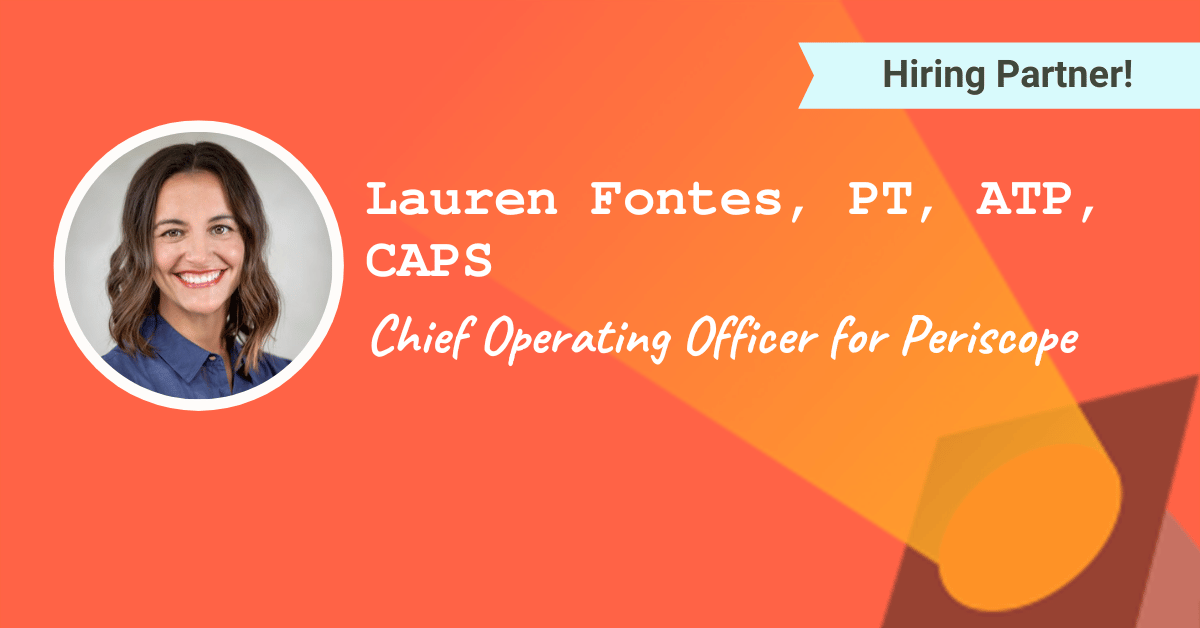
This week’s spotlight is on Lauren Fontes, PT, ATP, CAPS, a non-clinical physical therapist who is now a Chief Operating Officer for Periscope!
We’re excited to share that Periscope is a hiring partner of Go Non-Clinical, our community for clinicians exploring non-clinical careers!
This post may contain affiliate links or codes. This won’t increase your cost, but it helps keep TNCPT alive, and free of annoying ads! Thank you for your support. 🙂
What is your full name, title, and company name for your current, primary role?
Lauren Fontes, PT, ATP, CAPS — Chief Operating Officer for Periscope

Where are you located?
California
Please refrain from contacting our spotlight participants on social media. There are thousands of readers just like you out there. 🙂 Please ask your questions in the comments on this blog post.
If you’re a Non-Clinical 101 student or Go Non-Clinical member, you can network with many of our spotlight participants in our community!
Where did you go to PT school, and what year did you graduate?
University of California, San Francisco, 2005
What did you do when you first finished school, and for how long?
My first job was for California Children’s Services, outpatient neuro. I was there for six years. Following this, I did a short bout of travel- working in skilled nursing facilities and then worked part time for two employers, a private outpatient pediatric clinic and a large community hospital, dividing my time between outpatient pediatrics, acute care, neonatal intensive care, and inpatient rehab.
In what setting(s) did you work, and what types of patients did you treat?
I have worked in almost every setting. In addition to the settings noted above, I worked per diem in home health. Between these settings, I have worked in all areas, from neuro to trauma to cardio. I have always loved variety and working in the various settings kept things interesting.
What did you enjoy about your early roles? What didn’t you enjoy?
I loved patient care, developing custom treatment plans to address unique needs, and helping patients and their families meet their goals. I loved working with people and learning about various medical conditions. I did not enjoy the documentation requirements and rigid schedules.
After 10+ years, the physical demands of neurological and inpatient rehab were also taxing.
What else have you done since then, prior to your current role?
Part of my role in outpatient pediatrics included ordering and managing DME and orthotics. I worked closely with DME vendors and this was a part of my job I enjoyed. This provided an excellent background for Periscope work.
When and why did you decide to do something non-clinical?
In 2013, I started completing assessments for Periscope. I was looking for a more flexible schedule and ready to try something new. In 2020, the opportunity to work full time with Periscope, primarily remote, became available, and this was a great fit for my lifestyle.
What are you doing these days?
I now serve as Chief Operating Officer for Periscope. I oversee operations and workflows, work toward company-wide alignment on our mission and strategy, and operationalize strategies around new business and service lines. I work with current customers and new customers to develop partnerships and identify opportunities for growth.
Are you still treating patients, or are you solely non-clinical?
I am solely non-clinical.
How long have you been in your current Chief Operating Officer role?
In January 2026, I transitioned from EVP of Operations to Chief Operating Officer. My role has evolved within Periscope from a lead reviewer to lead recruiter to business operations. This has allowed me to learn all aspects of the company and better support the company as Chief Operating Officer.
Did you get any special certifications or training along the way to help you get into your current role?
I obtained my CAPS and ATP certifications while serving as a Periscope reviewer. I also completed a certification program at Stanford Business School prior to transitioning to Chief Operating Officer.
How did you find your job? Did you apply or find it through a connection?
I was referred to Periscope by a colleague who thought I may enjoy using my clinical skills in a new way.
Editor’s note: Periscope is a hiring partner of The Non-Clinical PT! If you’re interested in non-clinical opportunities with Periscope, check out their open positions on Periscope’s careers page.
What are some of the things you did to stand out, take initiative, and advance in your career?
I believe I stood out by demonstrating intellectual flexibility and a genuine desire to learn and grow. I love learning and trying new things. This fit well with Periscope’s agile model.
How have people reacted to you leaving patient care?
While friends and family often ask if I miss patient care, the flexibility and work-life balance this role has provided is clear.
What’s a typical day or week in the life like for you? What types of tasks and responsibilities fill your time?
Most days start early around 6 a.m. PST. I spend a lot of time supporting customers, managing new partnerships and implementation, and connecting with the various departments on workflows.
What are some of the rewards of your Chief Operating Officer role? What are the biggest challenges?
Periscope’s assessments provide critical information that supports high-risk individuals. We are often the only clinician that has been to the home and can help identify proper resources. Success stories from the health plans are rewarding.
One challenge is that we are an evolving organization, with workflows and processes being developed as we grow. At times it feels like we are changing a tire while driving, but this has strengthened my ability to adapt and be solution-oriented.
How did your clinical background prepare you for this role? Which skills transferred?
Problem solving and developing custom treatment plans was always something I enjoyed in patient care. This transferred well into my role in operations. People skills and working with a variety of personalities and diagnoses has also carried over well.
Roughly speaking, how are the hours and pay compared to patient care?
Although I am still working full-time hours, the schedule is much more flexible.
What type of person do you think would do well in your Chief Operating Officer role?
If you enjoy solving problems, learning, looking for creative solutions, and working with people — and are willing and able to be flexible — you would do well as a Chief Operating Officer.
Do you work remotely or onsite?
Primarily remote with occasional onsite meetings.
Does your organization hire PT, OT, or SLP professionals into non-clinical roles? If so, what type of roles?
Primarily PT, OT, and RN roles, but we have developed a position for a PTA.
Editor’s note: You can also find all open positions at Periscope on the private job board inside our Go Non-Clinical community, where members can contact hiring managers directly and get a head start on the application process.
Did you read any books, take any courses, or do anything special overall to get you where you are today?
I completed a one-year program at Stanford Business School.
What is a typical career path for someone in your Chief Operating Officer role?
As we grow, I anticipate more employees within my organization that will support business growth and allow me to focus on strategy.
What is next for you? What are your high-level career aspirations?
I look forward to growing as COO, supporting organizational growth, and developing great leaders.
Editor’s note: This spotlight is part of a five-part series featuring members of the Periscope team. From flexible 1099 consulting to full-time clinical leadership and C-suite roles, these spotlights show the range of non-clinical career paths available to rehab therapists at Periscope. Read the rest of the series:
