
Published:

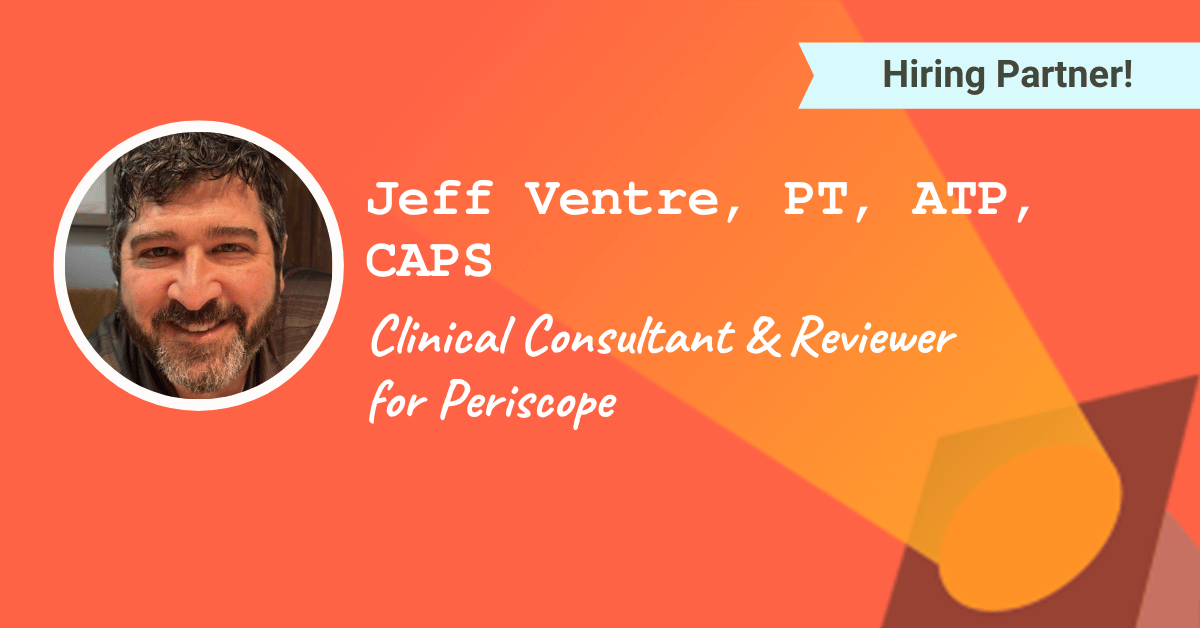
This week’s spotlight is on Jeff Ventre, PT, ATP, CAPS, a non-clinical physical therapist who is now a Clinical Consultant and Reviewer for Periscope and Physical Therapy Supervisor for a state-run developmental disabilities program!
We’re excited to share that Periscope is a hiring partner of Go Non-Clinical, our community for clinicians exploring non-clinical careers!
This post may contain affiliate links or codes. This won’t increase your cost, but it helps keep TNCPT alive, and free of annoying ads! Thank you for your support. 🙂
What is your name, title, and company name for your current, primary role?
Jeff Ventre, PT, ATP, CAPS — Clinical Consultant and Reviewer for Periscope

What additional roles do you currently have?
In addition to my work with Periscope, I serve as the Physical Therapy Supervisor for a large state-run program supporting individuals with developmental disabilities. I oversee a team of 14 PTs and PTAs, manage clinical operations, and support adaptive equipment and mobility-related services across the region.
Where are you located?
Buffalo, NY
Please refrain from contacting our spotlight participants on social media. There are thousands of readers just like you out there. 🙂 Please ask your questions in the comments on this blog post.
If you’re a Non-Clinical 101 student or Go Non-Clinical member, you can network with many of our spotlight participants in our community!
Where did you go to PT school, and what year did you graduate?
D’Youville University, 2000
What did you do when you first finished school, and for how long?
I have worked with developmentally disabled adults for the past 26 years.
In what setting(s) did you work, and what types of patients did you treat?
I have spent my entire PT career working with developmentally disabled adults, adaptive equipment, and complex wheelchair seating and positioning.
What did you enjoy about your early roles? What didn’t you enjoy?
Early on, I really enjoyed the relationships and the ability to make a tangible difference in people’s daily function and quality of life. Working with individuals long-term allowed me to see progress in a meaningful way. What I didn’t enjoy as much was the lack of resources at times and the challenge of navigating systems that weren’t always designed to support complex needs efficiently.
When and why did you decide to do something non-clinical?
It wasn’t a sudden decision — it evolved over time. As I gained experience in adaptive equipment, home modification assessments, and complex mobility, I found myself increasingly involved in consultation, documentation, and justification for medical necessity. I realized I enjoyed the problem-solving and the ability to influence care at a broader level, not just one patient at a time. That naturally led me into consulting and review work with Periscope.
What are you doing these days?
Currently, I split my time between two very different but complementary roles. With Periscope, I work as a 1099 consultant and reviewer, completing in-home assessments and writing medical necessity summaries for complex rehab equipment, home modifications, and other functional needs.
In my state role, I supervise a PT department, oversee clinical services, and help guide adaptive equipment decisions for individuals with developmental disabilities. The combination allows me to stay connected to both clinical care and higher-level decision-making. For fun, I work for the Buffalo Bills in the command center during Bills home games and other stadium events. Go Bills!
Are you still treating patients, or are you solely non-clinical?
I’m no longer treating in a traditional, ongoing therapy model. My Periscope work involves functional assessments and evaluations, but not longitudinal treatment. My state role is primarily administrative and supervisory at this point.
How long have you been in your current role?
I have been a Physical Therapy Supervisor since approximately 2015. I began working with Periscope as a consultant and reviewer in 2023.
What do you wish you would’ve known before going into this role?
I only wish I would have known about it sooner, but maybe I wouldn’t have been as ready as I feel now.
Did you get any special certifications or training along the way to help you get into your current role?
I completed my ATP and CAPS certifications, and I’m actively involved in RESNA coursework.
How did you find your job? Did you apply or find it through a connection?
Periscope had a posting on an online job website that I happened to be interested in. I applied, and about a year later I was contacted. They explained that in my state it was a slow process in getting health plans on board, hence the delay.
Editor’s note: Periscope is a hiring partner of The Non-Clinical PT! If you’re interested in working as a Clinical Consultant and Reviewer, check out their open positions on the Periscope careers page.
Did you do anything special to your resume and cover letter to land the job?
I highlighted my passion for the profession and shared my knowledge and experience with home modification and DME assessments.
What are some of the things you did to stand out, take initiative, and advance in your career?
I didn’t necessarily set out to “move up,” but I consistently tried to add value beyond my assigned role. Early on, I gravitated toward more complex cases, especially in adaptive equipment and wheelchair seating, and became a resource that others could rely on. I took initiative by helping solve problems that didn’t have clear ownership, whether that was assisting with equipment decisions, improving documentation, or supporting newer staff.
Over time, I also became more involved in training, mentoring, and helping shape processes within the department. I focused on being dependable, practical, and solutions-oriented, which built trust with both leadership and my peers. That combination of clinical expertise, willingness to step in where needed, and consistency over time ultimately led to leadership opportunities.
How have people reacted to you leaving patient care?
Most people see it as a natural progression.
I didn’t really “leave” patient care entirely — I just shifted how I contribute.
Instead of direct treatment, I’m now helping ensure that individuals receive appropriate equipment and services, often at a systems level. Colleagues tend to respect that transition.
What’s a typical day or week in the life like for you? What types of tasks and responsibilities fill your time?
No two days are exactly the same, which I enjoy. On the Periscope side, I may be completing in-home assessments, reviewing documentation, or writing detailed medical necessity summaries. On the state side, my time is spent supervising staff, reviewing referrals, coordinating services, addressing operational issues, and supporting clinical decision-making. There’s a mix of problem-solving, communication, and documentation throughout the week.
What are some of the rewards of your role? What are the biggest challenges?
The biggest reward is being able to impact care on a broader scale, helping ensure that individuals receive the right equipment or services to improve safety and independence. The challenge is balancing multiple roles and managing time effectively, especially when both positions are demanding in different ways.
How did your clinical background prepare you for this role? Which skills transferred?
My clinical background is the foundation for everything I do. Skills like functional assessment, clinical reasoning, documentation, and understanding patient needs all translate directly. Communication and the ability to justify recommendations clearly and defensibly are especially important in consulting and review work.
What type of person do you think would do well in your role?
Someone who is detail-oriented, able to think critically, and comfortable making decisions with incomplete information. Strong writing and communication skills are important, as well as the ability to work independently. It also helps to be adaptable and willing to learn, especially when dealing with complex cases.
Do you work remotely or onsite?
It’s a mix. My Periscope work includes both remote documentation and in-home assessments. My state role is primarily onsite with some flexibility depending on the day.
Did you read any books, take any courses, or do anything special overall to get you where you are today?
Most of my growth has come through experience and mentorship rather than formal coursework, though I’ve taken hundreds of hours of continuing education coursework to hone skills and knowledge of wheelchair seating and positioning, especially as technology continues to change and improve. Over time, I developed a niche in adaptive equipment and complex mobility, which opened doors to consulting opportunities. Staying curious and continuing to learn on the job has been key.
What is a typical career path for someone in your role?
There isn’t one single path, but many people start with a strong clinical foundation and then specialize, whether in equipment, utilization review, consulting, or leadership. From there, opportunities can expand into roles that influence care at a broader level rather than direct treatment.
What is next for you? What are your high-level career aspirations?
I’d like to continue growing in the consulting space while maintaining a meaningful role in leadership. Long-term, I’m interested in continuing to influence systems of care, improve access to appropriate equipment and services, and mentor others who are looking to expand beyond traditional clinical roles.
What would you recommend to someone who is considering going into a role like yours? Do you have any special words of wisdom for the readers?
Build a strong clinical foundation first. From there, look for opportunities to specialize — especially in areas like adaptive equipment, documentation, or complex cases. Networking and being open to new opportunities are also important. You don’t have to leave clinical work entirely; there are ways to expand your role over time.
Editor’s note: You can also find all open positions at Periscope on the private job board inside our Go Non-Clinical community, where members can contact hiring managers directly and get a head start on the application process.
What would you like to change most in your profession, and why? How would you propose doing so?
I’d like to see better alignment between clinical recommendations and payer systems, especially when it comes to medically necessary equipment. Too often, the process is overly complex and delays care. Improving communication, documentation standards, and collaboration between clinicians and payers would go a long way.
What career advice would you give yourself that you wish you had during school?
Don’t feel like you have to follow a single, traditional path. There are many ways to use your degree, and your career can evolve over time. Be open to opportunities that may not be obvious early on.
What would you teach to today’s graduate students in your profession, if you had the opportunity?
I would emphasize clinical reasoning and documentation. Being able to clearly explain why something is needed is just as important as knowing what to do. That skill opens doors in both clinical and non-clinical roles.
Do you have any special advice for others who want to follow in your footsteps?
Be patient and build your expertise over time. Find an area you enjoy and go deep with it. Opportunities tend to follow when you become known for something specific.
Don’t be afraid to step outside of your comfort zone when new roles present themselves.
Editor’s note: This spotlight is part of a five-part series featuring members of the Periscope team. From flexible 1099 consulting to full-time clinical leadership and C-suite roles, these spotlights show the range of non-clinical career paths available to rehab therapists at Periscope. Read the rest of the series:
