
Published:

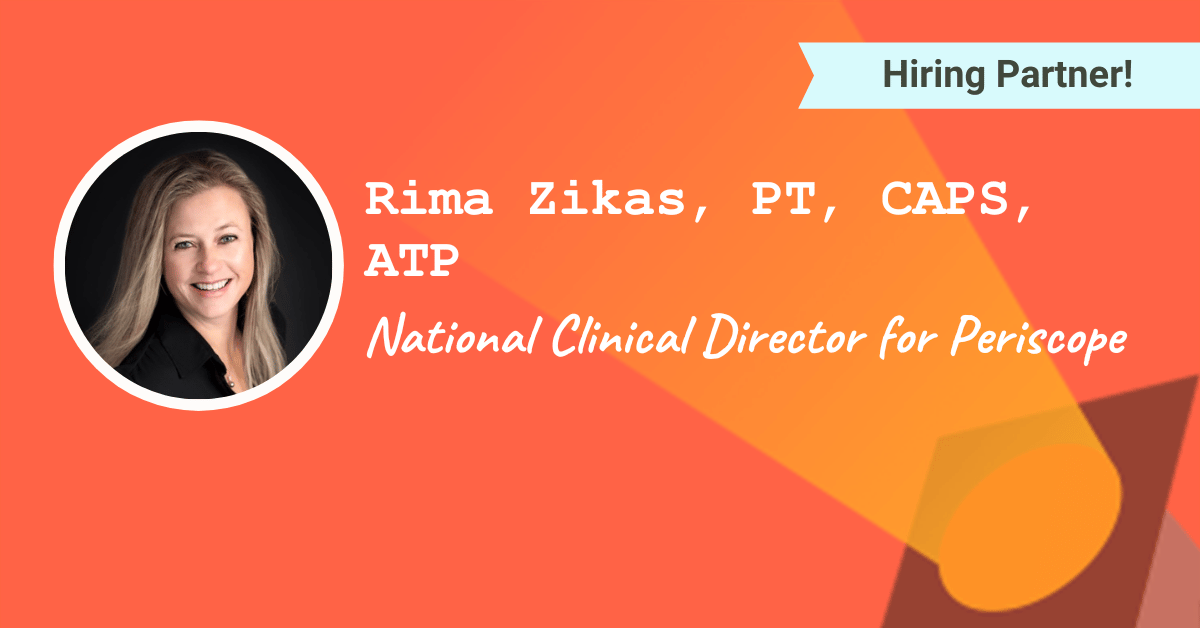
This week’s spotlight is on Rima Zikas, PT, CAPS, ATP, a non-clinical physical therapist who is now a National Clinical Director for Periscope!
We’re excited to share that Periscope is a hiring partner of Go Non-Clinical, our community for clinicians exploring non-clinical careers!
This post may contain affiliate links or codes. This won’t increase your cost, but it helps keep TNCPT alive, and free of annoying ads! Thank you for your support. 🙂
What is your full name, title, and company name for your current, primary role?
Rima Zikas, PT, CAPS, ATP — National Clinical Director for Periscope

Where are you located?
Seattle, WA
Please refrain from contacting our spotlight participants on social media. There are thousands of readers just like you out there. 🙂 Please ask your questions in the comments on this blog post.
If you’re a Non-Clinical 101 student or Go Non-Clinical member, you can network with many of our spotlight participants in our community!
Where did you go to PT school, and what year did you graduate?
Received my Master’s in Physical Therapy at University of Wisconsin-Madison in 1999.
What did you do when you first finished school, and for how long?
Entering the field during a hiring freeze and a period of layoffs presented an immediate challenge, but it also taught me the value of versatility. I started my career in Columbus, WI, balancing a hybrid inpatient acute and outpatient role at a rural community hospital with a pediatric home health position in Madison and per diem work at a nursing home.
When the pediatric agency closed six months later, I leveraged my professional network, reaching out to a former clinical instructor. This led to a full-time outpatient orthopedic role, allowing me to transition my hospital work to weekends — a balance I found both professionally and personally rewarding.
In what setting(s) did you work, and what types of patients did you treat?
I’ve had the privilege of working across nearly every clinical setting, which has allowed me to support patients at every stage of their healthcare journey. My background includes treating everything from acute bedside cases to specialized outpatient needs. I’ve worked in sports medicine and pediatrics, but I also find great reward in the technical side of the field, such as wound management and wheelchair seating and mobility evaluations.
Having a background in women’s health as well has truly allowed me to treat the “whole patient” regardless of the setting.
What did you enjoy about your early roles? What didn’t you enjoy?
What I found most rewarding in my early roles was the incredible diversity of the patient population. I truly enjoyed connecting with people from every walk of life — from elite athletes to refugees — and helping them navigate their unique therapy goals.
However, like many in our field, I found the administrative pressures challenging. Balancing high-volume productivity standards with the deep, focused documentation required for quality care often meant working through breaks or after hours. It was a constant exercise in efficiency to ensure that the drive for “metrics” never compromised the clinical excellence my patients deserved.
What else have you done since then, prior to your current role?
I took a break from clinical work to raise twins. What was supposed to be a few months turned into several amazing years. It was such a rewarding part of life, and honestly, it gave me a whole new perspective on multitasking and patience that I use every day now.
This “pause” provided a natural pivot point in my career, allowing me to return to the healthcare field with a heightened focus on the systems and management side of the industry, eventually leading me into the leadership role I am in now.
When and why did you decide to do something non-clinical?
The idea of a career shift had been simmering for years, but I honestly didn’t know where to start or how to make a living wage outside the clinic. As therapists, we have all this education, but it can feel like our experience is “too niche.”
I just felt it in my bones that I could do more on a bigger scale. I eventually took a leap into 1099 consulting work, which kept my clinical skills sharp while I figured out the industry side of things. That was the bridge I needed to get where I am now.
What are you doing these days?
I work full time for Periscope as a National Clinical Director. I wear many hats in my role, and no two days are ever the same. I manage the full lifecycle of our PT/OT consultants in the field (who complete in-home medical needs assessments), from recruiting and onboarding to mentoring and training. My goal is to ensure we have the right talent to meet our partner’s needs.
I help manage key partner accounts and represent the company in strategic meetings with medical directors. I work with a great team to serve as a bridge between clinical expertise and operational strategy. On the clinical side, I work on designing and implementing educational tools and reviewing medical documentation.
Are you still treating patients, or are you solely non-clinical?
I am solely non-clinical and don’t treat patients.
How long have you been in your current National Clinical Director role?
I started as a 1099 consultant doing in-home assessments back in 2019. I moved into a reviewer role shortly after, and then in 2022, I transitioned to a full-time W-2 role. At that time, there were only a few of us!
Seeing the company grow from those early days to what it is now has been such a “unicorn” experience. I feel so lucky to have grown right along with the organization.
What do you wish you would’ve known before going into this role?
I find it hard to look back with “wishes” or “regrets,” because that implies a desire for a different path. I believe this opportunity arrived at exactly the right time. As a perpetual learner, I’ve thrived on the steep learning curve.
If anything, I’ve learned that you don’t need to have every answer on day one — the most important skill is the ability to adapt and remain curious. The transition into this role happened exactly when it was supposed to, and the learning I’ve done along the way has been the most fulfilling part of the experience.
Did you get any special certifications or training along the way to help you get into your current role?
I received my CAPS (Certified Aging in Place Specialist) and Assistive Technology Professional (ATP) certifications while in this role.
How did you find your job? Did you apply or find it through a connection?
The consultant role popped into my feed on a job search, and I applied for the consultant opportunity initially.
Editor’s note: Periscope is a hiring partner of The Non-Clinical PT! If you’re interested in non-clinical consulting and clinical leadership roles, check out Periscope’s careers page.
Did you do anything special to your resume and cover letter to land the job?
Not really! But I did make sure to send a really sincere follow-up email after my interview to express how much I wanted the role. I was honestly a little nervous that being out of the workforce to raise my kids would hold me back, so I’m just so happy they took a chance on me and saw what I could bring to the table.
What was the interview like for the role?
I had a phone interview, but it was more of a discussion.
What are some of the things you did to stand out, take initiative, and advance in your career?
It really started with a connection. The CEO and COO happened to be traveling to Seattle in my early consulting days, and I met up with them. It was so inspiring. I had no idea really what the company was all about or how it operated behind the scenes. I knew that I wanted to be part of it.
Over time, I made sure I asked my mentor questions and expressed interest for potential growth. When they asked if I’d be interested in doing more, I told them I was willing to wait as long as it took for a door to open. That patience and genuine interest really made the difference.
How have people reacted to you leaving patient care?
Honestly? I don’t think anyone really reacted! Because I had already been away for a few years raising my twins, the shift felt very natural. When I was ready to jump back in, my main goal was to keep the license I’d worked so hard for, but I knew deep down I didn’t want to go back to the traditional patient care side of things. It wasn’t some big “announcement” — it was just me finding a new way to use my skills that actually fit my life at the time.
What’s a typical day or week in the life like for you? What types of tasks and responsibilities fill your time?
My days are incredibly varied, which keeps things exciting. Most of my time is spent on my computer or phone, virtually meeting with the internal team, external partners, and managing the flow of our consultant network. I’m responsible for making sure we have the right people on the right cases, but I also get to be creative with projects and educational tools.
I still keep my clinical “reviewer” hat nearby so I can jump in and help that team whenever they need a hand. Since our field consultants are out at all hours, I do get calls throughout the day and evening. I’m in the middle of a personal goal to set firmer “office hours” — it’s a challenge when you love what you do, but the company is great about pushing us to prioritize that work-life balance.
What are some of the rewards of your National Clinical Director role? What are the biggest challenges?
The biggest reward for me is the trust. I don’t feel micromanaged; instead, I feel totally empowered and trusted to do the right work. Plus, I’m a fan of the flexibility and getting to work from home!
It’s rewarding to be part of something this unique and exciting. Watching the company grow over the last few years has been such a journey, and I’m genuinely looking forward to what’s next. As for the challenges, it’s really just that boundary piece. When you’re part of something growing this fast, the biggest hurdle is learning how to finally “unplug” and step away.
How did your clinical background prepare you for this role? Which skills transferred?
My “therapist brain” never really turns off! My clinical background is the foundation for everything I do. Being comfortable talking to all kinds of people for all kinds of reasons is a huge one — that’s a skill you can only really get from years at the bedside or in the clinic.
I use my knowledge base every single day when I’m looking at diagnoses, DME, or home safety and equipment recommendations. Especially having that home health background — it gives me a unique lens to understand what a patient actually needs to be safe and successful.
Honestly, though, the biggest transferrable skill has been intellectual curiosity. In therapy, you’re always a detective trying to solve a puzzle, and I use that same mindset to solve operational puzzles now!
Roughly speaking, how are the hours and pay compared to patient care?
Comparing the two is like night and day! I don’t miss the “clock-in, clock-out” grind of the clinic at all. Even though the hours can be fluid, the flexibility more than makes up for it. Plus, the pay is better than what I was making in patient care, so it’s been a very rewarding shift in every sense of the word.
What type of person do you think would do well in your National Clinical Director role?
I think the best fit for this role is someone who is never satisfied with just “knowing enough” — you have to want to keep growing. You need to be a bit of a visionary, but you also need the discipline to be detail-oriented in the day-to-day. Communication is huge, and the ability to listen and resolve problems is important. There’s that saying that it’s not about being right; it’s about getting it right.
Do you work remotely or onsite?
Remotely. I do go out in the field at times, if needed for cases or trainings. Periscope is based in California, where it started, but there is no brick-and-mortar building or site. As a team, we do have face-to-face meetups and travel a few times a year.
Editor’s note: You can also find all open positions at Periscope on the private job board inside our Go Non-Clinical community, where members can contact hiring managers directly and get a head start on the application process.
Does your organization hire PT, OT, or SLP professionals into non-clinical roles? If so, what type of roles?
The organization is a network of PT, OT, SLP, and RN consultants performing one-time in-home assessments. Growth happens from within the organization.
Did you read any books, take any courses, or do anything special overall to get you where you are today?
Professional coaching, team building events, CAPS, ATP, and I am constantly watching webinars when I have the time on various topics.
What is a typical career path for someone in your National Clinical Director role?
I’m not even sure I can answer that one! There really isn’t a “typical” career path for a role like this, and that’s actually what makes it so exciting. It’s not like the clinic where you just move from junior to senior therapist. This is more for the person who is comfortable carving out their own space and turning their clinical expertise into something totally new. We’re kind of building the map as we go!
What is next for you? What are your high-level career aspirations?
My high-level goal is to keep evolving alongside the business. I’m really focused on honing my leadership abilities right now because I want to be prepared to step up whenever a new door opens.
It’s been so rewarding to witness our growth over the last few years, and I’m definitely not done yet! I’m looking to take the lead on more initiatives and really grab the reins as we continue to scale. I’m just excited to see what the future holds for all of us.
What would you recommend to someone who is considering going into a role like yours? Do you have any special words of wisdom for the readers?
Don’t give up. It’s so easy to feel like your clinical niche is the only place you belong. I felt this way for years. I promise you, there is so much more out there.
You have to be willing to be comfortable being uncomfortable for a while. That “in-between” phase where you’re learning a new language and a new way of working can be scary, but it’s exactly where the growth happens. If you feel that pull to do something different, trust it — the right role is waiting if you’re patient enough to find it.
What would you like to change most in your profession, and why? How would you propose doing so?
I would try to change the public’s definition and image of what “therapy” actually is. We need to move away from the idea that we’re just the people who help you get out of bed or give you exercises. “Therapy” is an umbrella term for a massive amount of clinical expertise, and I’d love to see the profession respected and valued for that depth. We have roles in consulting, educating, in technology, home safety, home modification, medical device innovation, complex equipment, and high-level diagnostics — just to name a few.
What career advice would you give yourself that you wish you had during school?
There’s more out there. Change is good.
What would you teach to today’s graduate students in your profession, if you had the opportunity?
Try everything. Don’t feel like you have to lock yourself into one niche right away — it’s totally okay to change things up as you grow! I’d also tell them to actively seek oversight and feedback. That’s not a sign of weakness; it’s a way to get better.
And most importantly, remember that you don’t need to prove you’re right. You aren’t there to prove you have all the answers; you’re there to learn and find the best solution. Being coachable is your greatest asset.
Editor’s note: This spotlight is part of a five-part series featuring members of the Periscope team. From flexible 1099 consulting to full-time clinical leadership and C-suite roles, these spotlights show the range of non-clinical career paths available to rehab therapists at Periscope. Read the rest of the series:
