
Published:

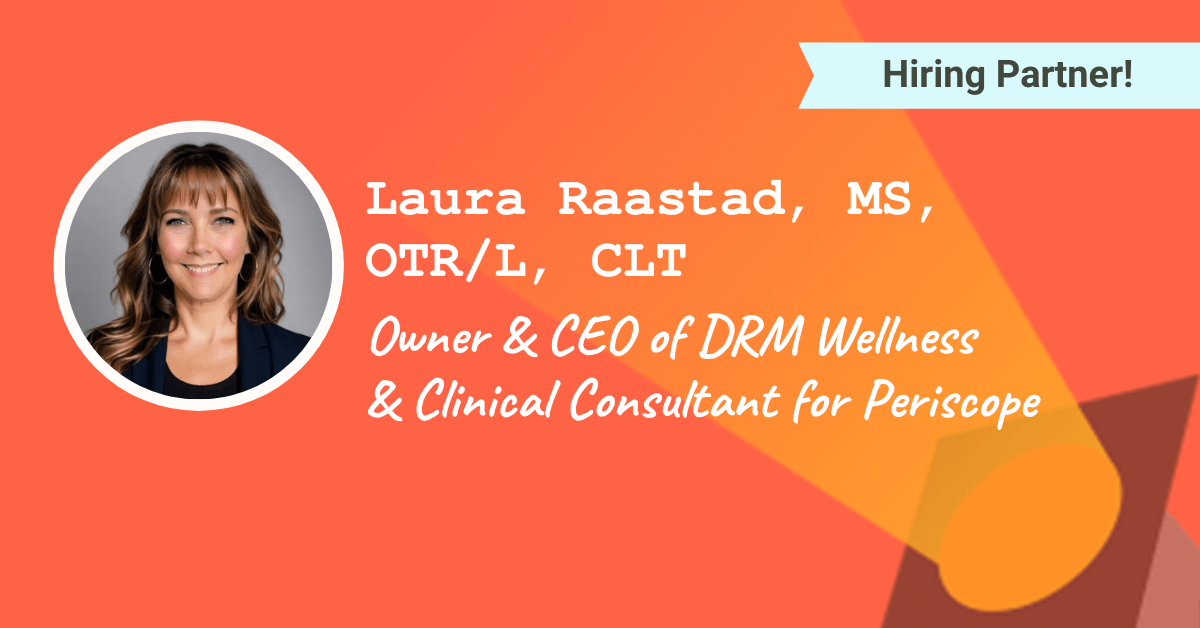
This week’s spotlight is on Laura Raastad, MS, OTR/L, CLT, a non-clinical occupational therapist who is now the Owner & CEO of DRM Wellness and a Clinical Consultant for Periscope!
We’re excited to share that Periscope is a hiring partner of Go Non-Clinical, our community for clinicians exploring non-clinical careers!
This post may contain affiliate links or codes. This won’t increase your cost, but it helps keep TNCPT alive, and free of annoying ads! Thank you for your support. 🙂
What is your full name, title, and company name for your current, primary role?
Laura Raastad, MS, OTR/L, CLT — Owner of DRM Wellness
What additional roles do you currently have?
I also work as a 1099 Clinical Consultant for Periscope.

Where are you located?
Omaha, Nebraska.
Please refrain from contacting our spotlight participants on social media. There are thousands of readers just like you out there. 🙂 Please ask your questions in the comments on this blog post.
If you’re a Non-Clinical 101 student or Go Non-Clinical member, you can network with many of our spotlight participants in our community!
Where did you go to OT school, and what year did you graduate?
I went to Dominican University of California in San Rafael, California, and graduated in 2006.
What did you do when you first finished school, and for how long?
When I first finished school, I started working in the hospital setting. After that, I intentionally explored a variety of practice settings, including working as a travel therapist. My heart was always in the ICUs, and I always found my way back there.
My goal early in my career was to gain broad experience and exposure to different patient populations and environments so I could become a well-rounded clinician and truly understand the full scope of what I could do in occupational therapy.
In what setting(s) did you work, and what types of patients did you treat?
I worked in pediatrics, including hippotherapy, where I helped children develop motor skills and confidence through therapeutic riding. I also worked in long-term acute care hospitals, treating patients with complex medical conditions, including spinal cord injuries. In addition, I gained experience in skilled nursing facilities and outpatient settings, working with patients recovering from surgeries, injuries, and chronic conditions.
I also loved working in mental health, particularly focusing on habits and routines. Occupational therapy is so uniquely positioned to help people rebuild structure in their daily lives, and that work felt very meaningful to me. We worked on establishing healthy routines for sleep, self-care, medication management, and participation in meaningful activities. Helping someone move from feeling overwhelmed, hopeless, or stuck to having a predictable, manageable daily routine can make a huge difference in their mental health and overall independence.
While I valued the experience I gained in each of those settings, the hospital environment always felt like home to me. There is something incredibly meaningful about working with patients in the ICU or acute care who have been critically ill and helping them regain the most basic levels of independence. Being part of those early recovery moments, when someone goes from being completely dependent to taking those first steps toward independence again, is one of the most rewarding parts of this profession for me.
What did you enjoy about your early roles? What didn’t you enjoy?
What I really enjoyed about my early roles was the opportunity to learn from some incredible therapists and mentors. I was fortunate to work with experienced clinicians and lead therapists who took the time to teach me the real “why” and the clinical reasoning behind what we do.
Some of the best clinicians I worked with in the hospital and ICU really helped me become comfortable with complex medical patients. They taught me how to understand and manage lines, tubes, and monitors, and how to safely mobilize patients who were critically ill.
Those experiences helped build my confidence and shaped the therapist I am today. I also loved seeing patients make meaningful progress, especially in acute care when someone goes from being very medically fragile to regaining basic independence.
One of the challenges early on was simply the learning curve. Working with medically complex patients can feel overwhelming at first, and there is a lot to learn quickly. But in many ways, that challenge is what pushed me to grow, ask questions, and develop stronger clinical skills.
What else have you done since then, prior to your current role?
Over time, my interests began to shift toward areas where occupational therapy could have a broader impact outside of traditional clinic walls. That led me to open my own practice, DRM Wellness, where I focus on two areas that are often underserved in our profession.
The first is working with individuals in larger and bariatric bodies. Much of my work centers on functional mobility, strength, and independence in ways that are practical, judgment-free, and directly tied to everyday life. I’m passionate about helping people move better, participate fully in their lives, and regain confidence in their bodies.
The second area is legal support services. I provide functional capacity evaluations, home safety evaluations, and care needs assessments that translate clinical findings into clear, objective functional data for attorneys and courts.
Through DRM Wellness, I’ve built a practice that combines traditional occupational therapy with bariatric-focused wellness, aging-in-place services, and legal evaluations. My goal is to apply occupational therapy in ways that truly reflect its core purpose: helping people function safely, independently, and meaningfully in their daily lives.
When and why did you decide to do something non-clinical?
I began working with Periscope as a consultant in 2019, before opening my own practice. At that point in my career, I was experiencing a significant amount of burnout from the demands of traditional clinical roles and feeling pretty overwhelmed.
The work allowed me to step out of the role of the treating therapist and focus instead on objective functional evaluation and advocacy. I found it incredibly rewarding to be able to assess a person’s abilities, environment, and care needs and clearly communicate what supports would help them live more safely and independently. It gave me a different perspective on occupational therapy and helped me rediscover the impact our profession can have.
What are you doing these days?
In addition to running DRM Wellness, I continue to work as a consultant with Periscope, where I perform functional evaluations and assessments that help advocate for appropriate care, equipment, and support for individuals with complex needs.
I love working for Periscope. It has been an incredibly valuable part of my professional development. I truly love the work I do with them. It has made me a stronger therapist and a much better documenter because the process requires very clear clinical reasoning and detailed, objective reporting.
Are you still treating patients, or are you solely non-clinical?
Oh, I definitely still treat patients. I think I always will. Being involved in clinical care is really part of who I am as an occupational therapist.
After COVID, I did step away from full-time clinical work for about a year and worked in medical staffing, but I realized pretty quickly how much I missed working directly with patients.
There’s something incredibly meaningful about helping someone regain function and independence, and that connection is what drew me to this profession in the first place. Even though I do a lot of consulting, evaluations, and non-clinical work now, I always want to keep at least a toe in patient care.
Staying clinically active keeps me grounded, sharpens my perspective, and ultimately makes me better at all the other work I do.
What percentage of your time is spent clinically vs. non-clinically?
Right now, I would say my time is split roughly 40% clinical and 60% non-clinical. I still treat patients because staying clinically active is important to me and keeps me grounded in the realities of patient care. At the same time, a growing portion of my work is focused on developing programs, consulting, and building services that expand how occupational therapy can be used.
A lot of my non-clinical time is spent developing wellness programs and initiatives for larger and bariatric bodies. I also spend time on program development, education, and building systems that allow these services to reach more people.
My goal moving forward is to continue shifting more toward that program development and consulting side while still maintaining some level of clinical work so I stay connected to the patients and populations I care about.
How long have you been in your current roles?
I have been working with Periscope since 2019, and I opened my business in October 2023.
What do you wish you would’ve known before going into this role?
I think one thing I wish I had fully understood before stepping into this role is just how different the perspective is when you move from being a treating therapist to performing objective evaluations and writing reports that will be reviewed and used in legal settings.
When I first started working with Periscope, I didn’t fully appreciate how important precision, clarity, and defensible documentation would be. As clinicians, we’re used to writing notes for continuity of care and justification of services and need, but in this type of work, every word matters. The reports have to clearly explain your clinical reasoning and stand up to review by attorneys, reviewers, and sometimes courts.
What I quickly realized, though, is that the review process and the team at Periscope are an incredible learning environment. The reviewers provide thoughtful feedback that really sharpens your clinical thinking and documentation skills. Over time, that process made me a much stronger evaluator, a better writer, and honestly a better therapist overall.
Looking back, I wish I had known just how much I would grow from that experience. Working with Periscope didn’t just teach me how to do evaluations. It fundamentally improved how I assess function, how I communicate clinical findings, and how I advocate for what individuals truly need.
Did you get any special certifications or training along the way to help you get into your current role?
Not specifically for this role, but along the way I did pursue additional training that has been helpful. I became a Certified Lymphedema Therapist (CLT), which deepened my understanding of complex medical conditions and how physical changes can impact a person’s function and independence.
I have also completed training in functional capacity evaluations (FCEs), which has been especially valuable for the legal support and evaluation work I do today. That training helped strengthen my ability to objectively assess function, document findings clearly, and translate clinical observations into meaningful reports.
How did you find your job? Did you apply or find it through a connection?
I actually came across the opportunity with Periscope on Indeed quite a few years ago. I was exploring different professional opportunities at the time outside of traditional care, and the role stood out to me because it allowed me to apply my occupational therapy skills in a different way, focusing on evaluation and functional assessment rather than traditional treatment.
Editor’s note: Periscope is a hiring partner of The Non-Clinical PT! If you’re interested in therapy consulting and evaluation roles, browse all of their current openings on Periscope’s careers page.
Did you do anything special to your resume and cover letter to land the job?
I didn’t do anything particularly special with my resume or cover letter. I simply submitted my resume and was fortunate to be contacted for an interview fairly quickly. I think what likely helped was the variety of clinical settings I had worked in. Having experience across multiple practice areas gave me a broad perspective on patient care and function, which translated well into the evaluation work required for the role.
What was the interview like for your Clinical Consultant role?
I had a really great interview with an incredible physical therapist named Ken Babich, who unfortunately passed away a few years ago. He was extremely knowledgeable and supportive, and I immediately felt comfortable talking with him about the role and the work involved.
Ken had a way of making the conversation feel both professional and encouraging, and it was clear how passionate he was about the work. I feel very lucky that I had the opportunity to be trained and mentored by him early on. He taught me a great deal about the evaluation process, clinical reasoning, and the importance of thorough, thoughtful documentation.
When did you start your business?
I started DRM Wellness in October 2023.
Where did you get the idea for your business?
The idea for my business really came from what I was seeing while working in hospitals, especially with critically ill patients. I was helping people regain basic independence after serious illness, but I kept noticing a disconnect between wellness and what had actually brought them into the hospital.
Many of the challenges I was seeing were related to long-term issues with mobility, habits, and overall health. I found myself thinking that if we could reach people earlier, before things became a crisis, many of them might never end up in the hospital at all.
That realization led me to create DRM Wellness, where the focus is on helping people improve mobility, function, and independence earlier through wellness, bariatric-focused care, and aging-in-place services.
How have people reacted to you leaving patient care?
I don’t think most people feel like I’ve actually left patient care because I still stay clinically involved. Treating patients is an important part of who I am as a therapist, so I’ve always kept at least some level of clinical work in what I do.
What has really changed is that I’ve expanded into program development and new service models. I’ve always been someone who likes building things and asking what else occupational therapy could be doing to better support people. Because of that, many of my colleagues are less focused on me stepping away from traditional roles and more curious about what I’m working on next.
In many ways, that program development side has allowed me to help more people by creating services and approaches that didn’t previously exist in our community.
What’s a typical day or week in the life like for you? What types of tasks and responsibilities fill your time?
My weeks are a mix of clinical work, evaluations, and administrative time. I typically have designated admin days where I focus on documentation, report writing, program development, and managing the business side of my practice.
For my clinical work, I see many of my occupational therapy clients in their homes, which allows me to work with them directly in their own environments and address real-life functional challenges. I conduct functional capacity evaluations in my office, where I’m able to complete more structured testing and detailed assessments.
I also continue consulting with Periscope and try to fit those evaluations in throughout the week as my schedule allows. Those cases often involve comprehensive functional assessments and detailed reports.
So most weeks involve a combination of patient visits, evaluations, report writing, and developing new programs and services within my practice.
I also try to make sure I carve out time for life outside of work. I’m a busy sports and show choir mom, so a lot of my time revolves around practices, games, and performances. It’s a full schedule, but I wouldn’t have it any other way. I also make it a priority to be present for my family, including my husband and our doodle, who definitely keeps things entertaining at home.
What are some of the rewards of your roles? What are the biggest challenges?
One of the biggest rewards of my role is the variety. I’m able to work directly with patients while also contributing through evaluations, legal support work, and program development. I really enjoy helping people regain independence and advocating for the resources they need.
The biggest challenge is balancing all the different responsibilities that come with running a practice. Between clinical work, documentation, program development, and the administrative side of the business, there’s always a lot going on, but it keeps the work interesting and meaningful.
How did your clinical background prepare you for this role? Which skills transferred?
My clinical background prepared me well for this role because I had experience working in a wide variety of settings and with many different patient populations. That gave me a strong understanding of function, mobility, and how medical conditions impact a person’s daily life.
The skills that transferred most were clinical observation, functional assessment, and clinical reasoning. As therapists, we’re constantly evaluating how someone moves, how they perform tasks, and what barriers might affect their independence. Those same skills are essential when completing evaluations for Periscope.
My hospital and acute care experience was especially helpful because it taught me how to assess complex medical conditions, understand medical records, and clearly document findings, which is critical when writing objective reports.
Roughly speaking, how are the hours and pay compared to patient care?
The pay tends to be more consistent compared to traditional patient care. One of the things I really appreciate about working with Periscope is that it removes a lot of the administrative frustrations that often come with clinical practice. I’m not spending time calling insurance companies for prior authorizations or trying to justify medical necessity in order to get paid.
Instead, I’m able to focus on performing thorough evaluations and producing clear, objective reports. That shift allows me to spend my time using my clinical skills rather than navigating the insurance process, which has been a really positive change.
What type of person do you think would do well in your Clinical Consultant role?
I think someone who does well in this role needs to have a thick skin and be very detail-oriented. A lot of the work we do with Periscope involves gathering additional information when insurance companies or other parties are questioning whether certain services or care are medically necessary. Because of that, you can sometimes walk into situations where people are already frustrated or feeling defensive.
It’s important to stay calm, professional, and focused on the purpose of the evaluation. Strong documentation skills are also essential. You have to be very clear and detailed in explaining the “why” behind your clinical findings and recommendations so that the report accurately reflects the person’s functional abilities and needs.
Do you work remotely or onsite?
I essentially work remotely. I spend most of my time traveling throughout Nebraska and Iowa completing evaluations in people’s homes. Because of that, I’m rarely working out of a traditional office setting. Most of my work happens in the field, meeting clients where they live and evaluating their functional abilities within their real environments.
Does your organization hire OT professionals into non-clinical roles? If so, what type of roles?
Yes. Periscope works with PTs, OTs, and SLPs across the country in a variety of roles.
Editor’s note: You can also find all open positions at Periscope on the private job board inside our Go Non-Clinical community, where members can contact hiring managers directly and get a head start on the application process.
Did you read any books, take any courses, or do anything special overall to get you where you are today?
I didn’t follow one single course to get where I am today. Much of what I’ve learned has come from hands-on experience, mentorship, and continuing to invest in learning along the way.
I am part of an amazing program run by an occupational therapist named Kara Welke. Her Therapy Business Builder program through Next Level OT has helped me think more strategically about building and structuring my own practice. Any PT, PTA, OT, COTA, or SLP that has a dream about starting a practice and thinking outside of the traditional therapy box should check out the program.
I also enjoy reading business and productivity books. Buy Back Your Time by Dan Martell and Good to Great by Jim Collins both shaped how I think about managing time, building systems, and putting the right people in the right roles.
What is a typical career path for someone in your role?
A typical path often starts with gaining strong clinical experience and learning as much as possible about the profession. From there, I encourage therapists to start pushing the walls of what is considered traditional practice.
Occupational therapy skills translate incredibly well into many different roles beyond direct patient care. Once you understand function, problem solving, and how people interact with their environments, there are countless opportunities to apply those skills in new and creative ways.
What is next for you? What are your high-level career aspirations?
I’m really focused on helping change the way therapy and medical care are delivered for people in larger bodies. There are still many gaps in how healthcare approaches mobility, fitness, and independence for this population, and I want to be part of shifting that conversation.
Long term, I hope to continue developing programs, education, and services that make therapy more inclusive and functional for everyone. I have big dreams for expanding this work and helping more clinicians think differently about how we support health, movement, and independence.
What would you recommend to someone who is considering going into a role like yours? Do you have any special words of wisdom for the readers?
If someone is considering a role like this, my biggest advice is to stay curious and be willing to step outside of traditional career paths. Build a strong clinical foundation first and learn as much as you can about how people function in real life. Those skills translate far beyond direct patient care.
Also, don’t be afraid to try new opportunities, even if they look a little different from what you expected when you first entered the profession. Occupational therapy gives us an incredible skill set in problem solving, functional assessment, and understanding how people interact with their environments. Those abilities can open doors to many roles you may not have considered.
Most importantly, remember that our profession has so much room to grow. If you see a gap in care or a better way to help people, don’t be afraid to explore it.
What would you like to change most in your profession, and why? How would you propose doing so?
What I would most like to change is how little many people understand about occupational therapy and the scope of what we can actually do. We have such a unique skill set that focuses on function, independence, and helping people participate fully in their daily lives, yet many people still don’t clearly understand how we differ from other professions or when they should seek out OT services.
In many ways, I feel like occupational therapy is still one of the best-kept secrets in healthcare. I would love to see our profession invest more intentionally in marketing and public education so that patients, healthcare systems, and communities better understand the value we bring.
The more clearly we can communicate what occupational therapy truly offers, the more opportunities there will be for OTs to expand into new roles and help more people live healthier, more independent lives.
What career advice would you give yourself that you wish you had during school?
I would probably tell my younger self not to feel like there is only one path in occupational therapy. When you’re in school, it can feel like your career has to fit into a few traditional settings, but in reality, the skills we learn can translate into so many different roles. Some of the most meaningful parts of my career have come from stepping outside of the traditional therapy box and exploring new ways to use occupational therapy to help people.
What would you teach to today’s graduate students in your profession, if you had the opportunity?
That it’s okay to blaze your own trail. Healthcare is changing rapidly, and the profession doesn’t look the same as it did when I was in school. In many ways, that’s a really good thing because it creates opportunities for innovation and new ways to apply our skills.
I would encourage students to be creative, take thoughtful risks, and stay curious. If you are passionate about something or you see a gap in care, chances are other people see that need too. Occupational therapy gives you an incredible skill set. Don’t be afraid to explore different ways to use it.
Do you have any special advice for others who want to follow in your footsteps?
If you’re actively looking for a new role outside of traditional healthcare, my biggest advice is to really break down what you already do in your current job. Therapists have incredibly valuable skills, but sometimes we don’t realize how transferable they are. When writing your resume and cover letter, focus on translating those skills into language that makes sense for the role you’re applying for.
Occupational therapists in particular are very strong at task analysis, problem solving, and understanding how people interact with systems and environments. For example, evaluating a patient’s ability to complete daily activities is essentially analyzing processes, identifying barriers, and developing solutions. Those same skills translate well into roles like consulting, program development, case review, ergonomics, and many other fields.
Don’t underestimate the value of your training. If you can clearly explain how your skills solve problems for an organization, you can open doors to opportunities you may not have originally considered.
Editor’s note: This spotlight is part of a five-part series featuring members of the Periscope team. From flexible 1099 consulting to full-time clinical leadership and C-suite roles, these spotlights show the range of non-clinical career paths available to rehab therapists at Periscope. Read the rest of the series:
