
Published:

Sword Health doesn’t sell physical therapy to patients directly. It sells digital musculoskeletal care as a benefit, one that employers, health plans, and labor unions buy on behalf of the people they cover, alongside programs for women’s health, cardiometabolic conditions, and mental health.
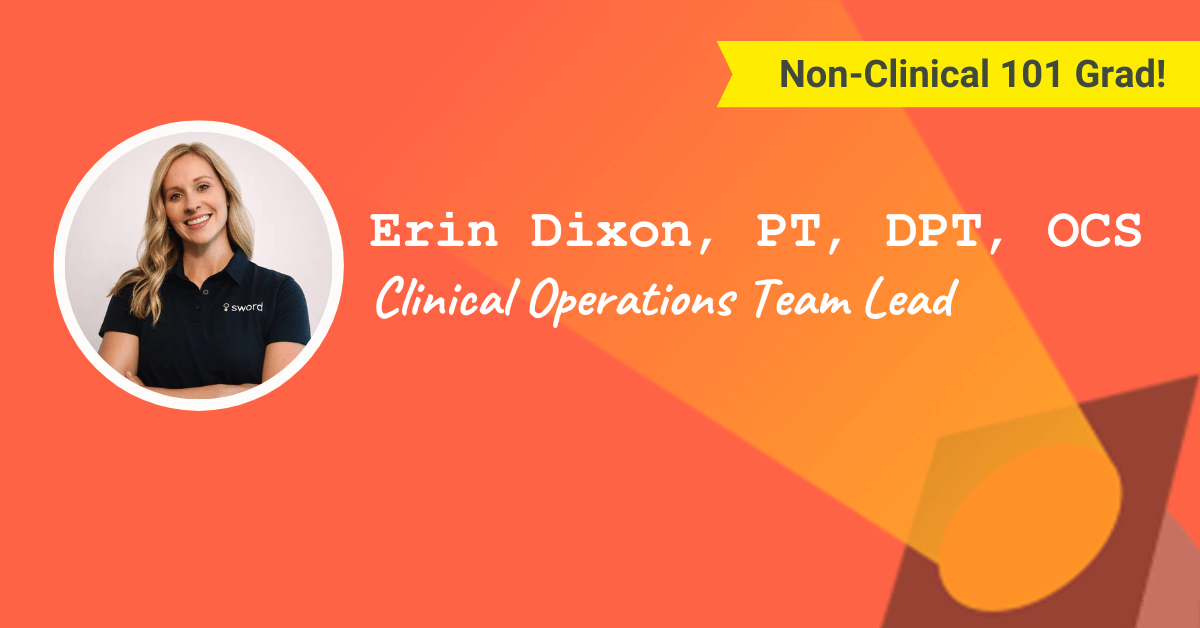
Erin Dixon, PT, DPT, OCS, treated as a physical therapist and now works, entirely non-clinically, as a Clinical Operations Team Lead for Sword Health. Clinical operations is the function that keeps a program like this running once someone enrolls, from that first call through the support that follows.
Because the care arrives through a worker’s benefits package, the person on the other end of the call is a member, not a patient, and the interview below uses that word throughout.
Companies in this corner of the market hire rehab clinicians for both the care and the operations around it, and our guide to telehealth physical therapy careers has the wider list.
Erin’s answers are below.
This post may contain affiliate links or codes. This won’t increase your cost, but it helps keep TNCPT alive, and free of annoying ads! Thank you for your support. 🙂
Where she trained, and the outpatient years
What is your full name, title, and company name for your current, primary role?
Erin Dixon, PT, DPT, OCS (she/her/hers) — Clinical Operations Team Lead for Sword Health
Where are you located?
Gretna, LA (New Orleans)
Where did you go to PT/OT/SLP/A school, and what year did you graduate?
LSU Health Sciences Center Shreveport, graduated in 2013
What did you do when you first finished school, and for how long?
I started working as a PT at a local hospital in the OP Ortho department for three years. I left that position to start working as a Travel PT for two years before transitioning back into a permanent role.
In what setting(s) did you work, and what types of patients did you treat?
I have primarily worked in OP Ortho with a focus on post-op patients and sports medicine. I also have experience working with the Work Comp population in Travel and PRN roles. My favorite patient populations to work with are active older adults and fitness athletes.
What did you enjoy about your early roles? What didn’t you enjoy?
Starting my career, I was fortunate to join a team that truly felt like family. While those first three years provided a vital foundation for my clinical skills, I eventually reached a ceiling for growth at that facility.
My passion was shifting toward sports medicine and working with active populations—a specialization that required a different clinical environment. One of the highlights of that role, however, was the ability to provide consistent 1:1 care, which allowed me to hone my patient-centered approach.
We actually used paper documentation back then. It’s laughable now, but it definitely brings back memories of a simpler workflow.
Why she left the clinic and what she’s doing now
What else have you done since then, prior to your current role?
Following my initial role, I spent roughly two years in travel and PRN settings before returning to a permanent position in an OP Ortho clinic.
In 2021, I transitioned into gym co-ownership, where for four years I balanced the responsibilities of Head Coach and Administrator while managing a small caseload of cash-based PT clients. To leverage my mid-day flexibility, I also joined Sword Health as a remote Intake Specialist.
When and why did you decide to do something non-clinical?
After years of seeing two to three patients per hour in traditional clinics, I found myself facing significant burnout. I felt that the high-volume model compromised the quality of care I could provide, and the rigid scheduling left little room for clinical flexibility.
While I explored the cash-based model to regain that autonomy, I realized I didn’t want my clinical income to rely solely on that space; I wanted to find a balance where my financial stability wasn’t tied to the inherent unpredictability of marketing and maintaining a private cash-based caseload.
I have always been intrigued by the potential of remote work, not only for the flexibility it offers but for its role in the future of healthcare.
I felt it was vital to immerse myself in the digital healthcare space early on, ensuring I stayed ahead of the curve as technology continues to redefine how we deliver patient care.
What are you doing these days?
I work full time as a Clinical Operations Team Lead at Sword Health, which involves leading a team of Intake Specialists within Thrive, a Digital Physical Therapy Program.
Are you still treating patients, or are you solely non-clinical?
This position is non-clinical.
How long have you been in your current role?
I started working at Sword Health in February 2024 in a part-time role as an Intake Specialist. I received my promotion as a Clinical Operations Team Lead in September of 2025.
Do you work remotely or onsite?
100% remote
What the week holds, and which clinical skills still do the work
What’s a typical day or week in the life like for you? What types of tasks and responsibilities fill your time?
As a Team Lead, my priority is being there for the Intake Specialists on my direct team and supporting my colleagues in any way I can. I start every morning by responding to Slack messages and checking in on any current projects.
My week is filled with 1:1 meetings and general team meetings as we all work together to improve workflows, solve problems, and provide mentorship/coaching at times. I work closely with the other team leads to stay ‘on call’ for our Intake Specialists. Since they’re often in the middle of live member calls, we prioritize being available for real-time support so they can get the fast answers they need to provide a great member experience.
Overall, it’s a balance of keeping an eye on the ‘big picture’ metrics while making sure no one on the team feels like they’re on an island.
What are some of the rewards of your role? What are the biggest challenges?
Transitioning into digital health has offered me the incredible reward of a flexible, remote lifestyle—allowing me to work from anywhere without missing a beat.
While managing a team was a new challenge after years of clinical work, the mentorship and collaboration from my colleagues has been great. It’s allowed me to grow into a leadership role with confidence, backed by a team that genuinely wants to see each other succeed.
How did your clinical background prepare you for this role? Which skills transferred?
The core clinical skills we develop during initial evaluations—specifically motivational interviewing—translate perfectly into this space. The ability to listen actively, build rapport, and empathize with members is a direct carryover from clinical practice that allows us to connect deeply with users in a digital environment.
Roughly speaking, how are the hours and pay compared to patient care?
I work a standard 40-hour week, though I often find myself logging on early or catching up late at night—not out of necessity, but because I’m genuinely more motivated in this role. The best part is the mental clarity; once I log off, I’m truly done.
There are no unfinished notes hanging over my head like there were in the clinic.
Beyond the improved work-life balance, this transition has also provided a significant pay increase compared to my time as a staff PT.
What she’d like to have known, and how she prepared
What do you wish you would’ve known before going into this role?
Stepping into the Intake Specialist role was a fascinating challenge because of its novelty. It’s the kind of position where success is driven by hands-on experience.
I leaned into the extensive on-the-job training to quickly master the workflows and nuances of the digital healthcare space.
Did you get any special certifications or training along the way to help you get into your current role?
I leveraged specialized resources from The Non-Clinical PT to help navigate my career transition. Their framework was instrumental in helping me identify what roles would be the best fit for me.
How did you find your job? Did you apply or find it through a connection?
I learned about Sword Health through a clinical spotlight on The Non-Clinical PT website and immediately went to Sword’s website to find the available openings.
Did you do anything special to your resume and cover letter to land the job?
To prepare for the transition, I optimized my resume for ATS compatibility and utilized myperfectresume.com to help me craft a resume that highlighted my non-clinical and clinical skills.
What was the interview like for the role?
While some time has passed since my initial interview, I remember the atmosphere being incredibly welcoming and conversational. Since then, the process has evolved; it now includes a clinical scenario assessment to help candidates demonstrate their practical decision-making skills.
How have people reacted to you leaving patient care?
Most people are very understanding because they know how life-changing remote work has been for me.
Who fits the role, and where it leads
What type of person do you think would do well in your role?
This role is a perfect fit for a fast learner who thrives in an ever-evolving, fast-paced environment. Success here relies on strong time management and the ability to adapt on the fly. We believe in setting our people up for success from day one, which is why we provide dedicated mentorship to ensure every new hire feels fully supported and confident as they transition into the team. I strongly feel that this applies to not only my role, but also other roles within Sword Health.
Does your organization hire PT, OT, or SLP professionals into non-clinical roles? If so, what type of roles?
For the Intake and Treatment roles, the company will only hire DPTs.
What are some of the things you did to stand out, take initiative, and advance in your career?
I maintained a proactive presence in our digital workspace, consistently offering support and guidance to colleagues via Slack and team meetings. This led to me assisting with the mentorship team for new employees and hosting meetings to foster communication with co-workers and discuss best practices specific to our roles. I believe these efforts helped me stand out when I applied for the Team Lead position.
Did you read any books, take any courses, or do anything special overall to get you where you are today?
Just reviewed the information from the Non-Clinical 101 course and their website.
What is a typical career path for someone in your role?
The company has divisions for general orthopedic conditions, pelvic health, and fitness. There are a ton of opportunities for clinical and non-clinical work at Sword. Oftentimes, Clinical and Non-Clinical PTs will start out in the intake and treatment PT roles before applying for Team Lead (supervisor) positions.
What is next for you? What are your high-level career aspirations?
I couldn’t be happier with where I am today. One of the best parts about working at Sword is the momentum; there’s a constant sense of possibility here, and it’s exciting to think about what new doors might open as we continue to evolve.
Do you have any advice for others who want to follow in your footsteps?
My biggest advice is to be intentional with your research. Remote work is a significant shift and isn’t the right fit for everyone—fortunately, there are many field-based, non-clinical roles for DPTs that offer a different kind of variety. The search can be a marathon, but through consistent networking and deep research, the right fit is out there.
I highly recommend the Non-Clinical 101 coursework as a roadmap to help you navigate those next steps and find your perfect alignment.
We’ve seen growth from within before at Sword Health
Companies like Sword Health hire rehab clinicians for both clinical and non-clinical roles. At Sword at least, roles on either side of the house can lead up into more senior non-clinical positions.
Erin names the path herself, and we can back it up. Two other folks we’ve spotlit from Sword’s also found their way up the ranks. Carly Cooper was a physical therapist on Sword’s clinical operations team before she became a team lead. John Grossman started as an intake specialist before moving into his clinical specialist role. It’s a small but consistent sample.
What to read next
- John Grossman’s spotlight, Clinical Specialist at Sword Health — he came into Sword through the same intake role, and he describes what those calls actually involve.
- Carly Cooper’s spotlight, Clinical Operations Team Lead at Sword Health — the same title on a different team, held since 2022.
- The Non-Clinical Jobs Report, from Go Non-Clinical, for Q2 2026 — which career paths led non-clinical hiring last quarter, and how much of the market is genuinely remote.
- Our guide to remote and work-from-home jobs for PTs, OTs, and SLPs — the wider set of roles you can do without a commute, well beyond digital musculoskeletal care.
- What hiring managers say gets a clinician hired — the things that move a resume out of the pile, from the people doing the hiring.
More resources for your non-clinical career
If you’re finding your own way through the non-clinical transition, we’ve created these FREE resources to help you get your bearings.
- Our weekly jobs newsletter: 100+ fresh non-clinical job postings every week, plus new spotlights, our latest articles, and hiring partners recruiting straight from our community.
- Four Secrets to Landing a Fulfilling Non-Clinical Healthcare Job: our free mini-course, delivered to your inbox.
- Our free career quiz: 15 questions, and you’ll come out with a much clearer picture of which non-clinical sectors suit you.
If you’d rather follow a step-by-step roadmap than piece this together on your own, that’s exactly why we made Non-Clinical 101. It’s our course & community teaching rehab pros how to make the switch in half the time with twice the confidence.
