
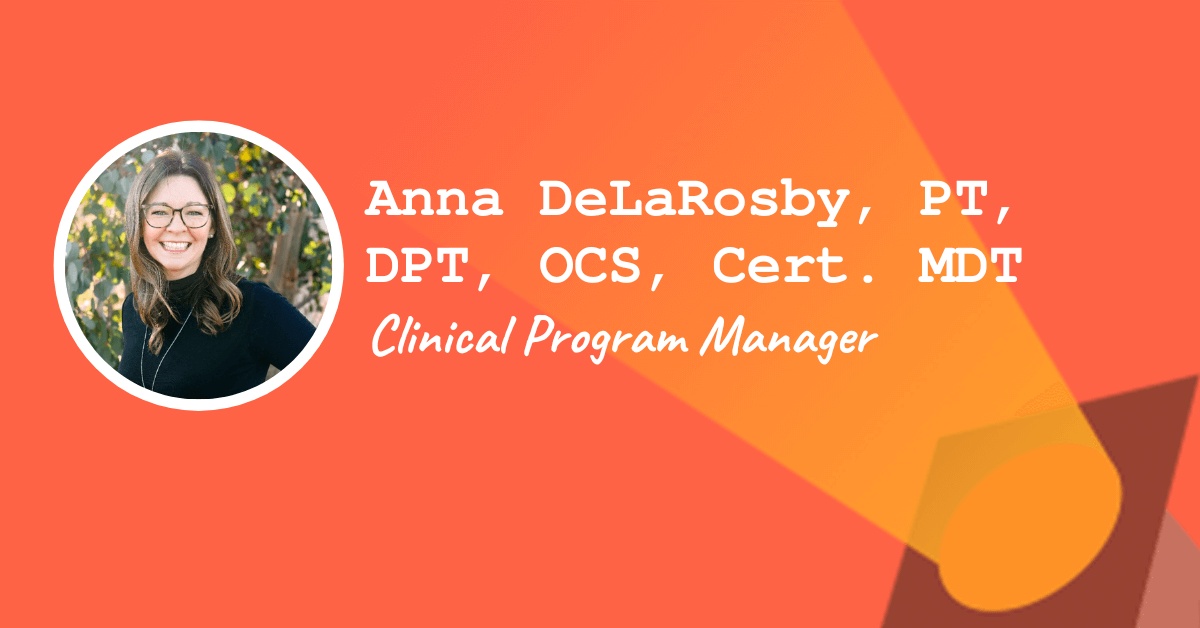


This week’s spotlight is on Anna DeLaRosby, PT, DPT, OCS, Cert. MDT, a non-clinical physical therapist who is now Clinical Program Manager for Physera Physical Therapy Group!
This post may contain affiliate links or codes. This won’t increase your cost, but it helps keep TNCPT alive, and free of annoying ads! Thank you for your support. 🙂
What is your full name, title, and company name for your current, primary role?
Anna DeLaRosby, PT, DPT, OCS, Cert. MDT — Clinical Program Manager, Omada Health/Physera Physical Therapy Group
What additional roles do you currently have?
I am in the process of proofing a textbook on digital health, I have taught Medbridge courses, and I am an occasional adjunct faculty.
Where are you located?
Bayport, MN.
Please refrain from contacting our spotlight participants on social media. There are thousands of readers just like you out there. 🙂 Please ask your questions in the comments on this blog post.
If you’re a Non-Clinical 101 student or Go Non-Clinical member, you can network with many of our spotlight participants in our community!
Where did you go to PT school, and what year did you graduate?
Clarke University, 2008.
What did you do when you first finished school, and for how long?
I worked in outpatient private practice as a PT, clinic manager, and clinical director for 10 years. I did a short stint of travel PT, some consulting, and teaching prior to finding digital health.
In what setting(s) did you work, and what types of patients did you treat?
I worked in outpatient orthopedics. A heavy portion of my caseload was spine.
What did you enjoy about your early roles? What didn’t you enjoy?
I loved (and still love) treating patients. I love differential diagnosis, I love teaching patients, I love helping people feel hopeful that they can recover. I used to say I was a purveyor of hope!
I loved empowering patients, and I really worked to create independence in my patients. I felt that if I could make it through a session without putting my hands on my patient that was a success. At the end of the visit, when the patient rated their pain less or function more, I could say, “You feel better because of what YOU did!” and enable them to treat themselves.
I enjoyed being a manager because I love the opportunities to mentor young professionals, have students, and watch my employees grow as clinicians and as people.
What I didn’t enjoy was the structure of clinic life. I didn’t enjoy the pressure to have more than one patient at a time, the constant urgent pace of everything, the pressure to always find ways to be more productive. I didn’t enjoy having to push my employees towards productivity when what I really wanted for them was to grow clinically and personally.
What else have you done since then, prior to your current role?
I have taught intermittently at the undergrad and graduate levels. I consulted for a health system developing a mentorship program. I was hired as a contractor for Physera in late 2019. Due to COVID, I quit in-person work and worked as a contractor for two telehealth companies until I took this role in 2021.
When and why did you decide to do something non-clinical?
I read the spotlight of Ellen Morello, and was intrigued by digital care. I had read that telehealth outcomes were comparable to in-person care and wanted to see if that was actually true.

It also aligned with my personal philosophy of patient empowerment. I liked that it was still patient care, but had a new structure.
I also loved the way that I got really concrete data about my patients: we are app based, so I can see exactly what exercises are completed, if the pain ratings are changing day to day, and I can tweak programs in almost real time.
The objective decision making this enabled was such a breath of fresh air from in-person care where you always hoped you could trust that data you got, but it always felt squishy.
In 2021, a full-time position opened with Physera. I couldn’t pass up the opportunity to do more data-based decision making. I also missed the mentoring and people development that I got to do as a manager and clinic director. This position included those responsibilities.
What are you doing these days?
I am a clinical program manager with Physera Physical Therapy Group. I still see telehealth patients, and I manage a nationwide network of telehealth PTs. I lead accreditation work for Physera/Omada, culminating in URAC Telehealth Accreditation in 2023.
Physera is the first accredited fully-digital musculoskeletal care company, demonstrating our commitment to quality. I continue to manage our MSK accreditation. I also get to participate in product development, clinical operations, MSK strategy, and quality assurance. I get to do a lot of different things in a week, which is really fun.
I am always learning. The nature of technology is that it is ever-changing, so I love the constant emphasis on continual improvement.
I also am working on having a textbook about telehealth rehabilitation published through McGrawHill. It will be available as part of a PT school curriculum. My co-authors and I get into a lot of detail about how to make telehealth as effective as in-person care. In addition to the textbook, we have published papers on telehealth clinical outcomes, a decision-making framework for telehealth, and a paper on the implications of GLP-1s on physical therapy.
I have co-authored a course in the APTA Learning Center on Safety in Digital Health, and co-created an Advanced Telehealth Certificate Series of four courses available on Medbridge.
Are you still treating patients, or are you solely non-clinical?
I do see patients. My caseload fluctuates based on other projects.
How long have you been in your current clinical program manager role?
Since July 2021.
What do you wish you would’ve known before going into this role?
I wish I would have understood what rehab technology existed, and how it can fill in the gaps of in-person clinical care. I wish I would have known that there are ways to continue to provide clinical care outside of the traditional in-person model.
How did you find your job? Did you apply or find it through a connection?
I found the contractor opportunity through The Non-Clinical PT’s emails, and then applied for my current role when it was posted internally.
Did you do anything special to your resume and cover letter to land the job?
I think having a personal philosophy of patient empowerment, and already challenging myself to educate and teach patients about their own care helped me articulate that I had a mindset that aligned with the structure of telehealth.
What was the interview like for the role?
The interview was online only. If you want a role in digital health, be prepared to present yourself well through digital means—attend to your environment, lighting, background, and ambient noise. Practice being on camera and using digital tools!
What are some of the things you did to stand out, take initiative, and advance in your career?
I asked a lot of questions. I was open to feedback, and open to lots of learning. I dug into data and learned about data-informed decision making. I learned the nuance of asynchronous work. I studied literature on what makes digital communication successful.
How have people reacted to you leaving patient care?
When I tell other clinicians that I do exclusively telehealth, they often respond with skepticism and ask, “How does that work?” I could talk for hours about HOW it works and what it takes to be successful. In fact, I wrote a textbook about it!
Changing our mindset about how we do what we do enables us to do so much more!
What’s a typical day or week in the life like for you? What types of tasks and responsibilities fill your time?
I see patients, do typical management tasks to support my team of clinicians, and attend meetings about operations, strategy, quality, and more. I get to ensure our clinicians have what they need, and that our clinical outcomes remain high.
What are some of the rewards of your role? What are the biggest challenges?
Some of the biggest rewards come from knowing that we are helping patients that, for a myriad of reasons, couldn’t access traditional physical therapy.
I love knowing that our clinicians are able to structure their work in a way that supports them as a whole person. I am so proud that we are creating structure for digital health that will push our profession forward.
How did your clinical background prepare you for this role? Which skills transferred?
Being a clinician is imperative for my role. I sit squarely within our clinical org, and I love that. I love learning about and participating in other aspects of our company, but my focus is ensuring that our clinical care—through delivery, provider support, the app experience, and our policies/procedures—supports exceptional clinical outcomes.
I could not do those things without innately understanding what therapy is, what patients need and want, and what clinicians need and want.
Ready to launch your own non-clinical career?
Plus, you’ll get early access to curated non-clinical job listings and a bonus lesson on AI!
What type of person do you think would do well in your clinical program manager role?
I think someone who loves learning, loves solving problems, loves change, and is constantly seeking to improve would do well.
Do you work remotely or onsite?
I work entirely remotely.
Did you read any books, take any courses, or do anything special overall to get you where you are today?
I read lots about telehealth and digital care. I am always learning about business, technology, remote work, and management.
Editor’s note: Interested in learning more about innovative healthcare delivery? Check out this spotlight on Kandis Daroski, PT, DPT, who is Senior Clinical Program Manager for Medbridge!
What is a typical career path for someone in your clinical program manager role?
I think most commonly people start as clinicians, and keep pushing and learning. And taking risks!
What is next for you? What are your high-level career aspirations?
I am really looking forward to getting this textbook published! I already have ideas for the second edition and supplemental materials.
I hope to continue working to push our profession toward accepting technology as a way to augment our expertise, broaden our reach, and decrease barriers to care.
I have learned to hold loosely to what I think the future might be—a few years ago I wouldn’t have ever dreamed that I’d write a textbook on telehealth or work for an app! I want to continue to empower patients and clinicians and improve healthcare.

