
Published:

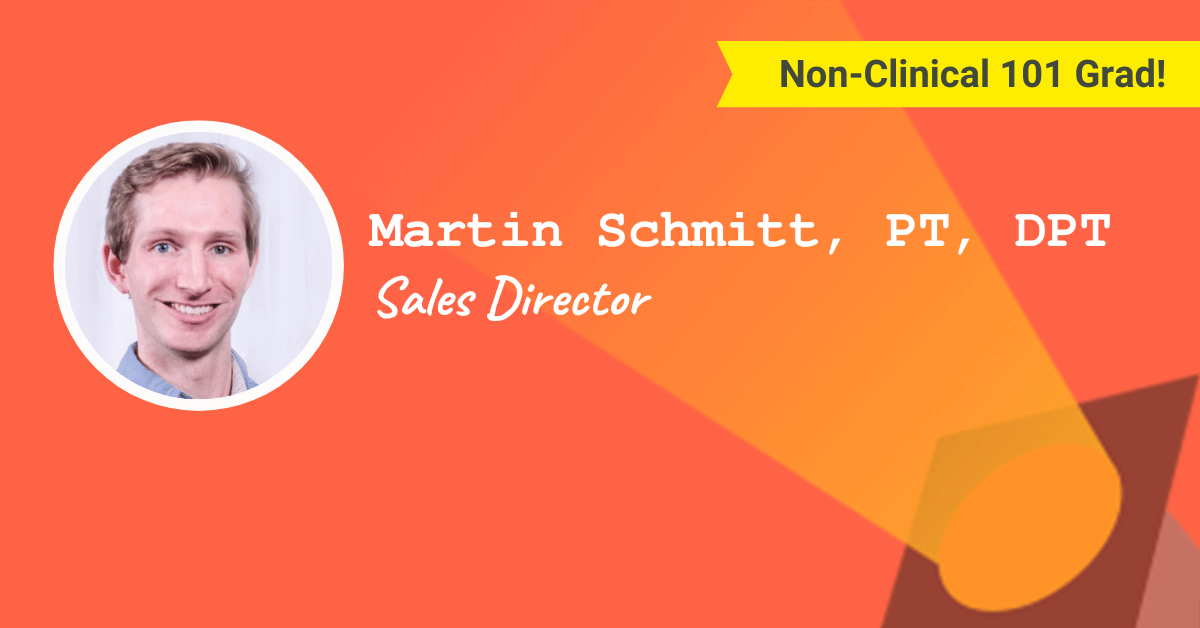
Martin Schmitt, PT, DPT, is Sales Director at RLDatix, which makes patient safety and compliance software for hospitals and health systems. If you’ve ever filed an event report after a patient fall, or waited on credentialing before a new hire could start seeing patients, you’ve touched the kind of software Martin sells.
His customers are the leaders responsible for safety and compliance across a whole health system, and he describes the work as a long-term partnership.
He’s a non-clinical physical therapist and a Non-Clinical 101 graduate who started at RLDatix in customer success. He’s since moved into healthcare sales, and names the one trait he thinks the job takes below.
This post may contain affiliate links or codes. This won’t increase your cost, but it helps keep TNCPT alive, and free of annoying ads! Thank you for your support. 🙂
What is your full name, title, and company name for your current, primary role?
Martin Schmitt, PT, DPT — Sales Director for RLDatix
What additional roles do you currently have?
CPQ Committee.
Where are you located?
Chicago, IL.
Where did you go to PT school, and what year did you graduate?
Saint Louis University. 2016 undergraduate, 2018 DPT. Go Billikens!
What did you do when you first finished school, and for how long?
Outpatient physical therapy for close to eight years.
In what setting(s) did you work, and what types of patients did you treat?
Outpatient. A whole variety of patients, primarily orthopedics (upper extremity, endurance athletes).
What did you enjoy about your early roles? What didn’t you enjoy?
The learning and development opportunities, continuing education, peer support and mentorship, the progress and impact made on patients, helping them improve and enhance their quality of life. One of the most rewarding components was starting my career at the same time the State of Illinois granted Physical Therapy Direct Access in August of 2018. For health screens, this was a great opportunity to educate potential patients, promote access and reputation to the PT profession, and provide guidance on referrals for further medical follow-up by their primary or a specialist. A fantastic way to deliver higher purpose for the greater good.
When and why did you decide to do something non-clinical?
In 2021, I realized I was increasingly interested in the systems and operational factors that influence patient outcomes. My wife, a labor and delivery nurse, worked through the challenges of the COVID-19 pandemic and inspired me to think about healthcare at a broader level. Seeing the burdens faced by frontline staff motivated me to pursue a career in healthcare technology, where I could help organizations improve operations and ultimately support clinicians and patients at scale.
What are you doing these days?
As a Sales Director at RLDatix, I work with healthcare organizations to help them improve patient safety, compliance, workforce management, credentialing, data archiving and migration, and operational performance through technology. My responsibilities include developing new partnerships, expanding existing client relationships, leading discovery conversations, and helping healthcare leaders solve strategic challenges across their organizations.
Are you still treating patients, or are you solely non-clinical?
Non-clinical.
How long have you been in your current role?
May 2025 – June 2026. I’ve been in a formal sales position since July 2026.
Did you get any special certifications or training along the way to help you get into your current role?
While I didn’t pursue any formal certifications, I invested heavily in professional development. I completed the Non-Clinical 101 course, worked closely with mentors including Lauren Braley and Katie Huggins, and sought guidance from friends and family with corporate leadership and hiring experience. Those relationships and continuous learning efforts were instrumental in helping me make the transition.
How did you find your job? Did you apply or find it through a connection?
Both. I had a wonderful personal referral who assisted me with the transition and coached me on skillsets. Connections and networking are essential. Having a fantastic mentor and coach is of great benefit as well.
Did you do anything special to your resume and cover letter to land the job?
The templates from the Non-Clinical 101 course were very helpful. I worked a lot with friends and family as well. An important reminder in the competitive landscape of job hunting and interviews is that most recruiters and hiring managers are reading through a lot of resumes.
Focus less on listing responsibilities and more on demonstrating results.
In my opinion, the key things are: one page (again, hiring teams read a lot of these!), up-to-date contact info, no grammatical errors, past-tense verbs for previous careers, and key actionable items with data that connects to the job description and role for which you are applying. I’m guilty of trying to cram as much as possible. The resume is the overview. When you get the interview, you can elaborate and provide more depth. Make yours stand out from the others!
What was the interview like for the role?
Three rounds of interviews with exceptional communication and hand-offs to the next round. It helps having a wonderful recruiter involved in the process representing the company and yourself. Each round involved highlighting previous experiences, the reason for the career transition, and strengths and weaknesses.
How have people reacted to you leaving patient care?
Overwhelmingly positive, many championed it.
The best part is I didn’t leave healthcare. I expanded my impact on healthcare.
What’s a typical day or week in the life like for you? What types of tasks and responsibilities fill your time?
In my role as a Customer Success Renewals Specialist, I focused on client retention, contract renewals, account health, proactive outreach, and collaboration with Sales and Customer Success teams to address client needs, identify risks, and support long-term partnerships. Much of my time was spent managing client relationships, reviewing contracts, navigating negotiations, and helping drive process improvements to enhance the customer experience.
Since transitioning into a Sales Director role, my focus has shifted toward developing new partnerships and growing existing client relationships. I work closely with healthcare leaders to understand their challenges, align solutions to their strategic goals, and help organizations improve operations, compliance, workforce management, and patient safety. While the responsibilities have evolved, relationship building, problem solving, and delivering value to clients remain at the center of what I do every day.
What are some of the rewards of your Sales Director role? What are the biggest challenges?
Rewards: building trusted relationships, helping healthcare organizations solve meaningful challenges, and creating opportunities that positively impact healthcare delivery at scale.
Challenges: continuously learning new aspects of healthcare technology, adapting to a rapidly evolving industry, and helping organizations navigate competing priorities while driving meaningful change. I love how it makes my brain tick and gets me to seek guidance from team members, mentors, and leaders on best practices and alternatives to maintain progress for the partnership.
How did your clinical background prepare you for this role? Which skills transferred?
Active listening, problem solving, communication, documentation, relationship building, and understanding healthcare operations have all translated directly from clinical practice into customer success and sales.
Roughly speaking, how are the hours and pay compared to patient care?
For me personally, the transition significantly improved my flexibility, work-life balance, and long-term career growth opportunities. While I valued my time in patient care, I’ve found that this path aligns well with my personal and professional goals.
What type of person do you think would do well in your Sales Director role?
Grit. When things don’t go as planned, or there’s rejection, digging deep to figure out an alternative course of action is important. It shows the client and team that you are invested. Even when it doesn’t go as planned, you’re gaining experience. And then you keep showing up and do it again. I don’t think of it as struggling. I look at it as a learning opportunity to be proactive in planning the next step.
Being comfortable with adversity and knowing how to temper your mindset by collaborating with your team, and other teams, to gain perspective from around you that ultimately will help you grow.
Team player mindset is essential. Helping those within the immediate team, department, and organization contributes to a great work culture that benefits the overall business and partnerships. I’m fortunate to have a supportive company with exceptional teams where people frequently champion the success of others.
Do you work remotely or onsite?
Hybrid. We have a fantastic headquarters office in the Loop in Chicago.
Does your organization hire PT, OT, or SLP professionals into non-clinical roles? If so, what type of roles?
Our organization has professionals from a variety of health-related backgrounds (MD, RN, PT, PTA, credentialing, healthcare quality).
Did you read any books, take any courses, or do anything special overall to get you where you are today?
Non-Clinical PT course, Carly Agar podcasts, Never Split the Difference by Chris Voss.
What is a typical career path for someone in your role?
My own path demonstrates one possible progression. I started in customer success and renewals before moving into sales. Depending on an individual’s strengths and interests, opportunities may exist within customer success, sales, leadership, operations, product development, solutions advisory, human resources, marketing, or other business functions.
What is next for you? What are your high-level career aspirations?
My goal is to continue growing in healthcare sales while helping clients solve meaningful challenges. Long term, I’m interested in people leadership, mentoring others, and developing high-performing teams that make a positive impact across healthcare.
What would you recommend to someone who is considering going into a role like yours? Do you have any special words of wisdom for the readers?
Be mindful of the story you’re telling yourself during the transition.
You can be your biggest supporter or your toughest critic.
Be your supporter and mentor. Show up for yourself and know what motivates you. The career pivot can be challenging physically and mentally. Focus on making healthy connections and narrowing in on what industry or company you are passionate about, then take each step at a time while finding balance of work, life, family, and navigating the career pivot journey.
What would you like to change most in your profession, and why? How would you propose doing so?
I’m still actively engaged with physical therapy and there have been immense changes that are exciting to follow (SB 197 in Utah being the first state to legally recognize PT as primary care — huge win!). I would love to see the day where PTs feel even more supported and recognized as the healthcare professionals that we are.
What career advice would you give yourself that you wish you had during school?
Clinical practice is only one of many ways to use a PT degree. The problem-solving, communication, leadership, relationship-building, and analytical skills we develop as clinicians are highly valuable both inside and outside of patient care.
What would you teach to today’s graduate students in your profession, if you had the opportunity?
Professional growth and guidance: resume prep, interview skills. We’re taught to succeed in the clinic and we’re highly employable in clinical and healthcare settings. Networking and mentorship paths to alumni who have transitioned into alternative paths in a healthcare capacity, such as sales, customer success, risk management, and quality improvement.
What to read next
- National Sales Director at Infinity Rehab — Caitlin Jones, MS, CCC-SLP — another clinician-turned-sales-director, on the SLP side of the same title.
- Head of Customer Success — Emily Graves (Cassata) — the customer-success-to-sales path Martin took, from someone who stayed on the success side.
- How to Get a Non-Clinical Job: Advice From the Hiring Managers Making the Decisions — what the people on the other side of the table are actually looking for.
- How to Create a Non-Clinical Resume (for PTs, OTs, and SLPs) — a template for turning clinical experience into results a hiring manager can use.
- The Non-Clinical Jobs Report, from Go Non-Clinical — sales and business development ran about 12% of Q2 postings, its second-largest category.
More resources for your non-clinical career
If you’re finding your own way through the non-clinical transition, we’ve created these FREE resources to help you get your bearings.
- Our weekly jobs newsletter: 100+ fresh non-clinical job postings every week, plus new spotlights, our latest articles, and hiring partners recruiting straight from our community.
- Four Secrets to Landing a Fulfilling Non-Clinical Healthcare Job: our free mini-course, delivered to your inbox.
- Our free career quiz: 15 questions, and you’ll come out with a much clearer picture of which non-clinical sectors suit you.
Martin went through Non-Clinical 101 on the way to this role. It’s our course & community teaching rehab pros how to make the switch in half the time with twice the confidence — a step-by-step roadmap rather than piecing it together on your own.
