
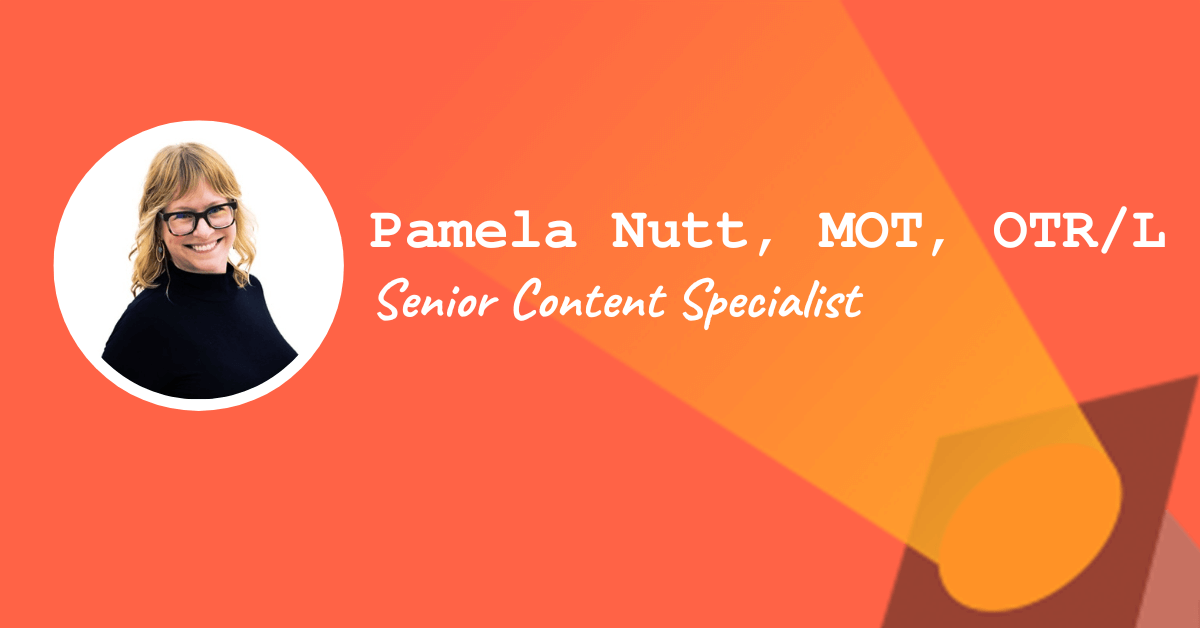


This week’s spotlight is on Pamela Nutt, MOT, OTR/L, a non-clinical occupational therapist who is now Senior Content Specialist for Medbridge!
This post may contain affiliate links or codes. This won’t increase your cost, but it helps keep TNCPT alive, and free of annoying ads! Thank you for your support. 🙂
What is your full name, title, and company name for your current, primary role?
Pamela Nutt, MOT, OTR/L — Senior Content Specialist for Medbridge

Where are you located?
Pittsburgh, PA.
Where did you go to OT school, and what year did you graduate?
University of Pittsburgh, 2012.
Please refrain from contacting our spotlight participants on social media. There are thousands of readers just like you out there. 🙂 Please ask your questions in the comments on this blog post.
If you’re a Non-Clinical 101 student or Go Non-Clinical member, you can network with many of our spotlight participants in our community!
What did you do when you first finished school, and for how long?
My OT career began as a staff occupational therapist in the hospital setting, and I held my first OT job for three years. The first six months were spent in the various intensive care units (ICUs) in the hospital where I was employed.
In what setting(s) did you work, and what types of patients did you treat?
I worked for nine years as a staff occupational therapist for one of the largest hospital systems in Pittsburgh. I began my career in the acute care setting, primarily working in the ICUs (trauma/burn, neuro, medical), but also provided OT services to orthopedics, cardiology, psychiatric, and neurologic inpatient populations. The majority of my patients were adults, but I also treated children who sustained burns.
After about two years, I moved to inpatient rehabilitation, where I treated a variety of medical conditions and worked as part of an interdisciplinary team. I then transferred to another acute care hospital setting within the system where oncology and orthopedics were my main patient populations. I spearheaded quality improvement initiatives and changed systematic processes to improve patient outcomes (reduced delirium and length of stay) by providing OT services early in the ICU.
After that, I moved into outpatient therapy, where I provided OT services to clients with chronic conditions, such as chronic pain and fibromyalgia, post-concussion syndrome, and other conditions that impacted daily living and quality of life.
What did you enjoy about your early roles? What didn’t you enjoy?
I really enjoyed the fast pace of the hospital setting.
It was very meaningful to me to be one of the first healthcare workers to get patients back to doing what is important and meaningful to them, and I really enjoyed providing caregiver and family education.
I did NOT enjoy the ridiculous productivity standards, documentation, and low pay.
What else have you done since then, prior to your current role?
I was employed by the University of Pittsburgh’s Department of Occupational Therapy as an adjunct instructor for about four years. I also have spoken at an AOTA conference on OT’s role in chronic pain management, and I was a clinical fieldwork educator for my entire clinical career.
When and why did you decide to do something non-clinical?
Frankly, I burned out. The hospital system for which I worked would NOT budge on productivity standards, and I felt as though I could no longer provide the level of care that my patients/clients deserved and NEEDED.
I struggled with the decision to leave direct patient care, but ultimately, I felt as though I was being unethical and untrue to my personal values and to my profession.
What are you doing these days?
These days, I work for Medbridge! I handle the accreditation of our OT, SLP, and nursing professional development courses, and I also manage and produce our podcasts.
On the side and pro bono, I am a freelance marketer/promoter for my local live music scene, which is mostly just FUN! Additionally, I play bass guitar and hope to join a band sometime soon!
Are you still treating patients, or are you solely non-clinical?
I am solely non-clinical although many of my musician friends seek my guidance for acute issues.
How long have you been in your senior content specialist role?
I’ve been with Medbridge since November 2021.

How did you find your job? Did you apply or find it through a connection?
Prior to working for Medbridge, I was considered a “Medbridge Super User” for my previous employer, an organization contracted with Medbridge. I helped my colleagues learn how to use Medbridge for continuing education purposes, and how to use the HEP builder and templates.
When I started feeling burned out clinically, I looked on Medbridge’s website for job openings; lo and behold, there was one for me!
Did you do anything special to your resume and cover letter to land the job?
I edited my resume slightly to use keywords from the job listing.
What was the interview like for the senior content specialist role?
The interview process was quite long for Medbridge. It consisted of many meetings over several days, totaling approximately six hours. I had to complete a project that was specific to the role as well.
What are some of the things you did to stand out, take initiative, and advance in your career?
To advance through my company, I focused on three key areas: initiative, visibility, and continuous growth. I proactively sought out projects that extended beyond my formal role, particularly those that addressed organizational needs or cross-functional gaps. I volunteered to complete projects outside of my typical daily role tasks, offered to lead initiatives, and helped develop new processes, even when it meant learning on the fly.
I also make it a point to build strong relationships across departments. By understanding how different teams work, I can better align my contributions and communicate the impact of my work more effectively. I regularly share progress, outcomes, and lessons learned with both peers and leadership, which helps build credibility and trust.
Lastly, I am committed to continuous learning—taking relevant courses, seeking mentorship, and asking for feedback. When opportunities arise, I like to be ready with both the skills and the mindset to step into new roles.
How have people reacted to you leaving patient care?
Many are initially shocked, especially those who I’ve worked with in the past. They remark that I was an impactful OT and that my clients “must feel lost” without me. Once I explain my new role, which requires OT expertise in a different way, they are excited and inquisitive. Mostly, many healthcare professionals that I know want to know how they can escape patient care!
What’s a typical day or week in the life like for you? What types of tasks and responsibilities fill your time?
A typical week in my role blends strategic planning, collaborative problem solving, and hands-on content development. I often start the week by aligning with cross-functional teams, such as clinical, education, and product, on project priorities and deadlines. My work involves shaping educational content, refining learning objectives, and ensuring alignment with accreditation standards or industry frameworks.
Midweek often includes content review sessions, meetings with subject matter experts, and editing or managing multimedia elements. I also spend time researching best practices or emerging evidence to inform our instructional strategies. Part of my role requires staying proactive by anticipating potential gaps in content, identifying ways to improve user engagement, or suggesting new formats for delivery.
By the end of the week, I typically review progress, adjust timelines as needed, and prep for the next production cycle. Though the tasks can vary, my time is consistently filled with a mix of writing, critical thinking, coordination, and continuous learning. Every day brings opportunities to improve how we educate and empower professionals.
What are some of the rewards of your role? What are the biggest challenges?
One of the most rewarding aspects of my role is the opportunity to advocate for the profession of OT on a larger scale. I get to collaborate with clinicians and educators to create high-quality, evidence-informed content that directly impacts how OT is understood and practiced across diverse settings.
Knowing that my work supports the growth of both new and experienced practitioners, and ultimately improves client care, is deeply fulfilling.
The biggest challenge is balancing clinical depth with practical constraints like time, format, or accreditation requirements. It can be difficult to include all the richness of OT practice while ensuring content stays focused, digestible, and compliant with CE standards. Navigating competing priorities and timelines, especially across interdepartmental teams, also requires thoughtful communication and flexibility.
Still, the chance to amplify OT’s voice, support professional development, and champion evidence-based practice makes the work incredibly meaningful.
How did your clinical background prepare you for this senior content specialist role? Which skills transferred?
My clinical background provided a strong foundation for my current role by honing both my critical thinking and my ability to translate complex concepts into meaningful, client-centered strategies. Working across acute care, inpatient rehabilitation, outpatient services, and chronic pain management gave me a deep appreciation for the full continuum of care. This breadth of experience taught me to approach problems holistically (considering the medical, psychosocial, and functional needs of individuals), which now helps me ensure that our content reflects the real-world challenges clinicians face.
As a fieldwork educator and adjunct faculty member at the University of Pittsburgh, I developed skills in mentoring, curriculum design, and instructional delivery. These experiences directly transferred to my responsibilities at Medbridge, where I now collaborate with subject matter experts, review educational content, and help align materials with professional standards and accreditation criteria.
Strong communication, clinical reasoning, and an enduring passion for occupational therapy advocacy have all been key to my success. Whether I’m designing CE materials or supporting interdisciplinary education initiatives, I draw daily from my years of hands-on practice and academic teaching to help elevate the profession and support meaningful learning experiences.
Ready to launch your own non-clinical career?
Plus, you’ll get early access to curated non-clinical job listings and a bonus lesson on AI!
What type of person do you think would do well in your senior content specialist role?
Someone who would thrive in my role needs to be both detail-oriented and big-picture focused. There’s a constant balance between ensuring accuracy, especially when working with accreditation standards or clinical content, and maintaining a strategic lens on how each project contributes to larger educational or professional goals.
Strong communication skills are essential. You need to be comfortable working with a wide range of collaborators. The ability to give and receive feedback constructively, ask clarifying questions, and diplomatically resolve differences is key.
A background in education or mentoring helps, but so does a natural curiosity and willingness to learn. Things move fast, and the ability to adapt to shifting timelines, tech tools, or regulatory updates is critical. People who enjoy structure but can still pivot when priorities shift tend to do well.
Lastly, a quiet passion for advocacy (especially for a field like occupational therapy) can be a powerful motivator. If you believe in the value of what you’re building, it’s easier to push through complex tasks or navigate competing demands.
Do you work remotely or onsite?
I work remotely, but I also attend conferences and conventions to represent Medbridge once or twice a year.
Does your organization hire PT, OT, or SLP professionals into non-clinical roles? If so, what type of roles?
Yes—a variety of roles at Medbridge have been filled by allied healthcare professionals.
Did you read any books, take any courses, or do anything special overall to get you where you are today?
I have watched some YouTube videos and completed some online learnings on leadership (for example) to boost skills necessary to climb a career ladder.
What is a typical career path for someone in your senior content specialist role?
I feel as though my career path has been quite atypical. My current role was created for me based on my job performance and interests!
What is next for you? What are your high-level career aspirations?
The sky is the limit! I would love to continue growing as a leader in healthcare education—amplifying the voice of occupational therapy, shaping strategic initiatives that drive professional development, and championing inclusive, evidence-based learning across disciplines.
What would you recommend to someone who is considering going into a role like yours? Do you have any special words of wisdom for the readers?
If you’re considering a role like mine, lean into opportunities that stretch your skills beyond clinical care, whether that’s teaching, mentoring, writing, or working on interdisciplinary projects. These experiences will help you build confidence in your voice and perspective.
My biggest piece of advice: don’t wait to be an expert before you step forward.
Your clinical insight is valuable, and your passion for the profession can open doors you never expected. Stay curious, be collaborative, and remember that advocacy and education are powerful ways to create lasting impact.
What would you like to change most in your profession, and why? How would you propose doing so?
What I’d most like to change in the occupational therapy profession is how widely it’s understood and valued, both by the public and within interdisciplinary teams. Too often, OT is underrepresented or misunderstood, despite its critical role in promoting function, independence, and quality of life.
To address this, I would advocate for more visible, consistent education about OT’s scope of practice, not only in academic settings, but across healthcare systems, policy platforms, and media. I believe we can lead this change by empowering clinicians with tools for self-advocacy, embedding OT more fully into team-based care models, and creating accessible, evidence-informed content that illustrates our impact in real-world terms. Visibility fuels value, and with greater understanding comes greater integration and respect for the work we do.
What career advice would you give yourself that you wish you had during school?
“Change is hard, but stagnation is awful.” I would tell my younger self not to fear stepping outside the traditional path, even if it feels uncertain at first. Growth often happens in uncomfortable spaces, and the skills you build along the way will serve you in ways you can’t yet imagine. Be open to new roles, trust your instincts, and advocate for the value you bring.
What would you teach to today’s graduate students in your profession, if you had the opportunity?
I’d teach students to really own their OT identity: know what makes our work unique and speak up about it. I’d also remind them that things will change fast, so stay flexible, stay curious, and don’t underestimate the power of sharing your stories.

