
Published:

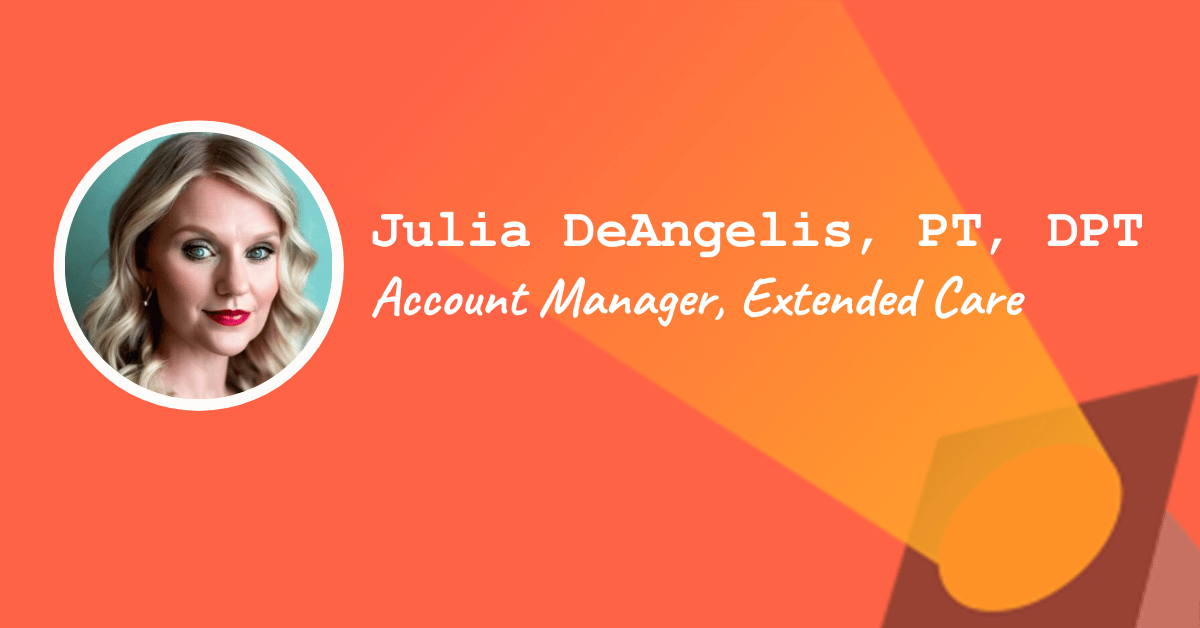
Julia DeAngelis is a non-clinical physical therapist who spent most of her career in acute care before moving into medical sales. She’s now Account Manager, Extended Care for Smith & Nephew.
If sales isn’t a world you’ve spent much time in, a little context helps. “Extended care” is the industry’s shorthand for skilled nursing and long-term care, the post-acute settings where a lot of wound care happens. Companies that make wound care products need someone who can walk into those buildings and talk with the staff: joining wound rounds, running in-services, answering questions from nurses and therapists who already know their stuff.
That work gets a lot easier when you’ve done the clinical side yourself, which is a big part of why these companies hire clinicians.
Julia’s answers are below. She gets into why she left patient care, how she found the role without a single connection at the company, and what her weeks look like now.
This post may contain affiliate links or codes. This won’t increase your cost, but it helps keep TNCPT alive, and free of annoying ads! Thank you for your support. 🙂
What is your full name, title, and company name for your current, primary role?
Julia DeAngelis, PT, DPT — Account Manager, Extended Care for Smith & Nephew (pharmaceutical/medical device sales), covering the South Jersey territory.
What additional roles do you currently have?
No additional roles. I recently resigned from a PRN role at Virtua Hospital that I had held on to for about nine years.
Where are you located?
Cherry Hill, NJ.
Where did you go to PT school, and what year did you graduate?
Thomas Jefferson University, 2006, and tDPT from Arcadia University in 2017.
What did you do when you first finished school, and for how long?
I was a PT in acute care for several years.
In what setting(s) did you work, and what types of patients did you treat?
Acute care, all units. Primarily geriatrics.
What did you enjoy about your early roles? What didn’t you enjoy?
I loved patient care and enjoyed working with the elderly. Over time, documentation and pressure around productivity became bigger challenges to daily workflow.
What else have you done since then, prior to your current role?
I have worked for a start-up in telehealth and RTM (Sword). I transitioned from that role into clinical wound care, treating with the mist therapy modality in Philadelphia.https://thenonclinicalpt.com/outpatient-pt-burnout/
When and why did you decide to do something non-clinical?
Following Covid, I had to acknowledge the burnout I was experiencing. That’s when I decided to pursue non-clinical opportunities.
What are you doing these days?
I’m loving my sales role at Smith & Nephew! I represent Santyl, which is a wound care medicine I believe in passionately.
I still love helping patients. I’m just doing it in a slightly different way.
Are you still treating patients, or are you solely non-clinical?
I am fully non-clinical.
How long have you been in your current Account Manager role?
I have been in this role since September 2025.
Did you get any special certifications or training along the way to help you get into your current role?
Yes, I am wound care certified (WCC).
How did you find your job? Did you apply or find it through a connection?
I found my current role through Indeed. I did not have any connections within the company.
Did you do anything special to your resume and cover letter to land the job?
I highlighted my experience in the two start-up roles I worked in and emphasized the transferable skills from working as a PT.
What was the interview like for the Account Manager role?
This was a much longer interview process than I was used to for PT roles. Seven rounds in all! Lots of coffees and lunches to see if the role would be a good fit.
How have people reacted to you leaving patient care?
People have been very supportive! A lot of PT colleagues have reached out for advice on how to do the same.
What’s a typical day or week in the life like for you? What types of tasks and responsibilities fill your time?
A typical day includes some cold calls to long-term care facilities, joining wound rounds, giving in-services to facility staff, meetings, and lots of driving!
What are some of the rewards of your Account Manager role? What are the biggest challenges?
I love that I still have the opportunity to impact patient health. The medication I represent is vital, and there are occasionally issues around access, so that can be a challenge.
In sales, you have to be ready for rejection, which can be tough.
How did your clinical background prepare you for this role? Which skills transferred?
The most impactful skill I brought with me was wound care knowledge, but being familiar with the setup and culture of long-term care facilities has been a huge help as well.
Roughly speaking, how are the hours and pay compared to patient care?
I feel well compensated compared to my clinical PT roles.
What type of person do you think would do well in your Account Manager role?
Anyone can be successful in sales if they sell with their heart and believe in the product. It helps to be mostly optimistic and unafraid to open conversations.
You will face some rejection, but nothing PTs haven’t dealt with when compared to patient refusals!
Do you work remotely or onsite?
I’m in the field on a daily basis.
Does your organization hire PT, OT, or SLP professionals into non-clinical roles? If so, what type of roles?
Yes! I have met a few PTs on my team who have transitioned into sales from clinical work.
Did you read any books, take any courses, or do anything special overall to get you where you are today?
I’ve read anything I could get my hands on about sales. I can provide a list of titles on request.
What is a typical career path for someone in your Account Manager role?
There is definitely room for growth into management or training.
What is next for you? What are your high-level career aspirations?
I’m super happy where I am right now. I could see myself eventually getting into a deeper educational or training role, but not for quite some time.
What would you recommend to someone who is considering going into a role like yours? Do you have any special words of wisdom for the readers?
I would recommend reading books on sales and becoming an expert on whatever product you would be selling.
What career advice would you give yourself that you wish you had during school?
Be open to anything and try everything! You’ll never know what you might end up loving.
What would you teach to today’s graduate students in your profession, if you had the opportunity?
I would teach them how to make the most of their contract when negotiating a new job. It’s important to have the literacy to ensure your compensation meets your value.
Do you have any special advice for others who want to follow in your footsteps?
Talk to everyone! Connections are very important. Also think about how to articulate what skills you’ve developed as a PT that easily translate into other industries.
Sales is an easy one. We influence patients and other providers every single day.
What Julia’s path says about moving into wound care sales
Two things in Julia’s answers stood out to us.
The first is that Julia didn’t make one leap. She went from acute care to a telehealth start-up, then into clinical wound care, and then into this role. By the time she applied she had a wound care certification and two start-up jobs to point at, which is what she put on her resume. Your first non-clinical role doesn’t have to be the one you want most. Each one gives the next employer something to see, and the roles (and pay!) get better as you go.
Second, if you’re preparing for a non-clinical job search, note what Julia’s looked like. Her interview ran far longer than anything she’d been through for a PT role, and a lot of it was coffees and lunches rather than formal rounds. That’s normal outside the clinic, and it isn’t a sign anything is wrong. Companies are working out fit, and you should be doing the same with them.
What to read next
- Medical sales careers for rehab clinicians — the full guide to this path, including who’s hiring and how the pay is structured.
- What non-clinical roles paid last quarter — You’ve just learned one person’s experience. The Non-Clinical Jobs Report, from Go Non-Clinical, shows the range across the spectrum.
- Preston Collins, a PT doing strategic account management at Medtronic — a similar job in a different corner of the medical sales world.
- Tonya Dubin, an OT in pharmaceutical sales — the pharma side of this, from an OT.
- How to build a non-clinical resume — Julia leaned on her transferable skills. Here’s how you can do the same.
More resources for your non-clinical career
If you’re finding your own way through the non-clinical transition, we’ve created these FREE resources to help you get your bearings.
- Our weekly jobs newsletter: 100+ fresh non-clinical job postings every week, plus new spotlights, our latest articles, and hiring partners recruiting straight from our community.
- Four Secrets to Landing a Fulfilling Non-Clinical Healthcare Job: our free mini-course, delivered to your inbox.
- Our free career quiz: 15 questions, and you’ll come out with a much clearer picture of which non-clinical sectors suit you.
If you’d rather follow a step-by-step roadmap than piece this together on your own, that’s exactly why we made Non-Clinical 101. It’s our course & community teaching rehab pros how to make the switch in half the time with twice the confidence.
