
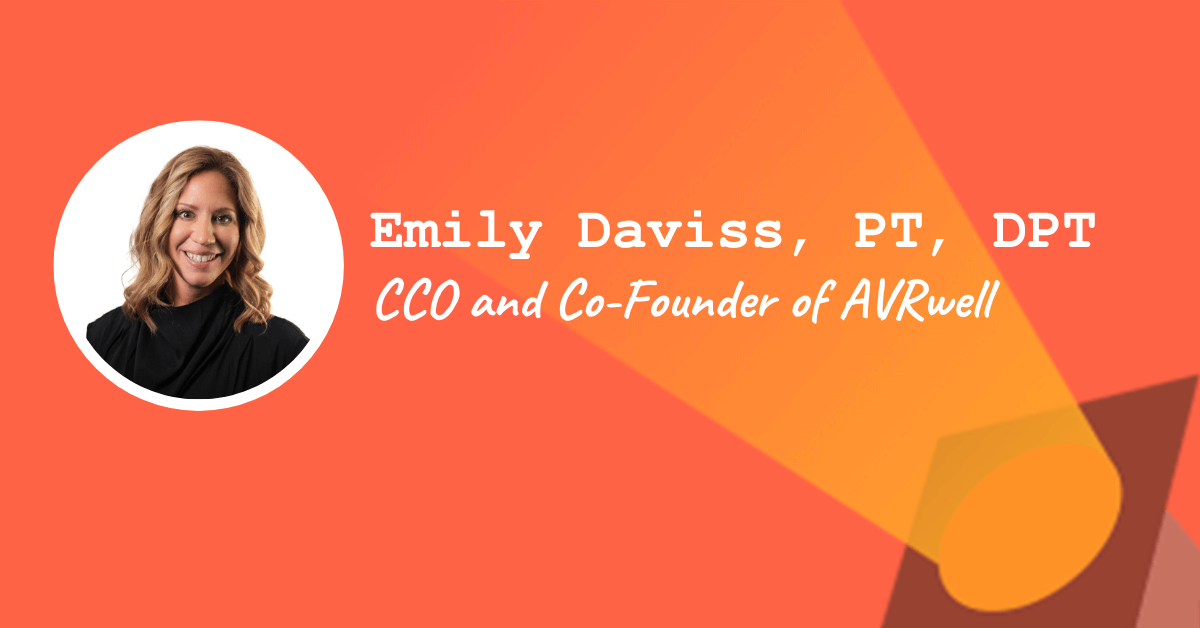


This week’s spotlight is on Emily Daviss, PT, DPT, a non-clinical physical therapist who is the CCO and Co-Founder of AVRwell!
This post may contain affiliate links or codes. This won’t increase your cost, but it helps keep TNCPT alive, and free of annoying ads! Thank you for your support. 🙂
What is your full name, title, and company name for your current, primary role?
Emily Daviss, PT, DPT — Chief Clinical Officer and Co-Founder of AVRwell Inc.
Where are you located?
Nashville, TN.
Where did you go to PT school, and what year did you graduate?
University of St. Augustine in St. Augustine, FL; 2011.
Please refrain from contacting our spotlight participants on social media. There are thousands of readers just like you out there. 🙂 Please ask your questions in the comments on this blog post.
If you’re a Non-Clinical 101 student or Go Non-Clinical member, you can network with many of our spotlight participants in our community!
What did you do when you first finished school, and for how long?
I worked in an outpatient setting at Brooks Rehabilitation in Tampa, FL for four years.
In what setting(s) did you work, and what types of patients did you treat?
I worked in outpatient neuro and ortho settings and then moved to a home care setting, treating all types of diagnoses. I focused mostly on neuro and amputee patients but also treated most post-operative orthopedic cases.
What did you enjoy about your early roles? What didn’t you enjoy?
I enjoyed my patients the most; I enjoyed learning about them and helping them reach their goals. It is and will always be my favorite part of being a physical therapist.
What else have you done since then, prior to your current role?
I worked at a medical device company called Penumbra. They started a division of their company in Immersive Healthcare to create a unique VR system to support patients in their rehabilitation and recovery. I was in this role for five years and supported sales, marketing, standardizing training, and driving utilization across the US with the VR device.
When and why did you decide to do something non-clinical?
I decided in 2019 to go the non-clinical route. At the time, I was working in TN in the home care setting and was finding that my salary was decreasing year over year due to reimbursement, and the documentation was increasing in the time required from me. I was burning out fast!
So, I put myself out there to search for other opportunities. A Penumbra recruiter reached out to me on LinkedIn, and I answered.
What are you doing these days?
These days, I’m focused on building AVRwell, the immersive rehabilitation content company I co-founded with two colleagues after Penumbra closed its rehab division. Since last November, we’ve been working to create engaging, clinically driven XR applications that make therapy more effective, affordable, and accessible for patients and clinicians.
It’s been a rewarding challenge to go from the stability of a larger organization to building something from the ground up. Every day involves balancing product development, partnership conversations, fundraising preparation, and customer outreach—but it’s exciting to see how much progress we’ve made in under a year.
We’re motivated by the impact this technology can have in helping people regain independence and improve quality of life, and that keeps us pushing forward.

Are you still treating patients, or are you solely non-clinical?
Currently, I am no longer treating patients. I was doing PRN for a while, but since co-founding this company with my colleagues, I focused all my attention on AVRwell’s success.
How long have you been in your current CCO & Co-Founder role?
My colleagues and I started AVRwell in November 2024.
What do you wish you would’ve known before going into this CCO & Co-Founder role?
I wish I had known just how much uncertainty comes with starting a company. At first, that might have felt daunting, but I’ve found that I actually thrive in that environment. The constant learning, problem solving, and adapting have made this role incredibly rewarding.
Instead of seeing uncertainty as a setback, I now view it as an opportunity to grow and to help shape something meaningful from the ground up.
That perspective keeps me confident about where we’re headed and excited about the impact our work will have on patients and clinicians.
How did you find your job? Did you apply or find it through a connection?
I found my medical device job with Penumbra through a recruiter who reached out to me on LinkedIn. My current role was created after meeting my co-founders while working at Penumbra.
Did you do anything special to your resume and cover letter to land the job?
I did a lot of networking and reaching out to my contacts to learn how a resume should look for a medical device job. Resumes for a PT job and a medical device role have a whole different look and feel. I always recommend reaching out to your network or sources like The Non-Clinical PT to learn how to successfully put your best foot forward.
What was the interview like for the role?
The interview process at Penumbra started with a recruiter reaching out to me directly. After an initial phone call, I was passed on to the regional manager for another conversation and then invited to fly out for an in-person meeting with both the national sales manager and the regional manager. It was a thorough, step-by-step process that gave me a good sense of the company and the people I’d be working with.
Like most medical device companies, the interviews focused heavily on experience, track record, and problem solving. I was asked for specific examples of how I had been successful in sales and how I built relationships with clinicians. The process was rigorous, but it reflected the high standards of the industry and helped ensure both sides had a clear understanding of fit and expectations.
What are some of the things you did to stand out, take initiative, and advance in your career?
I stood out by asking thoughtful questions, gathering customer feedback, and bringing solution-oriented insights back to my manager. I made sure to stay organized and resourceful, always finding answers even if I didn’t know them right away. Over time, I also worked to understand sales, marketing, customer success, and development, so I could contribute beyond my immediate role.
When did you start your business?
I started my business with two other co-founders in November 2024.
Where did you get the idea for your business?
The idea for our business came directly from our experience working together at a previous company that exited the immersive healthcare market. We had seen firsthand how powerful this technology could be for rehabilitation, and we didn’t want that progress to stop. That’s why we started our own company, focused on bringing immersive healthcare to patients and clinicians in a way that’s both scalable and ready for the market and building on what we learned from our past experience.
What is your business, and what types of products or services do you offer?
My company, AVRwell, develops immersive rehabilitation applications that combine clinical expertise with engaging extended reality (XR) experiences. Our flagship product, AquaVision, supports oculomotor training for patients recovering from concussion, stroke, visual impairments, and vestibular disorders.
Beyond vision therapy, we’re building a catalog of XR rehabilitation and wellness tools, including applications for relaxation, pain distraction, and functional movement, so clinicians can deliver therapy that is both effective and enjoyable for their patients.
How have people reacted to you leaving patient care?
They normally have a lot of questions about how I did it and are interested in the area I entered after patient care.
What’s a typical day or week in the life like for you? What types of tasks and responsibilities fill your time?
A typical week for me is a mix of clinical education, customer outreach, and company development. I work from home, where I connect with customers and hospital executives, educate clinicians on how to use our products, and even guest lecture at universities. In addition, I collaborate with our team on product development and marketing, so my role balances both the clinical and business sides of the company.
What are some of the rewards of your CCO & Co-Founder role? What are the biggest challenges?
The most rewarding part of my role is seeing our products make therapy more engaging and effective for patients and clinicians. I also enjoy the variety, educating clinicians, reaching customers, and shaping product development.
The biggest challenge is navigating the uncertainty of a startup, but I see it as an opportunity to keep learning and growing.
How did your clinical background prepare you for this role? Which skills transferred?
My clinical background prepared me by teaching me how to listen to patients and clinicians and turn their needs into practical solutions.
Skills like communication, problem solving, and adaptability transfer directly into guiding product development and educating users.
I also still draw on my clinical knowledge every day to help design and refine our products, so they truly fit into real-world practice.
What type of person do you think would do well in your CCO & Co-Founder role?
Someone who thrives in this role needs to be adaptable, curious, and comfortable with uncertainty. Strong communication skills are essential, both for building relationships with clinicians and for translating complex feedback into actionable ideas. It also helps to be detail-oriented and solution-focused since every challenge is an opportunity to problem-solve and move the company forward.
Does your organization hire PT, OT, or SLP professionals into non-clinical roles? If so, what type of roles?
Yes, we plan to hire PTs, OTs, and SLPs when our company begins to grow and have the need for more employees in the sales, marketing, and clinical success roles.
Did you read any books, take any courses, or do anything special overall to get you where you are today?
I’ve taken LinkedIn courses to build specific skills, and I make it a priority to attend conferences where I can learn about the latest in healthcare and technology. I also spend time networking and reaching out to people I can learn from, which has been one of the most valuable ways to grow in my role.
What is a typical career path for someone in your CCO & Co-Founder role?
A typical career path for someone in my role often starts with direct clinical practice, then moves into roles like clinical education, sales, or product support within healthcare companies. From there, many step into leadership positions where they can shape product development and strategy. It’s a path that combines clinical expertise with business and innovation experience.
Ready to discover your own non-clinical career path?
Plus, you’ll get early access to curated non-clinical job listings and a bonus lesson on AI!
What is next for you? What are your high-level career aspirations?
Next for me is continuing to grow AVRwell and expand the impact of our rehabilitation and wellness applications. My goal is to help make immersive healthcare tools widely accessible, so patients and clinicians everywhere can benefit. Long term, I aspire to keep leading at the intersection of clinical care and innovation, shaping technologies that transform rehabilitation.
What would you recommend to someone who is considering going into a role like yours? Do you have any special words of wisdom for the readers?
I’d recommend staying curious and open to learning because this kind of role asks you to wear many hats and step outside your comfort zone. Don’t be afraid of uncertainty; see it as an opportunity to problem-solve and grow.
Most importantly, keep patients and clinicians at the center of every decision, and you’ll stay grounded in what really matters.

